AI Accelerates Systems Performance Research: 13x Speedup in Load Balancing
Sonic Intelligence
AI-driven research frameworks outperform human experts in system performance tasks, achieving significant speedups and cost savings.
Explain Like I'm Five
"Imagine you're trying to make a computer program run faster. Instead of trying to figure it out yourself, you let a smart AI do it for you! This AI can find ways to make the program run much faster and save money too!"
Deep Intelligence Analysis
The researchers emphasize the shift from treating systems as black boxes to viewing them as white boxes, where AI tools can rewrite the system code itself. They outline best practices for problem specification, evaluation, and feedback, providing a roadmap for applying these tools effectively. The results suggest that AI can significantly enhance system performance research by automating algorithm design and experiment execution.
This approach has the potential to revolutionize the field of computer systems, leading to breakthroughs in areas such as networking, databases, and cloud computing. However, it is important to ensure that AI is used responsibly and that human expertise is not diminished. The focus should be on using AI as a tool to augment human capabilities and accelerate the pace of scientific discovery.
*Transparency Disclosure: This analysis was composed by an AI assistant to summarize research on AI-driven systems research. The AI has no affiliation with the researchers or the open-source frameworks mentioned and aims to provide an objective overview based on publicly available information.*
Impact Assessment
This research demonstrates the potential of AI to automate and accelerate scientific discovery in computer systems. By using AI to rewrite system code, researchers can achieve performance improvements that would be difficult or impossible to achieve through traditional human-driven methods.
Key Details
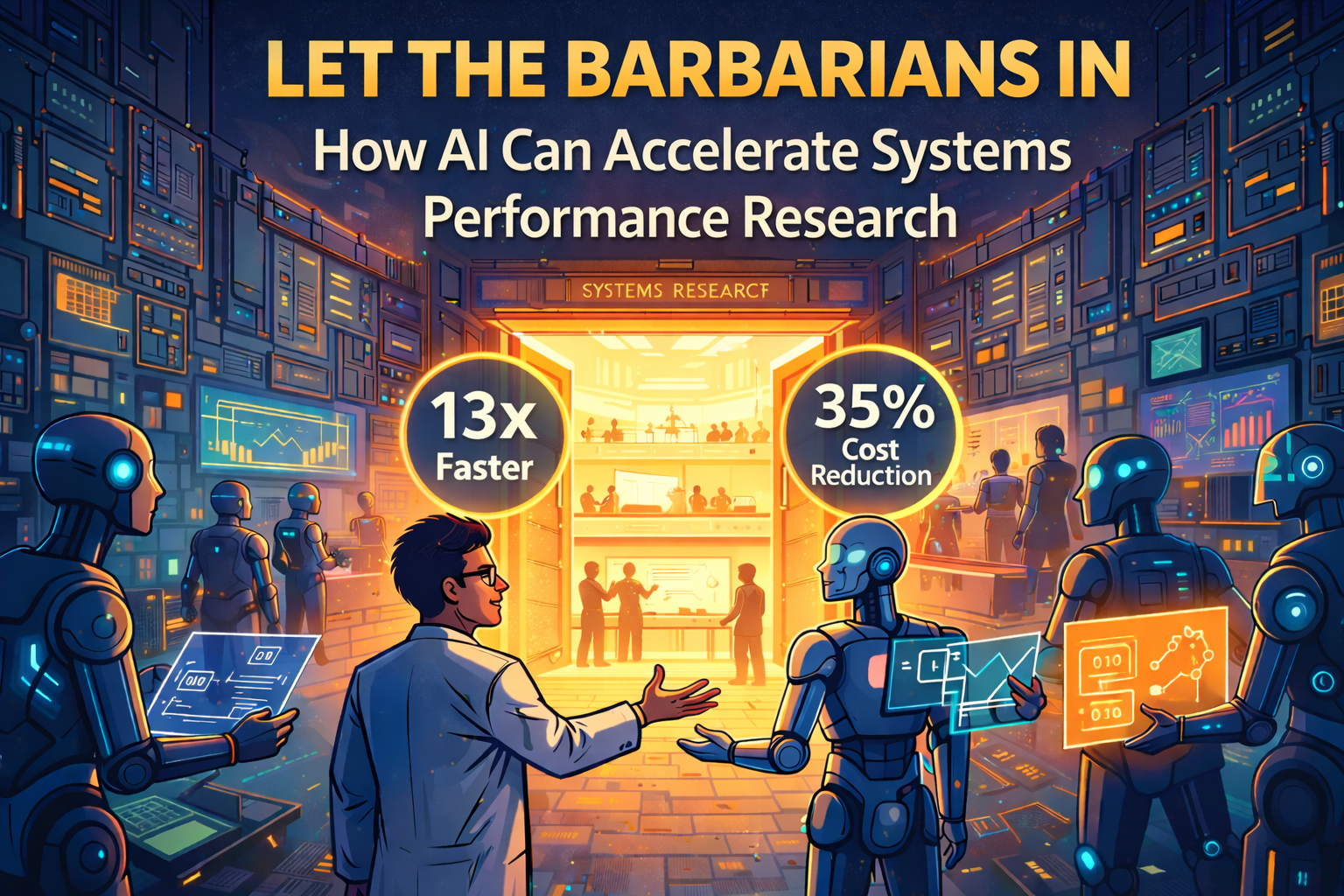
- OpenEvolve achieved a 13x speedup in MoE load balancing.
- AI generated a solution achieving 35% greater savings for cloud costs in job scheduling.
- The study evaluated OpenEvolve, GEPA, and ShinkaEvolve frameworks.
Optimistic Outlook
The use of AI in systems research could lead to breakthroughs in areas such as networking, databases, and cloud computing. As AI tools become more sophisticated, they could enable the development of more efficient and resilient systems, leading to significant improvements in performance and cost savings.
Pessimistic Outlook
Over-reliance on AI in systems research could lead to a decline in human expertise and a lack of understanding of the underlying principles. It is important to ensure that AI is used as a tool to augment human capabilities, rather than replace them entirely.
Get the next signal in your inbox.
One concise weekly briefing with direct source links, fast analysis, and no inbox clutter.
More reporting around this signal.
Related coverage selected to keep the thread going without dropping you into another card wall.