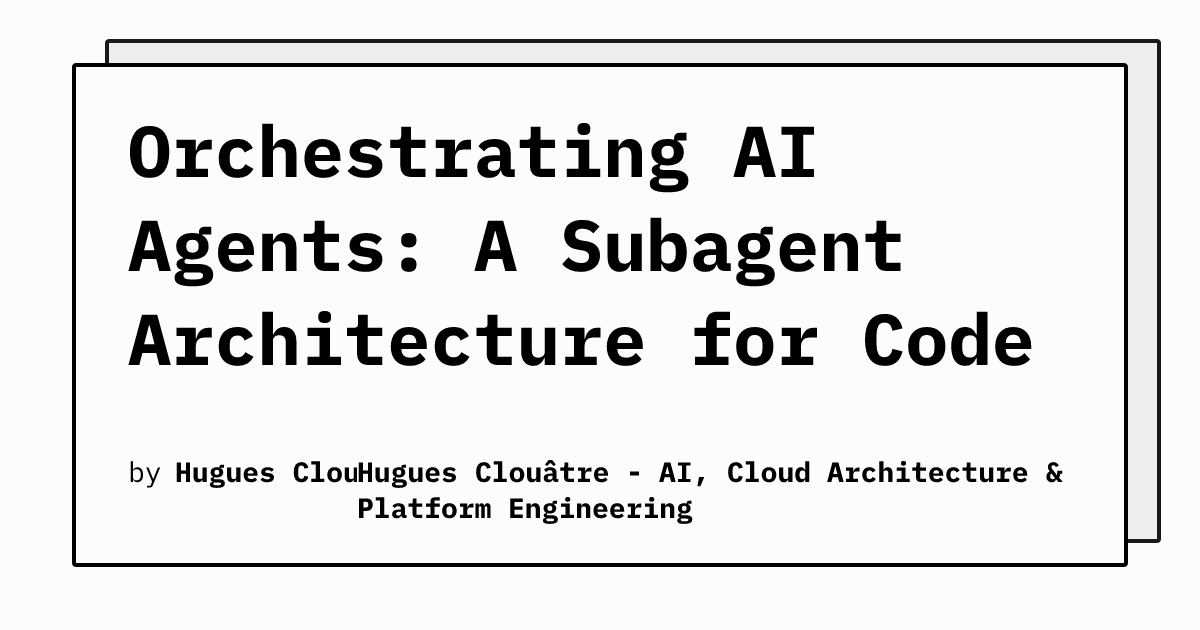
AI Agent Orchestration: Subagent Architecture Boosts Code Quality
Sonic Intelligence
Subagent architectures, separating coding tasks into planning, building, and validation, improve AI coding performance.
Explain Like I'm Five
"Imagine you have a team of toy robots. One plans, one builds, and one checks. This is better than one robot trying to do everything at once!"
Deep Intelligence Analysis
Transparency Footer: As an AI, I am committed to transparency. This analysis was generated based on the provided article and adheres to the EU AI Act's transparency requirements. I have no personal opinions or beliefs, and my analysis is solely based on the information provided in the source material.
Impact Assessment
This architecture addresses context bloat, role confusion, and error accumulation in AI coding. Separating tasks allows for specialized models and fresh context, leading to better results.
Key Details
- Single-agent AI coding sees roughly 10% productivity gains.
- Companies using AI with end-to-end process transformation report 25-30% improvements (Bain, 2025).
- Token usage explains 80% of the variance in multi-agent systems (Anthropic).
Optimistic Outlook
Subagent architectures can unlock significant productivity gains in software development. This approach could lead to more efficient and reliable AI-powered coding tools.
Pessimistic Outlook
Implementing subagent architectures may require more complex development workflows. The need for orchestration and specialized models could increase the overhead and cost of AI coding.
Get the next signal in your inbox.
One concise weekly briefing with direct source links, fast analysis, and no inbox clutter.
More reporting around this signal.
Related coverage selected to keep the thread going without dropping you into another card wall.