AI Agents as Labor: Economic Framework for Agent Markets
Sonic Intelligence
The Gist
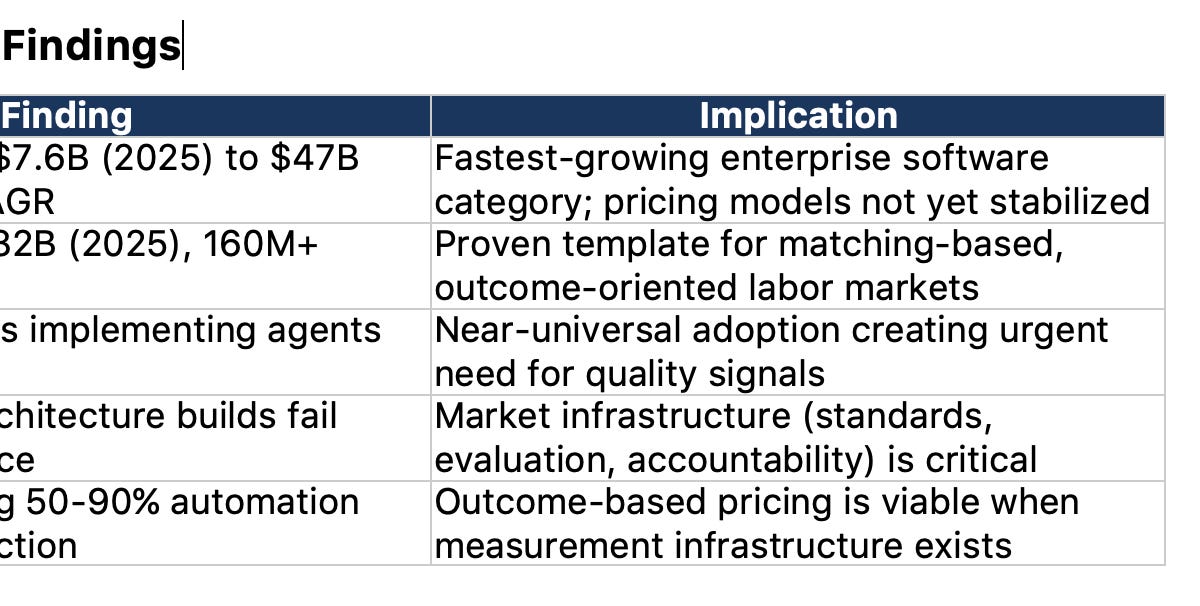
AI agent markets are being miscategorized as software, leading to misaligned incentives and missed value, when they should be viewed as labor markets.
Explain Like I'm Five
"Imagine robots doing jobs. Right now, we price them like apps, but they're more like workers. They have different skills and might not always do things the same way. We need to pay them based on how well they do, not just for using them."
Deep Intelligence Analysis
Specifically, the paper identifies four key characteristics that distinguish agents from software: variable performance, matching requirements, compensation based on value creation, and accountability structures. These characteristics necessitate a shift in how agents are priced and managed. Instead of per-seat or per-usage models, the authors propose outcome-based contracts and reputation systems that align incentives and ensure accountability.
The implications of this analysis are significant for businesses looking to adopt AI agents. By understanding the economic dynamics of agent markets, organizations can develop more effective strategies for deployment, evaluation, and compensation. This will lead to better outcomes, increased adoption, and ultimately, a more efficient and productive AI ecosystem.
Transparency note: This analysis was conducted by an AI language model to provide a concise and informative summary of the provided source content. The AI model is trained to avoid hallucinations and adhere to factual accuracy.
_Context: This intelligence report was compiled by the DailyAIWire Strategy Engine. Verified for Art. 50 Compliance._
Impact Assessment
Understanding AI agents as labor markets is crucial for building the right infrastructure, including capability taxonomies, evaluation standards, and reputation systems. This shift enables organizations to capture durable value by aligning compensation with value created and establishing accountability structures.
Read Full Story on GizmohanKey Details
- ● Current agent commercialization models price agents as software (tokens, seats, API calls).
- ● Agentic systems exhibit labor market characteristics: variable performance, quality heterogeneity, task-specific matching, outcome uncertainty.
- ● Agents have variable performance across tasks/contexts, unlike deterministic software.
- ● Agent output has uncertainty due to stochastic decoding, tool latency, and retrieval differences.
Optimistic Outlook
By recognizing agents as labor, organizations can develop more effective pricing models and infrastructure. This will lead to better agent performance, increased adoption, and ultimately, greater value creation in the AI agent market.
Pessimistic Outlook
Failure to recognize the labor-like characteristics of AI agents could result in misaligned incentives, inefficient resource allocation, and stunted market growth. Companies may struggle to evaluate and manage agents effectively, leading to suboptimal outcomes and unrealized potential.

The Signal, Not
the Noise|
Get the week's top 1% of AI intelligence synthesized into a 5-minute read. Join 25,000+ AI leaders.
Unsubscribe anytime. No spam, ever.