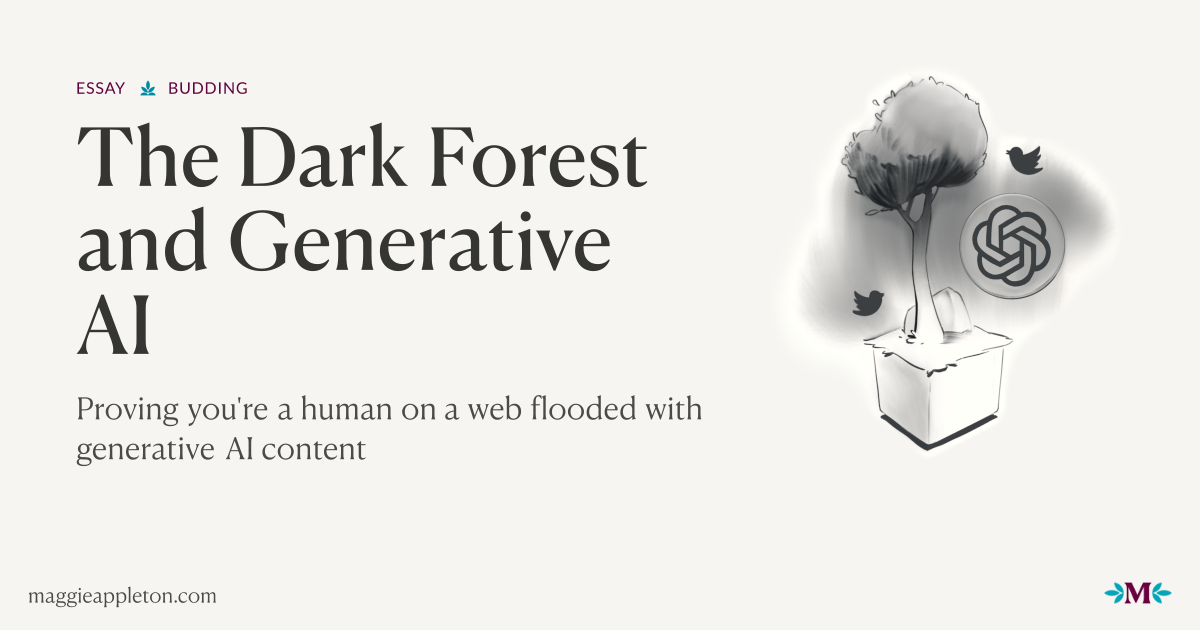
The AI Dark Forest: Generative Content Threatens Online Spaces
Sonic Intelligence
The proliferation of AI-generated content threatens to exacerbate the existing problems of bots and misinformation, pushing genuine human interaction further into hidden online spaces.
Explain Like I'm Five
"Imagine the internet is a forest. Now imagine robots are making lots of fake trees that look real. It's getting harder to find the real trees and real people. So people are hiding in secret gardens online."
Deep Intelligence Analysis
The article points to the rapid advancements in AI content generation, noting that LLMs have become competent copywriters much faster than expected and that image generators can now produce images indistinguishable from human work. This has led to a flood of AI-generated content, including advertising copy, blog posts, and social media updates, which threatens to overwhelm the web with generic and manipulated information.
The implications of this trend are far-reaching, potentially leading to increased social fragmentation, erosion of trust in online information, and the difficulty in distinguishing between human and AI-generated content. Addressing this challenge will require a multi-faceted approach, including the development of new tools for detecting and filtering AI-generated content, the promotion of human-centric online spaces, and the fostering of critical thinking skills to help individuals discern between authentic and artificial information.
Impact Assessment
The rise of AI-generated content poses a significant challenge to the integrity of online spaces. It threatens to drown out authentic human voices and further erode trust in online information, potentially leading to increased social fragmentation and manipulation.
Key Details
- LLMs are rapidly improving at generating human-like text for various purposes.
- Image generators can now produce images indistinguishable from human work.
- AI-generated content risks flooding the web with generic and manipulated information.
- Humans are retreating to closed online spaces to avoid automated predators.
- GPT-3.5 is a more capable version of GPT-3 with human reinforcement learning.
Optimistic Outlook
The awareness of the 'AI Dark Forest' phenomenon could spur the development of new tools and strategies for detecting and filtering AI-generated content. This could lead to a resurgence of human-centric online spaces that prioritize authenticity and meaningful interaction.
Pessimistic Outlook
The arms race between AI content generators and detection tools may be difficult to win, potentially leading to a future where it becomes increasingly difficult to distinguish between human and AI-generated content. This could have profound implications for online discourse, education, and the spread of misinformation.
Get the next signal in your inbox.
One concise weekly briefing with direct source links, fast analysis, and no inbox clutter.
More reporting around this signal.
Related coverage selected to keep the thread going without dropping you into another card wall.