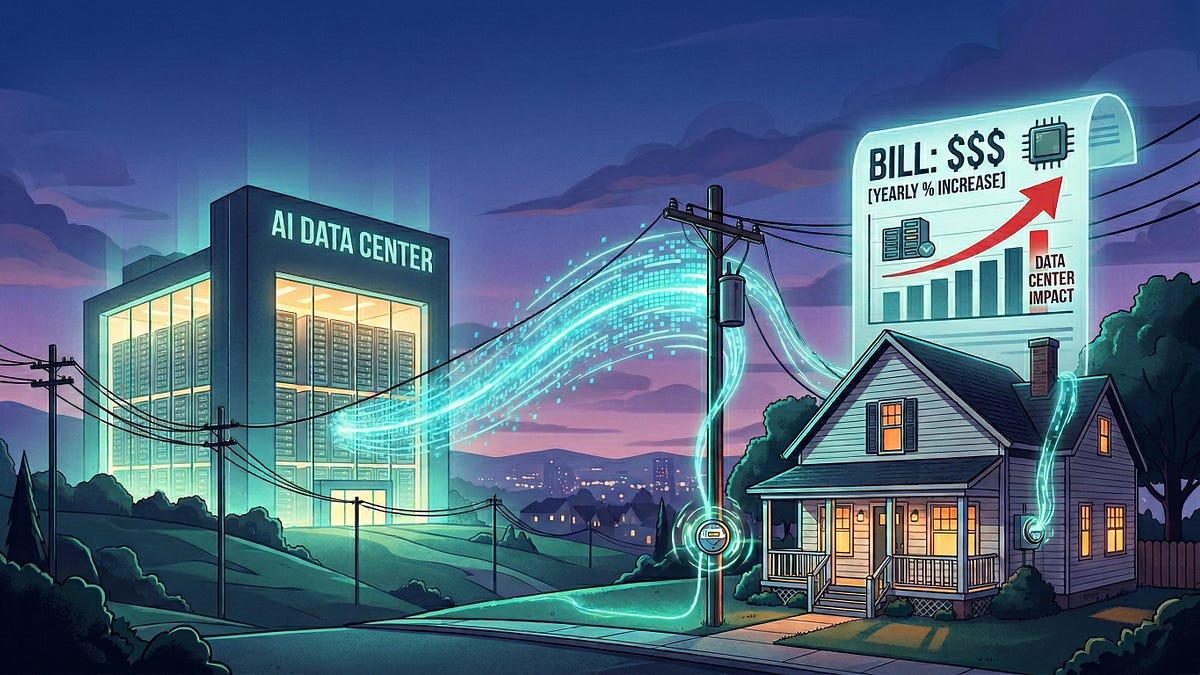
Government Policy, Not AI Datacenters, Drives PJM Electricity Bill Hikes
Sonic Intelligence
Poor market design and government policy, not AI datacenters, are primarily responsible for rising electricity bills in the PJM region.
Explain Like I'm Five
"Imagine you have two neighborhoods, one called PJM and one called ERCOT. Both are getting new, big computer centers (AI datacenters) that use a lot of power. In ERCOT, electric bills haven't changed much. But in PJM, bills are going up a lot, and people are blaming the new computer centers. This report says it's not the computer centers' fault; it's because PJM's electricity rules are old and not working well, causing prices to jump based on bad predictions, not actual usage."
Deep Intelligence Analysis
In the PJM area, residents are projected to face an average ~15% increase in their electricity bills in 2026 compared to the "pre-AI-Datacenter" era. This follows a ~20% jump in residential rates in New Jersey in June 2025, which some incorrectly attributed to a 300MW Nebius AI Datacenter for Microsoft, despite it self-generating over 85% of its power. The report firmly attributes the PJM price surge not to AI datacenter load growth, but to poor market design, specifically the "BRA capacity auction." The 2025/26 auction saw a staggering 9.3x increase over the previous year, driven by a "simulation" and PJM's demand and supply forecasts, which have a history of significant miscalculations. PJM is indeed an epicenter for AI, hosting major facilities like Google's Gemini training in Ohio, Anthropic/Amazon's "Project Rainier," Meta's "Prometheus" in Indiana and Ohio, and the world's largest datacenter hub in Northern Virginia.
Conversely, Texas, under the ERCOT grid, has witnessed an equivalent surge in AI datacenter development, with OpenAI, Google DeepMind, and Anthropic establishing massive facilities. Yet, power futures in Texas have remained relatively stable, moving only a few percent in the past year, with no comparable price spikes or crises. This stark contrast underscores the report's central argument: the fault lies with government policy and flawed market design, not the presence or growth of AI datacenters themselves.
The findings are crucial for informed public and policy discourse. Misattributing rising energy costs to AI datacenters risks misdirected regulatory efforts that could impede technological progress and economic growth. By highlighting the critical role of market design in accommodating new energy demands, the report advocates for a focus on structural reforms within energy markets to ensure stable and fair pricing, rather than penalizing essential AI infrastructure development. This analysis provides a clear, empirically supported distinction between the impact of technological advancement and the consequences of inefficient regulatory frameworks.
[EU AI Act Art. 50 Compliant]
Impact Assessment
This report debunks a common misconception, shifting blame from AI datacenters to flawed energy market design and policy. Understanding the true drivers of electricity costs is crucial for informed public discourse and effective energy policy, preventing misdirected regulation.
Key Details
- Residential electricity rates in New Jersey jumped ~20% overnight in June 2025.
- A 300MW Nebius AI Datacenter in NJ self-generates >85% of its power.
- PJM area residents may see ~15% bill increase in 2026 relative to 'pre-AI-Datacenter' era.
- ERCOT (Texas) power prices have been roughly stable for three years despite equivalent AI buildout.
- The PJM increase is largely attributed to a 9.3x increase in the 2025/26 BRA capacity auction.
- This PJM capacity auction increase is driven by a 'simulation' and PJM's demand/supply forecasts.
Optimistic Outlook
By accurately identifying poor market design as the root cause, policymakers can focus on implementing reforms that stabilize electricity prices without hindering AI infrastructure growth. This clarity could lead to more efficient energy markets and sustainable development of AI datacenters.
Pessimistic Outlook
If the public and policymakers continue to misattribute rising costs to AI datacenters, it could lead to punitive regulations or public backlash against AI development. This misdirection could stifle innovation and investment in critical AI infrastructure, despite its minimal direct impact on residential bills in well-designed markets.
Get the next signal in your inbox.
One concise weekly briefing with direct source links, fast analysis, and no inbox clutter.
More reporting around this signal.
Related coverage selected to keep the thread going without dropping you into another card wall.



