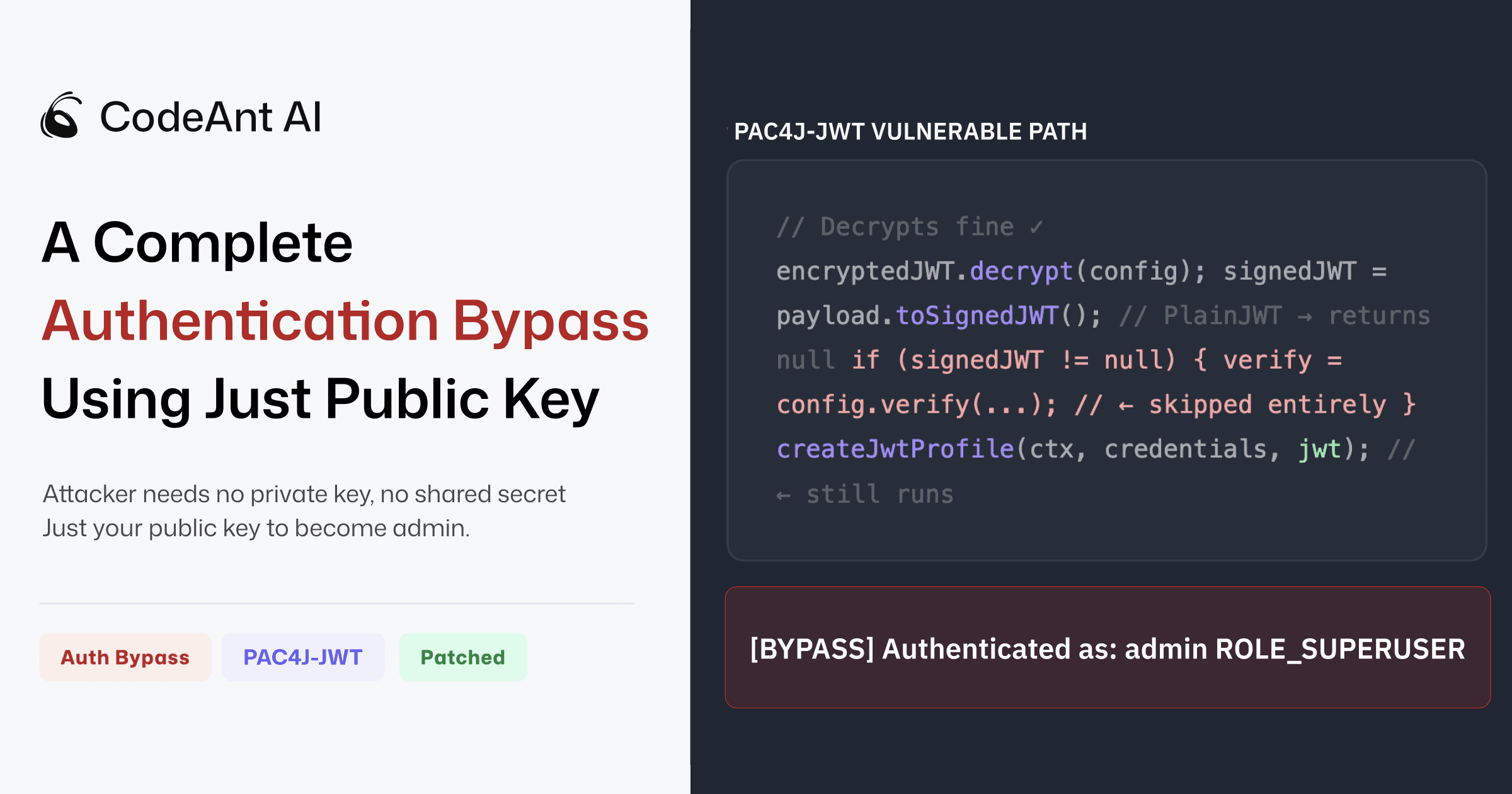
AI Discovers Critical CVSS 10.0 Authentication Bypass in pac4j-JWT Library
Sonic Intelligence
AI identified a critical authentication bypass in a widely used Java library.
Explain Like I'm Five
"Imagine a secret club where you show a special card to get in. This card is supposed to be signed by the club leader. But someone found a trick where they can make their own special card using only the club's public sign, letting them pretend to be anyone, even the leader, without knowing any secrets. A smart computer found this trick, and now the club is fixing it so everyone is safe."
Deep Intelligence Analysis
The discovery originated from an internal CodeAnt AI research project focused on validating the efficacy of CVE patches in popular open-source packages. Their AI code reviewer flagged an anomaly: a null check on `signedJWT` positioned directly before the signature verification block in `JwtAuthenticator.java`. This specific code arrangement created a condition where the critical signature verification process could be silently skipped, rendering the token's authenticity unchecked. A security engineer subsequently confirmed this as a true positive, revealing a complete authentication bypass.
Standard JWT authentication in `pac4j` typically employs two layers of protection: JSON Web Encryption (JWE) for confidentiality and JSON Web Signature (JWS) for integrity and authenticity. JWE encrypts the token using the server's public key, ensuring privacy in transit, while JWS signs the token, verifying its origin. Both layers are essential; encryption alone does not prove the token's legitimacy. The identified vulnerability subverts this critical two-layer defense by allowing the signature verification, which confirms authenticity, to be bypassed.
The implications are profound. Any system utilizing `pac4j-jwt` without the necessary patches is vulnerable to unauthorized access, potentially leading to data breaches, privilege escalation, and system compromise. The maintainer, Jérôme Leleu, has confirmed the vulnerability and released patches. Users are strongly advised to upgrade immediately to `pac4j-jwt` versions 4.5.9 or newer (for the 4.x line), 5.7.9 or newer (for the 5.x line), or 6.3.3 or newer (for the 6.x line). This incident underscores the vital role of AI in proactive security research and the continuous need for vigilance in software development and deployment to maintain robust security postures.
Transparency Statement: This analysis was generated by an AI model based on the provided source material. All factual claims are derived directly from the input. (EU AI Act Art. 50 Compliant)
Impact Assessment
This vulnerability allows complete system compromise without any secret knowledge, posing a severe risk to applications using the affected library. It highlights the critical role of AI in proactive security research and the urgent need for immediate patching across the software supply chain.
Key Details
- CVE-2026-29000 has been assigned to the vulnerability.
- The vulnerability carries a CVSS score of 10.0 (Critical).
- It affects `pac4j-jwt`, a widely used Java authentication library.
- Attackers can forge JWT tokens with arbitrary claims using only the server's public RSA key.
- Patches are available: upgrade to 4.5.9+, 5.7.9+, or 6.3.3+.
Optimistic Outlook
The rapid discovery of this critical flaw by an AI code reviewer and the subsequent swift patching by maintainers demonstrate the increasing effectiveness of advanced security tools. This proactive identification and mitigation process enhances software supply chain security, reducing the window for potential exploitation and safeguarding numerous systems.
Pessimistic Outlook
The existence of a CVSS 10.0 flaw in a widely used authentication library underscores the inherent challenges in secure software development and the potential for fundamental design errors. Many systems may remain unpatched due to delayed updates or lack of awareness, leaving them exposed to trivial but potentially devastating attacks that could lead to widespread data breaches.
Get the next signal in your inbox.
One concise weekly briefing with direct source links, fast analysis, and no inbox clutter.
More reporting around this signal.
Related coverage selected to keep the thread going without dropping you into another card wall.