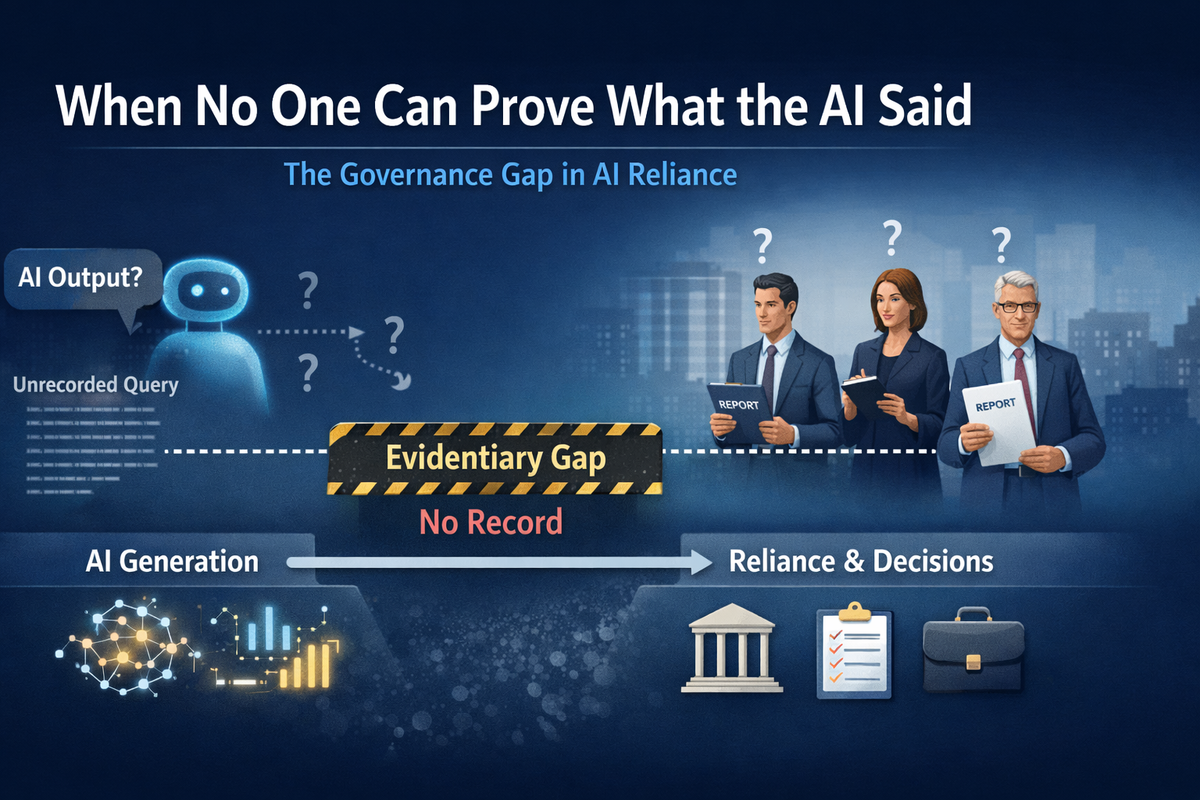
The AI Governance Gap: When AI's Words Vanish
Sonic Intelligence
Organizations struggle to reconstruct AI-generated information relied upon for critical decisions, creating an 'evidentiary problem'.
Explain Like I'm Five
"Imagine your friend tells you something important, but you can't remember exactly what they said or where they learned it. That's like AI influencing decisions without leaving a trace!"
Deep Intelligence Analysis
The non-deterministic nature of modern AI systems further exacerbates this problem. Unlike deterministic systems, where the same input always produces the same output, AI systems can generate different responses even with the same prompt. This makes it impossible to accurately reproduce the information that was originally presented.
Existing governance frameworks are inadequate for addressing this challenge. These frameworks typically assume that if an external representation influences a decision, it can be examined later. However, this assumption no longer holds true in the age of AI. The article calls for the emergence of a distinct 'AI Reliance Governance' layer that focuses on the creation, preservation, and examination of evidence-capable records of AI-generated representations. This new layer would be concerned with governing the evidentiary consequences of AI use once reliance occurs.
Transparency Footer: As an AI, I strive to provide objective information. My analysis is based on the provided source content and adheres to EU AI Act transparency guidelines.
Impact Assessment
The inability to verify AI's influence on decisions poses significant legal, financial, and reputational risks. Current monitoring systems are inadequate for capturing the context and framing of AI representations.
Key Details
- AI-generated summaries are increasingly relied upon without proper documentation.
- Modern AI systems are non-deterministic, making output reproduction unreliable.
- Existing governance frameworks fail to address the scale, speed, and opacity of AI-driven insights.
Optimistic Outlook
The emergence of a distinct 'AI Reliance Governance' layer could improve accountability and transparency. This new layer would focus on preserving evidence-capable records of AI-generated representations.
Pessimistic Outlook
Without robust governance, organizations face increasing difficulty defending decisions influenced by AI. The non-deterministic nature of AI makes accurate reconstruction nearly impossible.
Get the next signal in your inbox.
One concise weekly briefing with direct source links, fast analysis, and no inbox clutter.
More reporting around this signal.
Related coverage selected to keep the thread going without dropping you into another card wall.



