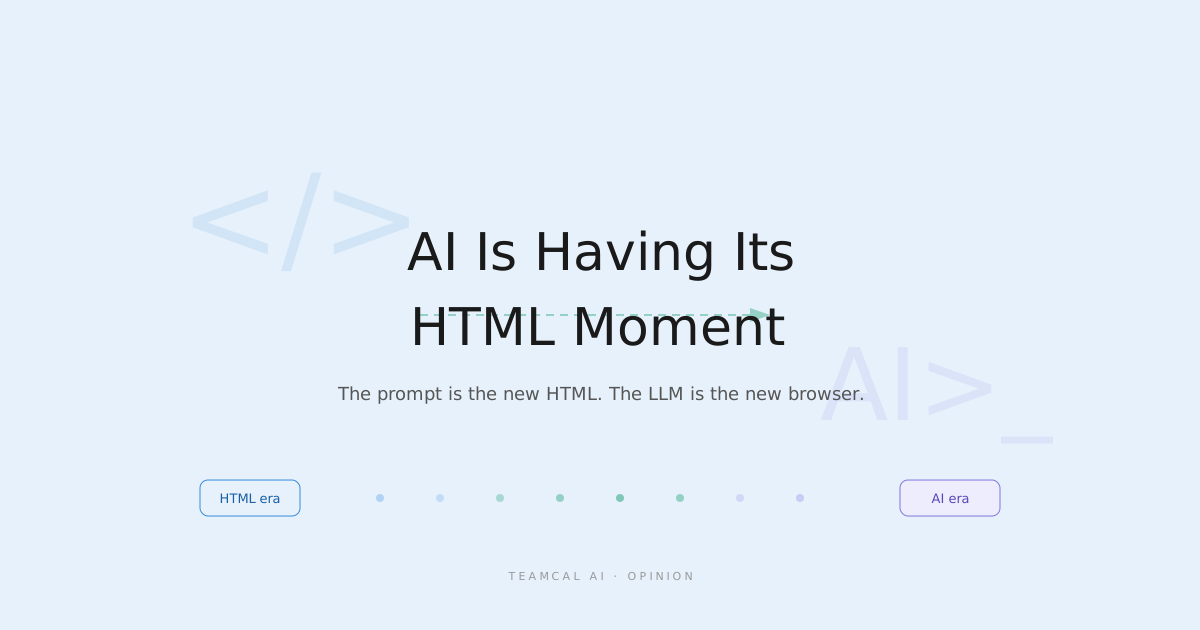
AI's "HTML Moment" Signals Foundational Shift in Digital Paradigm
Sonic Intelligence
The Gist
AI is undergoing a foundational shift akin to the internet's HTML era.
Explain Like I'm Five
"Imagine when the internet first started, and simple web pages (HTML) changed everything. Now, AI is doing something similar with "prompts" – simple instructions you give to smart computer brains (LLMs). Just like web pages grew into apps, these AI instructions will grow into super-smart computer helpers that can do many things for you, changing how we use computers forever."
Deep Intelligence Analysis
The analytical framework maps key internet components to their AI counterparts: the prompt as HTML for expressing intent, Large Language Models (LLMs) as the new browser interpreting this format, and tool use as the dynamic JavaScript enabling real-world actions. Further, context windows are likened to the Document Object Model (DOM), while memory and Retrieval Augmented Generation (RAG) serve as the new URLs, providing dynamic information access. This mapping highlights a progression through distinct waves, from early chatbots (static sites) to dynamic RAG systems (AJAX), and anticipating future agentic applications (web apps) and multi-agent orchestration (componentized front-ends). This structured view provides a predictive lens for identifying where the next significant shifts will occur.
The implications of this "HTML moment" are vast, suggesting that AI will not merely augment existing software but will fundamentally rewire the entire digital stack, birthing entirely new industries and interaction paradigms. The shift towards agentic applications, where software acts rather than just displays, will make graphical user interfaces optional, enabling more direct and intent-driven interactions. Strategic foresight demands recognizing these evolutionary patterns to capitalize on emerging opportunities in AI-native product development, infrastructure, and governance, preparing for a future where the "funnel becomes a conversation" and orchestrated AI systems become the norm.
_Context: This intelligence report was compiled by the DailyAIWire Strategy Engine. Verified for Art. 50 Compliance._
Visual Intelligence
flowchart LR
    A["Prompt is HTML"] --> B["LLM is Browser"];
    B --> C["Tool Use is JavaScript"];
    C --> D["Context Window is DOM"];
    D --> E["Memory RAG is URL"];
    E --> F["Agentic Apps"];
    F --> G["Multi-Agent Systems"];
Auto-generated diagram · AI-interpreted flow
Impact Assessment
This analysis provides a critical framework for understanding AI's long-term trajectory, suggesting that current developments are just the initial phase of a multi-decade transformation. Recognizing these architectural parallels helps anticipate future industry shifts, investment opportunities, and the emergence of entirely new AI-native paradigms.
Read Full Story on TeamcalKey Details
- ● The prompt is identified as the new HTML, a human-readable format for intent.
- ● Large Language Models (LLMs) are the new browsers, interpreting prompts.
- ● Tool use is the new JavaScript, enabling dynamic, world-acting behavior.
- ● Context windows are compared to the DOM, and memory/RAG to URLs.
- ● The article outlines 5 waves of AI evolution, paralleling HTML's impact from static sites to web apps.
Optimistic Outlook
By drawing parallels to the internet's explosive growth, this perspective suggests an immense potential for AI to spawn new industries, business models, and forms of interaction. The "collapsing interface layer into the instruction layer" promises more intuitive and powerful human-computer interfaces, accelerating innovation and accessibility across all sectors.
Pessimistic Outlook
Over-reliance on historical analogies can sometimes lead to misinterpretations of unique challenges or limitations inherent to AI, such as ethical concerns, computational costs, or the "black box" nature of models. The comparison might also downplay the potential for AI development to hit unforeseen technical or societal plateaus, leading to unrealistic expectations or investment bubbles.

The Signal, Not
the Noise|
Join AI leaders weekly.
Unsubscribe anytime. No spam, ever.
Generated Related Signals
Beyond Hallucination: A New Taxonomy for AI Model Failures
A precise classification of AI failures beyond 'hallucination' is crucial for effective debugging.
Re!Think It: In-Context Logic Halts LLM Hallucinations, Cuts Latency
A new framework embeds complex logic directly into LLM context windows, reducing external code and latency.
Google's TurboQuant Algorithm Slashes LLM Memory by 6x, Boosts Speed
Google's TurboQuant algorithm significantly reduces LLM memory footprint and boosts speed without quality loss.

AI Excels in Code, Fails in Creative Writing: A Developer's Dilemma
AI excels at coding tasks but struggles with nuanced human writing.
AI Coding Agents Demand Explicit Guidelines, Shifting Engineering Focus
AI coding agents necessitate explicit guidelines, shifting engineering focus to design and review.
Miasma: The Open-Source Tool Poisoning AI Training Data Scrapers
Miasma offers an open-source defense against AI data scrapers by feeding them poisoned content.