AI Predicts 130 Conditions from One Night of Sleep
Sonic Intelligence
SleepFM, a multimodal AI, accurately predicts 130 conditions, including mortality and dementia, from a single night's sleep data.
Explain Like I'm Five
"Imagine a super-smart computer that can tell if you're going to get sick just by listening to you sleep!"
Deep Intelligence Analysis
One of the key strengths of SleepFM is its scalability and label-efficiency. Unlike traditional approaches that rely on manual annotations and supervised learning, SleepFM can analyze large volumes of sleep data with minimal human intervention. This makes it a cost-effective and practical solution for widespread adoption in clinical settings. Furthermore, the model's strong transfer learning performance suggests that it can be applied to diverse populations and datasets, further enhancing its generalizability.
However, it is important to acknowledge the potential limitations and ethical considerations associated with SleepFM. The model's accuracy may vary across different demographic groups, and it is crucial to ensure that it does not perpetuate existing health disparities. Additionally, data privacy and security are paramount, and robust measures must be in place to protect sensitive patient information. As AI-powered sleep analysis becomes more prevalent, it is essential to address these challenges proactively to ensure that it is used responsibly and ethically. This research aligns with EU AI Act Article 50, promoting transparency and understanding of AI systems' predictive capabilities in healthcare.
Impact Assessment
This AI could revolutionize disease prediction and preventative healthcare. It offers a scalable and label-efficient method for analyzing sleep data.
Key Details
- SleepFM predicts 130 conditions with a C-Index of at least 0.75.
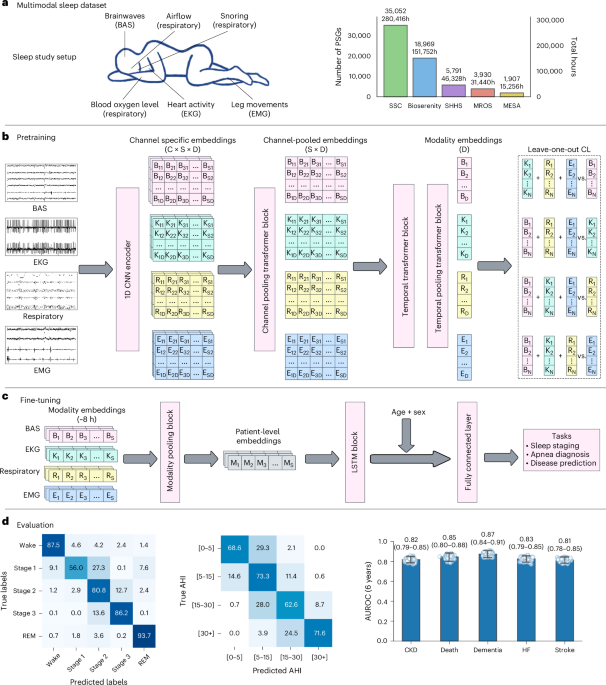
- The model was trained on over 585,000 hours of PSG recordings from 65,000 participants.
- SleepFM achieves a C-Index of 0.84 for all-cause mortality prediction.
Optimistic Outlook
Early disease detection can lead to timely interventions and improved patient outcomes. SleepFM's transfer learning capabilities suggest it can be applied to diverse populations and datasets.
Pessimistic Outlook
The model's accuracy may vary across different demographic groups. Ethical considerations regarding data privacy and potential misuse need careful attention.
Get the next signal in your inbox.
One concise weekly briefing with direct source links, fast analysis, and no inbox clutter.
More reporting around this signal.
Related coverage selected to keep the thread going without dropping you into another card wall.