AI Skills Evolve: From Prompts to Context-Aware Loader Specifications
Sonic Intelligence
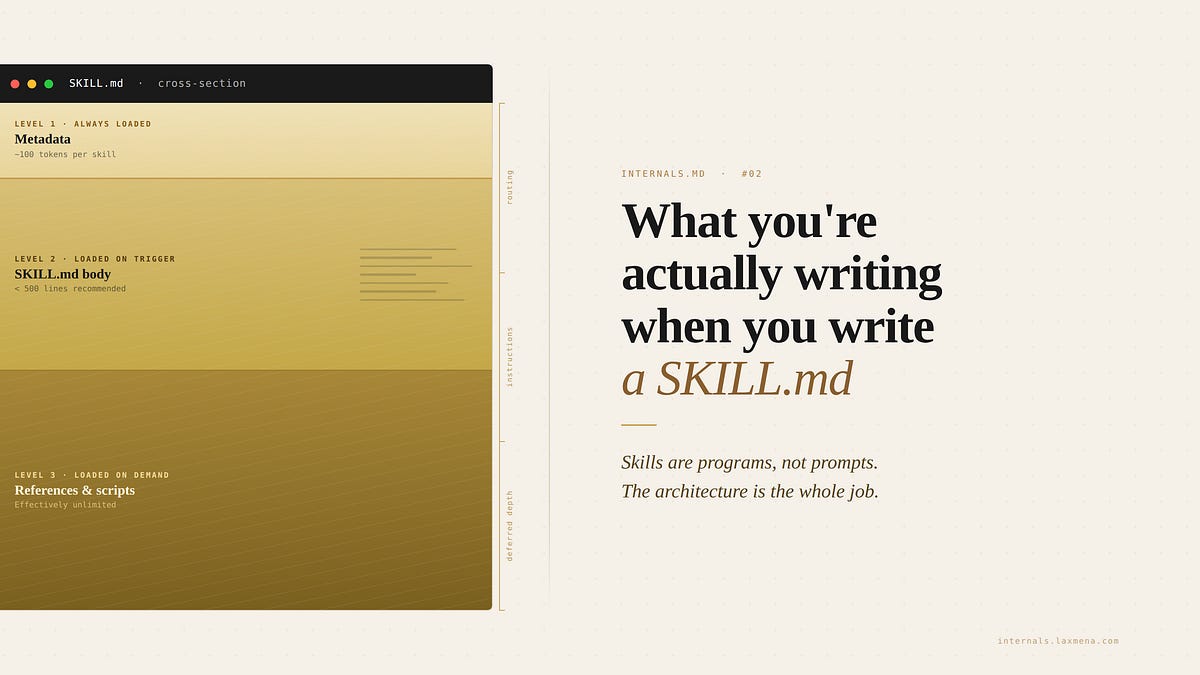
AI skills are programs, not static prompts, requiring architectural understanding for efficiency.
Explain Like I'm Five
"Imagine you have a super-smart robot. Instead of giving it a giant list of instructions every single time, you teach it how to find the right instructions only when it needs them. This makes the robot faster and smarter because it's not wasting time reading things it doesn't need right now."
Deep Intelligence Analysis
The practical implications of this architectural insight are profound. For instance, refactoring a verbose 1,200-line skill to a concise 180-line loader specification can yield a threefold reduction in context window consumption, from 20% to 7%, for the same task and output. This efficiency gain is not merely an optimization; it's a mitigation strategy against 'software rot' in AI skills, addressing issues like environment drift, version sensitivity, and non-reproducible failures. The adoption of an open standard like Anthropic's SKILL.md, published in December 2025 and compatible across various agent runtimes, further underscores the industry's move towards standardized, architecturally sound skill development.
Looking forward, this architectural clarity will drive the creation of more robust, scalable, and cost-effective AI agents. It shifts the focus from mere prompt crafting to sophisticated program design, demanding a deeper understanding of runtime dynamics and resource management. Organizations that embrace this 'skills as programs' mindset will gain a competitive edge in deploying complex, multi-modal agents, while those clinging to the 'skills as prompts' misconception will face escalating operational costs and persistent performance bottlenecks. This evolution is set to professionalize AI agent development, transforming it from an art of textual manipulation into an engineering discipline.
Transparency: This analysis was generated by an AI model based on the provided source material.
Visual Intelligence
flowchart LR
A["Skill Program"] --> B["Load Every Turn"]
A --> C["Load On Invocation"]
A --> D["Load On Demand"]
Auto-generated diagram · AI-interpreted flow
Impact Assessment
The redefinition of AI skills from static prompts to dynamic loader specifications fundamentally alters how developers optimize agent performance and resource utilization. This architectural shift is critical for scaling AI agents, reducing operational costs, and improving reliability by addressing issues like environment drift and version sensitivity.
Key Details
- Skills are programs with three execution stages: every turn, on invocation, and on demand.
- Inefficient skill architecture can consume 20% of the context window before agent work begins.
- Refactoring a 1,200-line skill to 180 lines reduced context consumption from 20% to 7%.
- Anthropic published the SKILL.md format as an open standard in December 2025.
- The SKILL.md format is compatible across platforms like Claude Code, Kiro, Cursor, and Codex CLI.
Optimistic Outlook
Embracing skills as loader specifications will lead to significantly more efficient and robust AI agents, enabling complex tasks with reduced computational overhead. The open standard for SKILL.md fosters cross-platform compatibility and innovation, accelerating the development of sophisticated, context-aware AI systems.
Pessimistic Outlook
Misunderstanding skills as mere prompts will continue to plague AI agent development with hidden costs and silent failures. Developers who fail to adapt to this architectural paradigm risk building brittle, resource-intensive agents that struggle with reproducibility and scalability, hindering broader adoption and trust.
Get the next signal in your inbox.
One concise weekly briefing with direct source links, fast analysis, and no inbox clutter.
More reporting around this signal.
Related coverage selected to keep the thread going without dropping you into another card wall.