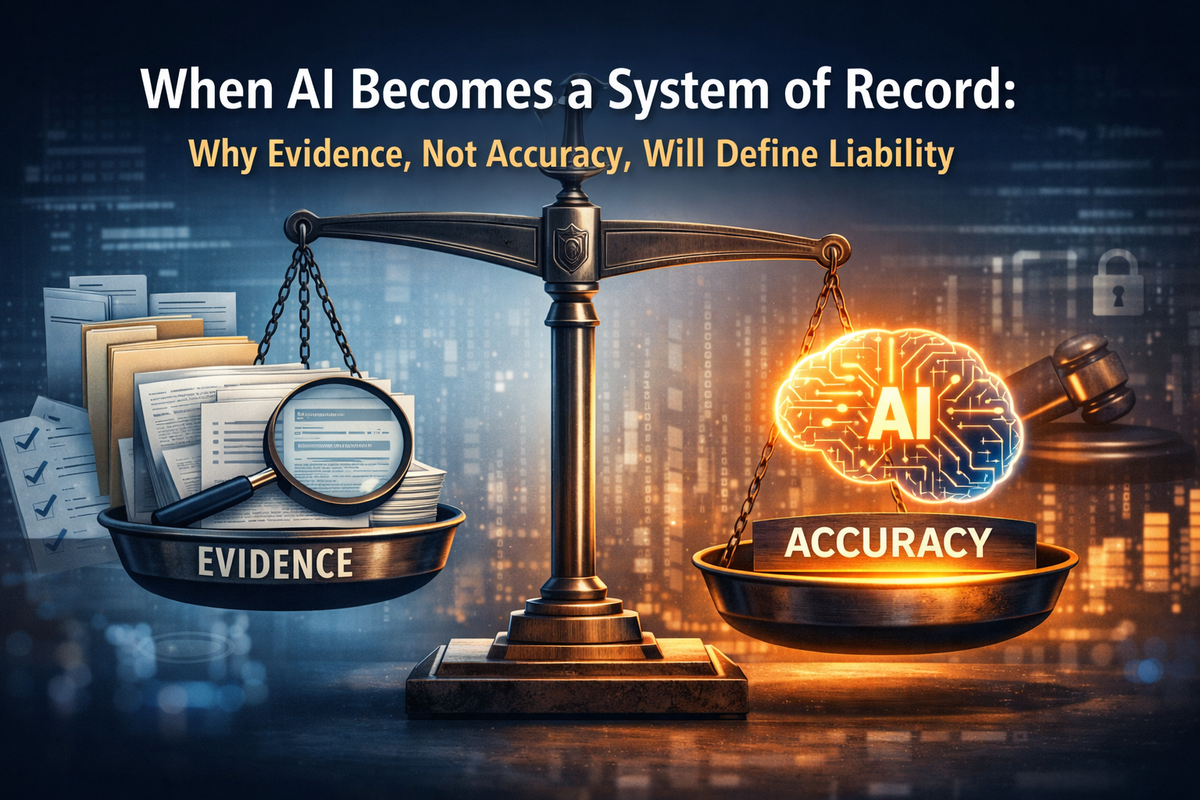
AI as System of Record: Evidence Defines Liability
Sonic Intelligence
AI outputs are increasingly relied upon, making them de facto systems of record, requiring robust governance and evidence.
Explain Like I'm Five
"Imagine your toy robot helps you decide what to eat, but you can't remember why it picked that food. Now, if that food makes you sick, it's important to know why the robot chose it, not just that it's usually right. We need to keep track of what the robot does!"
Deep Intelligence Analysis
The author argues that the inability to reconstruct AI-mediated representations is now considered a control failure by supervisory bodies. This means that organizations must be able to provide evidence of how AI systems arrived at specific outputs, especially when those outputs are questioned or lead to adverse outcomes. The traditional defense of model accuracy is insufficient; instead, organizations must demonstrate that they can stand behind the AI's decisions.
Furthermore, the article challenges the assumption that advances in model architecture will automatically reduce governance risk. On the contrary, as AI systems become more capable and autonomous, the standard of care rises. Regulators and courts will demand greater transparency and explainability, particularly when AI systems appear to understand context, infer causality, or predict outcomes.
In conclusion, organizations must proactively address the governance challenges posed by AI's evolution into a system of record. This requires implementing robust record-keeping practices, establishing clear lines of accountability, and ensuring that AI systems are designed to be transparent and explainable. Failure to do so will expose organizations to significant legal, regulatory, and reputational risks. The EU AI Act will likely codify many of these principles, making compliance essential for organizations operating within the European Union.
Impact Assessment
As AI systems become more integrated into critical processes, organizations must shift from focusing solely on accuracy to ensuring traceability, reproducibility, and accountability. Failure to do so exposes them to significant legal and regulatory risks.
Key Details
- AI outputs are being copied into reports and relied upon by staff.
- Supervisory bodies are treating the inability to reconstruct AI-mediated representations as a control failure.
- Accuracy is a performance metric; liability is a governance problem.
- AI outputs become artifacts when influencing decisions or communicated externally.
Optimistic Outlook
By implementing robust governance frameworks and record-keeping practices for AI systems, organizations can build trust and confidence in AI-driven decisions. This proactive approach can foster innovation while mitigating potential risks, leading to more responsible and beneficial AI adoption.
Pessimistic Outlook
The increasing reliance on AI outputs without proper governance could lead to widespread accountability failures and legal challenges. Organizations that fail to adapt to this new reality risk facing significant financial penalties, reputational damage, and erosion of public trust in AI.
Get the next signal in your inbox.
One concise weekly briefing with direct source links, fast analysis, and no inbox clutter.
More reporting around this signal.
Related coverage selected to keep the thread going without dropping you into another card wall.



