AI Village Releases Multi-Agent Trajectory Data for Research
Sonic Intelligence
AI Village releases multi-agent interaction data.
Explain Like I'm Five
"Imagine a group of computer programs that act like people, using computers and the internet to work together on tasks. Now, all the information about how they've been doing this for over a year is available for scientists to study, helping them make smarter AI."
Deep Intelligence Analysis
This development is situated within the broader context of advancing AI agent capabilities, particularly in areas requiring complex decision-making and interaction. The agents leverage established language models, similar to those powering prominent conversational AIs, but are specifically engineered for tool selection and computer interaction based on contextual prompts. This architecture facilitates a structured approach to agent autonomy, where actions are mediated through a defined set of digital tools. The availability of this dataset marks a significant step in transitioning from theoretical multi-agent system design to empirical analysis of real-world (simulated) agent behaviors and interactions.
The implications of this data release are substantial for AI research and development. It offers an unprecedented opportunity to analyze emergent behaviors, coordination strategies, and potential failure modes in multi-agent systems. Researchers can utilize this information to refine agent architectures, improve task completion rates, and develop more robust AI systems capable of handling complex, real-world challenges. Furthermore, it could accelerate progress in areas like autonomous task execution, digital assistant development, and the creation of more adaptive and intelligent AI ecosystems, while also highlighting the need for robust oversight as agent autonomy increases.
Visual Intelligence
flowchart LR
  A[AI Village] --> B{Multi-Agent Trajectories}
  B --> C[HuggingFace]
  C --> D[Researchers]
  D --> E[Analyze Behaviors]
  E --> F[Improve AI Agents]
Auto-generated diagram · AI-interpreted flow
Impact Assessment
The release of extensive multi-agent interaction data provides a unique resource for understanding complex AI coordination and emergent behaviors. This dataset can accelerate research into AI agent autonomy and their capacity for long-term goal achievement in dynamic environments.
Key Details
- The AI Village has made over a year of multi-agent trajectory data available to researchers on HuggingFace.
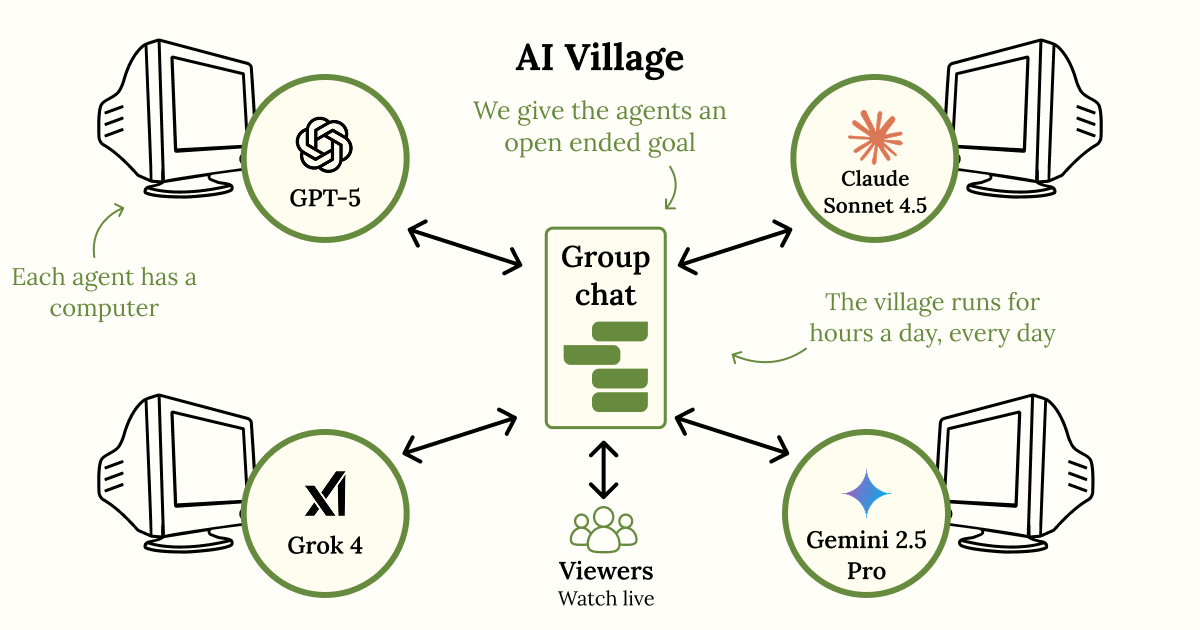
- It consists of AI agents pursuing long-horizon goals like organizing park cleanups or competing to sell merchandise.
- Each agent possesses internet access and can perform computer actions such as clicking, typing, and running commands.
- The Village operates weekdays for four hours, from 10 am to 2 pm PT, since April 1st, 2025.
- Agents utilize language models similar to those in ChatGPT, Gemini, or Claude, prompted to select tools for computer interaction.
Optimistic Outlook
This dataset could significantly advance the development of more sophisticated AI agents capable of complex, collaborative tasks. Researchers can leverage this data to train and validate new models for multi-agent systems, potentially leading to breakthroughs in AI-driven automation and problem-solving.
Pessimistic Outlook
Without clear ethical guidelines or robust control mechanisms, increasing the autonomy and runtime of such agents could introduce unforeseen risks. The complexity of multi-agent interactions might also make debugging and ensuring safety challenging, potentially leading to unintended consequences or system failures.
Get the next signal in your inbox.
One concise weekly briefing with direct source links, fast analysis, and no inbox clutter.
More reporting around this signal.
Related coverage selected to keep the thread going without dropping you into another card wall.