ARC-AGI-3 Benchmark Exposes Vast Gap Between Human and AI Intelligence
Sonic Intelligence
A new AI benchmark, ARC-AGI-3, highlights a vast gap between human and AI general intelligence.
Explain Like I'm Five
"Imagine a super-hard puzzle game where you don't get any instructions, and every level is completely new. Humans can figure out how to play and win every time. But even the smartest computer programs, which are great at puzzles they've seen before, get stuck and can't figure out the new ones. This new game, ARC-AGI-3, shows that computers still have a very long way to go to be as smart as a human brain at solving brand new problems."
Deep Intelligence Analysis
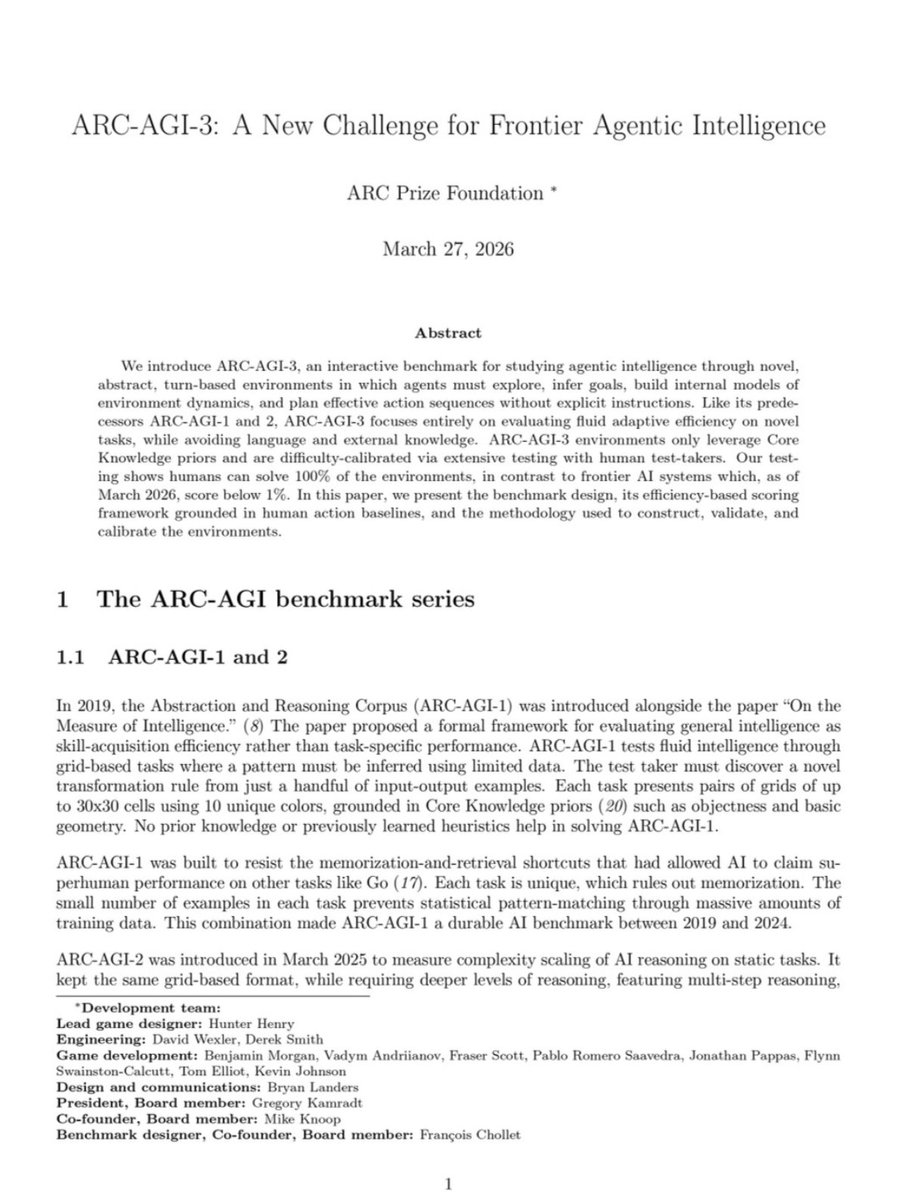
The benchmark's results are stark: humans achieved a 100% success rate, while leading models like Gemini 3.1 Pro, GPT 5.4, Opus 4.6, and Grok-4.20 scored less than 1%. This contrasts sharply with the near-solved status of ARC-AGI-1 (Gemini 98%) and the rapid progress on ARC-AGI-2 (3% to 77% in a year), indicating that ARC-AGI-3 effectively "resets the scoreboard." The scoring mechanism explicitly penalizes brute-force solutions, emphasizing the need for genuine understanding and efficient problem-solving over computational power. A $2 million Kaggle prize, requiring open-source solutions, aims to galvanize research into these foundational challenges.
The implications are far-reaching for the trajectory of AI research. Chollet's assertion that "scaling alone will not close this gap" suggests a pivot is needed from purely data-driven, large-scale training to new architectural paradigms that foster intrinsic motivation, common sense reasoning, and rapid, few-shot learning in truly novel situations. This benchmark serves as a crucial reality check for AGI timelines, indicating that achieving human-level general intelligence requires breakthroughs beyond current deep learning approaches, potentially shifting focus towards more biologically inspired or symbolic AI methods to bridge this fundamental cognitive divide.
[EU AI Act Art. 50 Compliant: This analysis was generated by an AI model. Transparency and traceability are maintained.]
Impact Assessment
ARC-AGI-3 demonstrates that current AI models, despite impressive scaling, still lack fundamental human-like abilities for novel problem-solving, adaptation, and understanding implicit goals in unknown environments. This re-calibrates expectations for AGI timelines and research priorities.
Key Details
- François Chollet released ARC-AGI-3, a new AI benchmark.
- ARC-AGI-3 features 135 novel game environments with no explicit instructions, rules, or goals.
- Humans achieved a 100% success rate on ARC-AGI-3.
- Leading AI models (Gemini 3.1 Pro, GPT 5.4, Opus 4.6, Grok-4.20) scored below 1% on ARC-AGI-3.
- The scoring mechanism explicitly penalizes brute-force approaches.
- A $2 million prize is offered on Kaggle for winning solutions, requiring open-sourcing.
Optimistic Outlook
The introduction of ARC-AGI-3 provides a critical, challenging benchmark that will drive fundamental research into more robust and adaptive AI architectures beyond current scaling paradigms. The open-source requirement for prize solutions will accelerate collaborative progress in the field.
Pessimistic Outlook
The stark performance gap on ARC-AGI-3 suggests that current AI research might be over-indexed on scaling existing architectures, potentially leading to diminishing returns in achieving true general intelligence. This could prolong the development of truly autonomous and adaptable AI agents, impacting timelines for advanced applications.
Get the next signal in your inbox.
One concise weekly briefing with direct source links, fast analysis, and no inbox clutter.
More reporting around this signal.
Related coverage selected to keep the thread going without dropping you into another card wall.