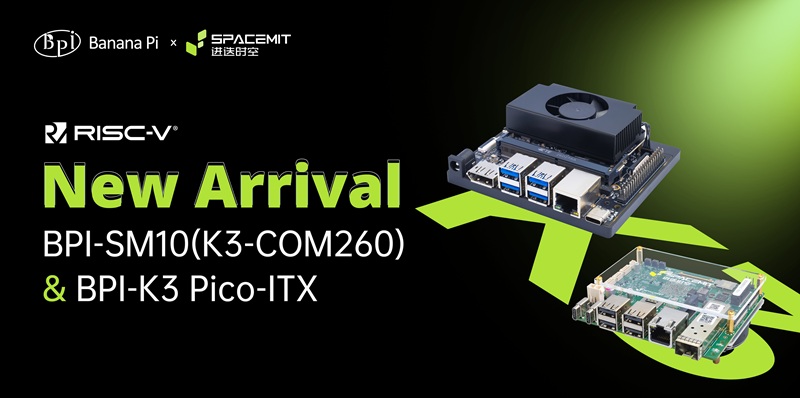
Banana Pi Unveils RISC-V AI Platforms with 60 TOPS and 30B LLM Inference
Sonic Intelligence
Banana Pi launches two RISC-V AI platforms, featuring 60 TOPS compute and 30B LLM inference.
Explain Like I'm Five
"Imagine tiny super-smart computer brains that can understand and talk like big AI programs, but they fit into small devices like robots or smart cameras. Banana Pi just made two new ones that are super fast and can do tricky AI stuff right inside the device, without needing to talk to a giant computer far away."
Deep Intelligence Analysis
The SpacemiT K3 chip boasts impressive specifications, including 60 TOPS of AI compute and the ability to run 30B-parameter large language models (LLMs) on-device at over 10 tokens per second. Its architecture integrates eight X100™ high-performance RISC-V general-purpose cores with eight A100™ dedicated AI compute cores, providing a balanced solution for both general computing and intensive AI tasks. With memory options up to 32GB LPDDR5 and a power envelope of 18W–35W, these platforms are designed for energy efficiency without compromising performance, targeting applications from autonomous AI agents and service robots to industrial automation and in-vehicle domain controllers.
The strategic implications are profound, particularly for the decentralization of AI processing. By enabling robust LLM inference directly on edge devices, these Banana Pi offerings reduce latency, enhance data privacy by minimizing cloud transfers, and lower operational costs associated with cloud-based AI. This shift empowers the development of more autonomous and responsive AI systems, fostering innovation in areas where real-time, local processing is critical. The success of these platforms will, however, depend on the continued expansion of the RISC-V software ecosystem and developer tools to fully leverage their hardware capabilities, potentially accelerating the transition towards a more distributed AI infrastructure.
Impact Assessment
This release signifies a major advancement in edge AI hardware, bringing high-performance, energy-efficient RISC-V platforms capable of running large language models directly on devices, reducing cloud dependency and enabling new applications in robotics and industrial control.
Key Details
- Banana Pi released BPI‑SM10 Developer Kit and K3 Pico‑ITX AI Industrial SBC in April 2026.
- Both products utilize the SpacemiT K3 RISC‑V AI chip, the world’s first RVA23-certified RISC‑V AI chip.
- The K3 chip delivers up to 60 TOPS (Tera Operations Per Second) of AI compute.
- It supports on-device inference for 30B-parameter large language models (LLMs) at >10 Tokens/s.
- The CPU features 8x X100™ RISC-V general-purpose cores and 8x A100™ dedicated AI compute cores.
- Memory options include 8GB/16GB/32GB LPDDR5 6400 MT/s.
- Power consumption ranges from 18W–35W.
Optimistic Outlook
The introduction of high-performance RISC-V AI platforms with significant TOPS and on-device LLM capabilities will accelerate the development of autonomous agents and edge AI applications. This could democratize access to advanced AI processing, fostering innovation in robotics, industrial automation, and smart devices.
Pessimistic Outlook
While powerful, the success of these new platforms hinges on robust software ecosystem development and developer adoption within the RISC-V space. Competition from established ARM and x86 solutions, coupled with potential supply chain challenges for new silicon, could hinder widespread market penetration.
Get the next signal in your inbox.
One concise weekly briefing with direct source links, fast analysis, and no inbox clutter.
More reporting around this signal.
Related coverage selected to keep the thread going without dropping you into another card wall.