The Cartographer Challenge: Moving LLMs Beyond Navigation to Strong AI
Sonic Intelligence
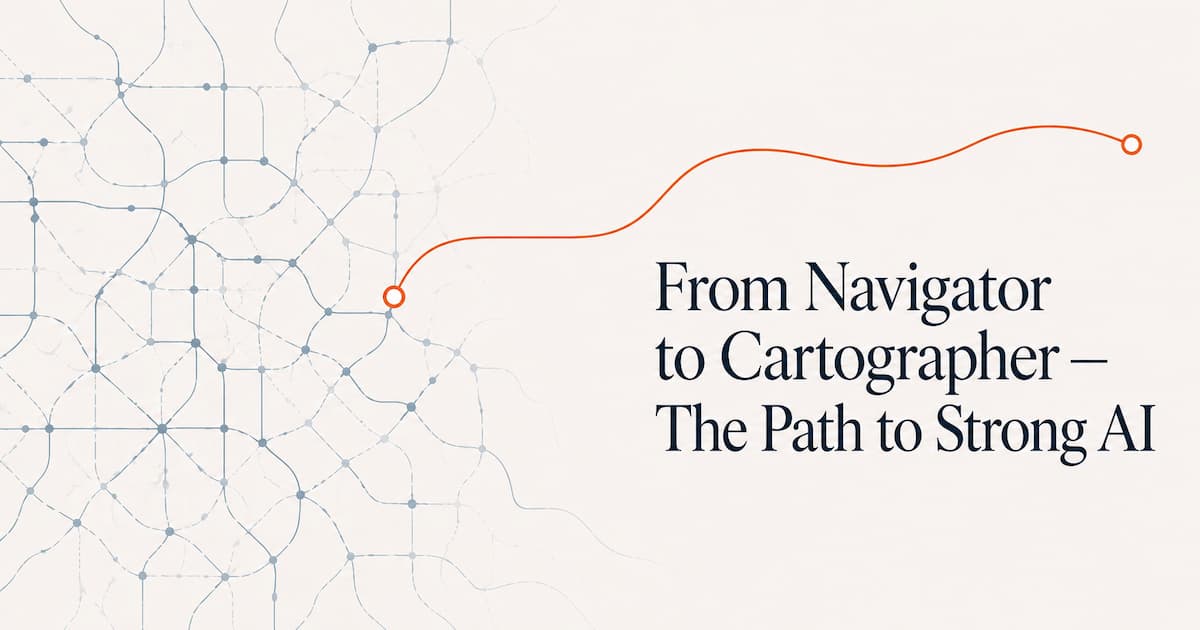
LLMs excel at navigating existing knowledge, but strong AI requires creating new conceptual frameworks.
Explain Like I'm Five
"Imagine a super-smart robot that knows everything written in every book and can find any answer super fast – that's what our AI brains are like now, they're amazing 'navigators.' But a 'really, really smart' robot wouldn't just find answers; it would invent new ways of thinking about things, like drawing a brand new map instead of just following an old one. We're trying to figure out how to teach robots to draw new maps."
Deep Intelligence Analysis
This analytical framework challenges the simplistic notion that "humans create and LLMs repeat," acknowledging that human cognition also heavily relies on navigating pre-existing cultural and professional categories. The critical inquiry shifts to identifying the mechanisms that enable rare moments of human conceptual innovation and how these might be replicated or fostered in artificial systems. The concept of "semantic attractors" is introduced, metaphorically representing stable points or familiar explanations within any domain that LLMs are particularly adept at identifying and gravitating towards. This capability, while practically powerful for most user needs, highlights the models' tendency to operate within established thought patterns rather than transcend them.
The forward-looking implications of this distinction are profound for AI research. Moving beyond the navigator paradigm requires a focus on developing AI architectures and learning processes that can generate genuinely novel conceptual structures, rather than merely optimizing the traversal of existing ones. This could involve mechanisms for meta-learning, self-reflection, or the ability to identify and challenge foundational assumptions within a knowledge domain. The pursuit of "cartographic" AI necessitates a deeper understanding of how new frameworks emerge, pushing the boundaries of current LLM capabilities and potentially unlocking a new era of AI that not only processes information but actively contributes to the evolution of human thought.
Impact Assessment
This conceptual distinction between 'navigator' and 'cartographer' capabilities in AI is fundamental to understanding the current limitations and future trajectory of large language models. It reframes the pursuit of strong AI, moving beyond mere task proficiency to the capacity for genuine conceptual innovation.
Key Details
- ● Modern LLMs demonstrate advanced intelligence in tasks like explaining complex ideas, writing code, and translating disciplines.
- ● LLMs are described as 'navigators' of existing human thought maps.
- ● Strong AI is conceptualized as a 'cartographer,' capable of changing the map itself by creating new distinctions and frameworks.
- ● The article questions how human innovation differs from LLM pattern recognition.
- ● 'Semantic attractors' are introduced as stable points in thought that LLMs are adept at identifying.
Optimistic Outlook
By clearly defining the gap between current LLM capabilities and strong AI, researchers can focus efforts on developing architectures and training methodologies that foster true conceptual innovation. This clarity could accelerate breakthroughs in AI's ability to generate novel frameworks, leading to unprecedented scientific and creative advancements.
Pessimistic Outlook
If current LLM development continues to prioritize scale and data without addressing the fundamental shift from navigation to cartography, the pursuit of strong AI may remain elusive. Over-reliance on 'semantic attractors' could lead to increasingly sophisticated, yet ultimately derivative, AI systems that struggle with genuine paradigm shifts.
Get the next signal in your inbox.
One concise weekly briefing with direct source links, fast analysis, and no inbox clutter.
More reporting around this signal.
Related coverage selected to keep the thread going without dropping you into another card wall.