Claude Code Dominates Engineer Tooling as AI Becomes Mainstream
Sonic Intelligence
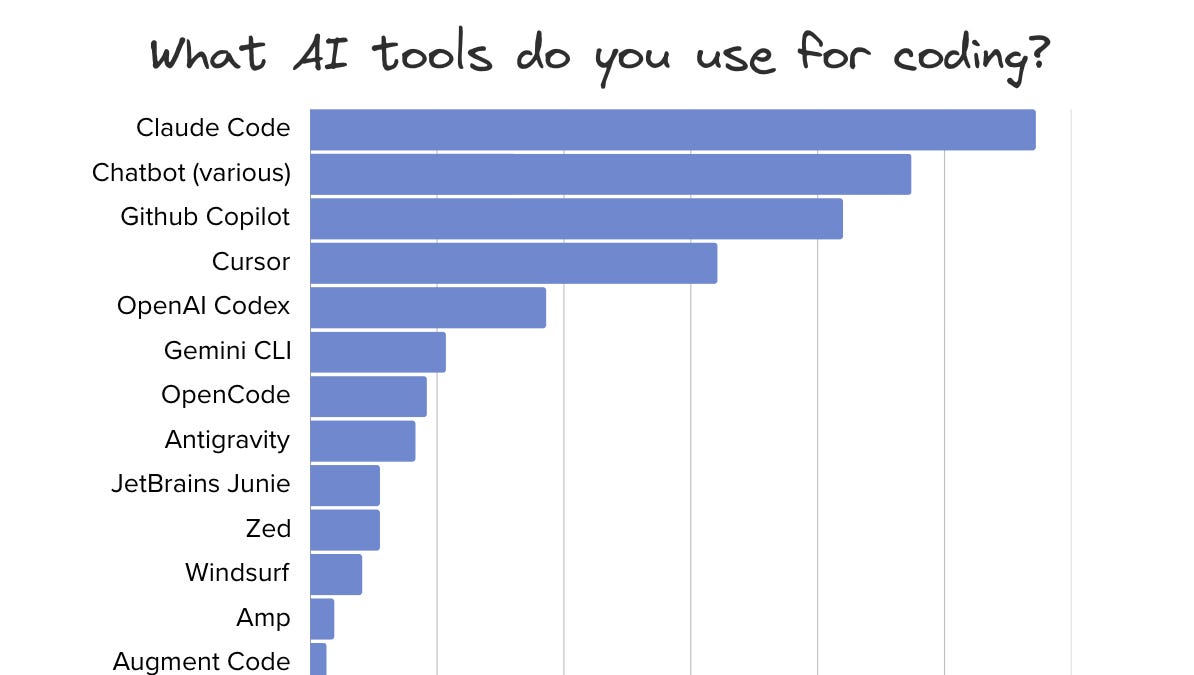
Claude Code rapidly became the top AI coding tool, with 95% of engineers using AI weekly.
Explain Like I'm Five
"Imagine a smart robot friend who helps you build LEGOs. Now, almost all the grown-up engineers have a super-smart computer friend that helps them write computer code, and one specific friend named 'Claude Code' is everyone's favorite because it's really good and fast!"
Deep Intelligence Analysis
This market reorientation is further contextualized by comprehensive survey data, revealing that 75% of engineers now dedicate at least half their work to AI-assisted tasks, with 56% reporting over 70% AI involvement. Anthropic's Opus and Sonnet models are overwhelmingly preferred for coding, demonstrating a clear technical advantage in this domain. The rising adoption of AI agents, utilized by 55% of engineers and particularly by staff+ engineers (63.5%), points to an increasing comfort with more autonomous AI assistance. Interestingly, while smaller companies overwhelmingly favor Claude Code, large enterprises still lean towards GitHub Copilot, likely influenced by existing procurement channels and Microsoft's extensive enterprise marketing efforts.
Looking forward, the sustained growth of AI tooling will necessitate a re-evaluation of engineering education and skill development, emphasizing AI proficiency and critical oversight rather than rote coding. The intense competition among AI tool providers, exemplified by Cursor's rapid growth despite Claude Code's lead, indicates a dynamic market ripe for further innovation. Enterprises must strategically assess their AI tooling investments, balancing immediate productivity gains with long-term considerations of vendor lock-in and the evolving capabilities of AI-powered development environments. This shift will fundamentally redefine the role of the software engineer and the architecture of future development pipelines.
EU AI Act Art. 50 Compliant: This analysis is based solely on the provided text, without external data or speculative inference.
Impact Assessment
The rapid ascent of Claude Code and pervasive AI adoption among engineers signals a critical shift in software development workflows. This data highlights evolving preferences and the increasing reliance on AI for productivity, impacting future tool development and enterprise procurement strategies.
Key Details
- Claude Code became the #1 AI coding tool in eight months since its May 2025 release.
- 95% of software engineers surveyed use AI tools at least weekly.
- 75% of respondents use AI for half or more of their software engineering work.
- 55% of respondents regularly use AI agents, led by staff+ engineers at 63.5%.
- Claude Code is the most loved tool (46%), followed by Cursor (19%) and GitHub Copilot (9%).
Optimistic Outlook
Widespread AI integration promises significant productivity gains and innovation in software engineering, enabling faster development cycles and more complex problem-solving. The high adoption of AI agents suggests a future where engineers leverage sophisticated AI for increasingly autonomous tasks, freeing up human creativity.
Pessimistic Outlook
Over-reliance on specific AI tools like Claude Code could lead to vendor lock-in or stifle diversity in the AI tooling ecosystem. Potential skill degradation or a lack of critical understanding of AI-generated code might emerge if engineers delegate too much responsibility without adequate oversight.
Get the next signal in your inbox.
One concise weekly briefing with direct source links, fast analysis, and no inbox clutter.
More reporting around this signal.
Related coverage selected to keep the thread going without dropping you into another card wall.