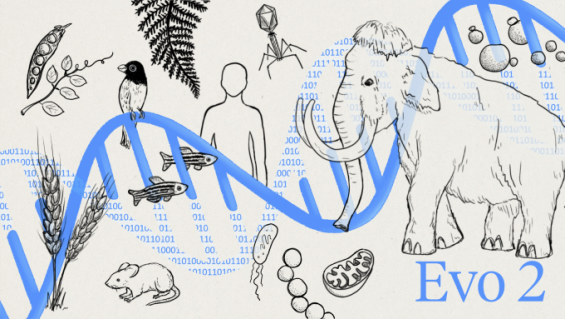
Evo 2 AI Achieves Unprecedented Scale in Gene Design and Genomic Analysis
Sonic Intelligence
Evo 2 AI, trained on 9.3 trillion base pairs, designs genes and analyzes DNA.
Explain Like I'm Five
"Imagine DNA is like a super long instruction book for living things. Scientists made a super smart computer program called Evo 2 that read 9.3 trillion pages from over 128,000 different instruction books (like humans, plants, and even mammoths!). Now, Evo 2 can help find tiny mistakes in these books that cause sickness, and even write new instructions to make tiny helpers, like viruses that fight bad germs. It's like having a super-fast editor for life's instruction manuals!"
Deep Intelligence Analysis
Evo 2's capabilities extend beyond mere analysis; it can identify mutations linked to diseases like breast cancer, demonstrating over 90% accuracy in pinpointing pathogenic BRCA1 mutations. Furthermore, the model has been successfully employed in designing artificial genomes at the bacterial level, including functional bacteriophages—viruses that infect bacteria—which holds promise for developing new treatments against antibiotic-resistant bacteria. Researchers have also used Evo 2 to design mitochondrial and yeast genomes, showcasing its versatility in synthetic biology.
The significance of Evo 2 lies in its potential to dramatically accelerate scientific discovery. By identifying patterns in gene sequences across organisms, it can solve problems in a fraction of the time required by traditional experimental methods, which often take years. This efficiency is expected to reduce the time and cost associated with cell and animal experiments, thereby speeding up the identification of genetic causes for human diseases and accelerating drug development. The analogy to large language models (LLMs) is drawn, with researchers noting that just as the internet shaped LLMs, evolution has imprinted patterns on DNA sequences, which Evo 2 is now learning to interpret.
However, the research also highlights current limitations. While Evo 2 can design components, creating a fully functional, 100% artificial lifeform remains a distant goal. Experts caution that even a single missing or incorrectly modeled essential gene can render a genome non-functional within a cell. Additionally, despite its high accuracy in identifying pathogenic mutations, many hurdles must be overcome before Evo 2's applications can be directly integrated into clinical settings. This underscores the ongoing need for rigorous biological validation and ethical considerations as AI continues to advance in the realm of genetic engineering.
Impact Assessment
This foundational AI model significantly accelerates genetic research by identifying disease-causing mutations and designing novel genes at an unprecedented scale. It promises to reduce the time and cost associated with traditional experimental methods, potentially revolutionizing drug discovery and disease treatment. The ability to process vast genomic data quickly could unlock new biological insights.
Key Details
- Evo 2 was trained on 9.3 trillion base pairs from over 128,000 species, marking the largest scale to date.
- It can process genomes up to one million base pairs at a time, facilitating understanding of distant gene relationships.
- The model successfully identified pathogenic BRCA1 breast cancer mutations with over 90% accuracy.
- Evo 2 has been used to design functional bacteriophages, showing potential for treating antibiotic-resistant bacteria.
- It was trained on 30 times more data than its predecessor, Evo 1, released in 2024.
Optimistic Outlook
Evo 2's capabilities could dramatically speed up the identification of genetic disease causes and accelerate drug development, leading to more targeted and effective therapies. Its potential to design functional biological components, like bacteriophages, offers new avenues for combating challenges such as antibiotic resistance. The model's efficiency in analyzing complex genetic patterns promises to unlock deeper understanding of life's operating principles.
Pessimistic Outlook
Despite its advancements, Evo 2 is still far from creating fully functional artificial lifeforms, as essential gene modeling remains a significant hurdle. Clinical application faces numerous challenges, suggesting a long road before direct patient benefits are realized. Over-reliance on AI in gene design without robust biological validation could lead to unforeseen complications or misinterpretations of complex genetic interactions.
Get the next signal in your inbox.
One concise weekly briefing with direct source links, fast analysis, and no inbox clutter.
More reporting around this signal.
Related coverage selected to keep the thread going without dropping you into another card wall.