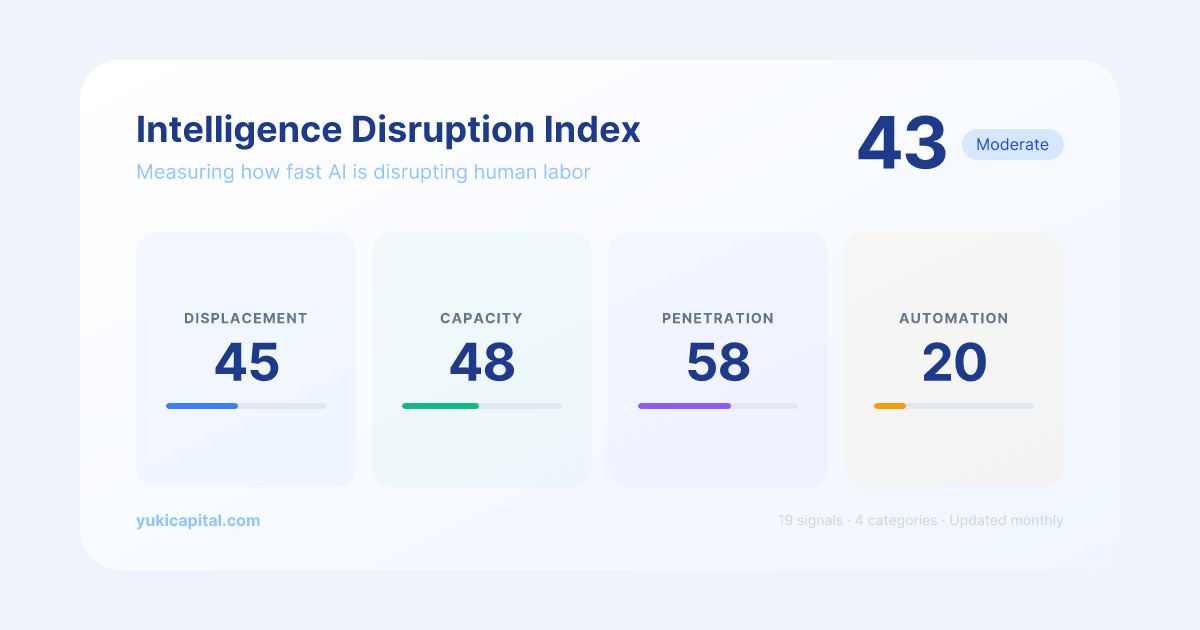
Intelligence Disruption Index: Measuring AI's Impact on Human Labor
Sonic Intelligence
The Intelligence Disruption Index (IDI) tracks AI's displacement of human workers across various sectors, aggregating 19 signals into a single score.
Explain Like I'm Five
"Imagine a score that tells us how much robots are taking over people's jobs. It looks at things like how many jobs are disappearing and how cheap robots are getting."
Deep Intelligence Analysis
The Job Displacement category tracks employment decline in AI-exposed occupations, headcount changes in Big 4 firms, hiring demand, unemployment rates in the information sector, wage compression, and business formation. The AI Capacity & Cost category measures the capabilities and affordability of AI, considering factors like the time horizon for AI task completion and the pricing of frontier models. The AI Penetration category assesses the extent to which AI is being used in real work, distinguishing between AI assistance and full task automation. The Physical Automation category tracks the adoption of robots and autonomous vehicles in replacing physical human workers.
The IDI uses publicly available data sources and employs a transparent methodology. Each category is equally weighted, and signals are normalized to a 0-100 scale. The index is updated monthly, providing a timely indicator of AI's impact on the labor market. The inclusion of counter-signals aims to capture economic resilience against displacement, providing a more nuanced picture of the overall impact of AI on employment.
Impact Assessment
This index provides a quantitative measure of AI's impact on employment, helping to inform policy decisions and societal discussions about the future of work.
Key Details
- The Intelligence Disruption Index (IDI) measures AI's impact on human labor.
- The IDI aggregates 19 signals across 4 categories: Job Displacement, AI Capacity & Cost, AI Penetration, and Physical Automation.
- The IDI uses publicly available data sources, including BLS, FRED, Indeed, and METR.
- Each category is equally weighted at 25%.
Optimistic Outlook
The index includes counter-signals like wage growth and business formation, which measure economic resilience against displacement. This suggests that the economy may adapt to AI-driven changes.
Pessimistic Outlook
The index tracks job displacement in AI-exposed occupations, highlighting the potential for significant disruption to the labor market. This could lead to increased unemployment and inequality.
Get the next signal in your inbox.
One concise weekly briefing with direct source links, fast analysis, and no inbox clutter.
More reporting around this signal.
Related coverage selected to keep the thread going without dropping you into another card wall.