Leopold Aschenbrenner's $5.5B Portfolio Bets on AI Power Infrastructure
Sonic Intelligence
A 24-year-old investor's $5.5 billion portfolio highlights the critical power infrastructure bottleneck for AI.
Explain Like I'm Five
"Imagine building lots of huge brains (AI computers) that need tons of food (electricity). A smart young investor, Leopold, realized that not enough food is being made, so he's putting his money into companies that make food for these brains, like special power plants. He thinks this 'food' is the next big thing!"
Deep Intelligence Analysis
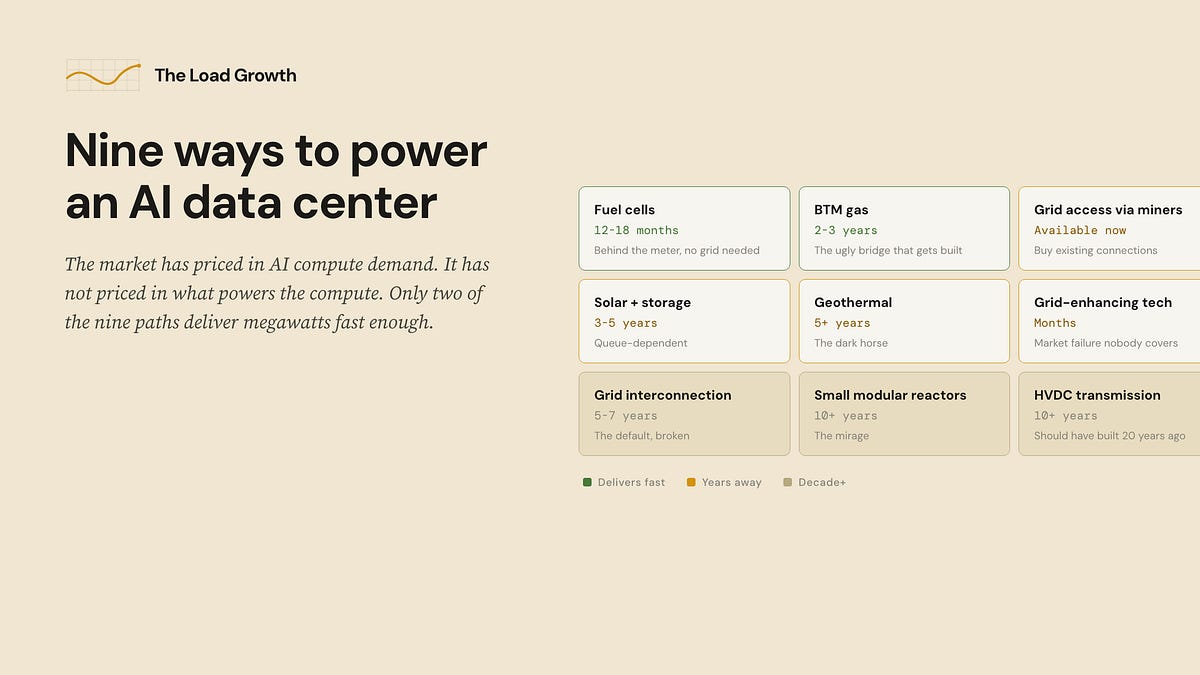
The scale of the impending power crisis is stark. Meta's planned Hyperion campus alone is projected to require 5 gigawatts, equivalent to five nuclear reactors. Across the industry, 550 planned data centers are set to demand a combined 125 GW. S&P Global forecasts a tripling of US data center power demand from 50 GW in 2024 to 134 GW by 2030. This surge is occurring against a backdrop of two decades of flat US electricity demand, leaving the power sector unprepared. Grid connection times of five to seven years are untenable for the rapid deployment cycles of AI. Aschenbrenner's strategy, therefore, prioritizes "behind-the-meter" generation and other emerging paths like geothermal or advanced transmission, which bypass the grid's inherent limitations. His exit from Nvidia and shorting of consensus AI plays in Q4 2025, redirecting capital into power infrastructure, highlights a contrarian but potentially highly lucrative bet on the fundamental physics of AI scaling.
The implications are profound, suggesting a fundamental re-evaluation of investment priorities across the AI ecosystem. The "power-first" paradigm will likely drive unprecedented innovation and capital deployment into energy generation, storage, and transmission technologies. This shift could lead to a decentralization of power infrastructure, with data centers becoming increasingly self-sufficient or relying on microgrids. However, it also presents significant challenges: environmental concerns regarding energy sources, the potential for increased energy costs, and the risk of grid instability if the transition is not managed effectively. The race to power AI is now as critical as the race to build it, and those who solve the energy equation will likely capture disproportionate value in the coming decade.
Visual Intelligence
flowchart LR
    A["AI Compute Demand"] --> B["Massive Power Need"]
    B --> C["Current Grid Limitations"]
    C --> D["Long Connection Times"]
    D --> E["Investment Opportunity"]
    E --> F["Behind-Meter Generation"]
    F --> G["Fuel Cells"]
    G --> H["Oracle Bloom Deal"]
Auto-generated diagram · AI-interpreted flow
Impact Assessment
This analysis reveals a critical, underpriced bottleneck in the AI boom: power infrastructure. As AI compute demand skyrockets, the ability to supply reliable, scalable energy to data centers is becoming the limiting factor, creating immense investment opportunities and systemic challenges.
Key Details
- Leopold Aschenbrenner manages a $5.5 billion hedge fund.
- His fund is concentrated in power delivery methods for data centers.
- Oracle signed a deal to buy 2.8 gigawatts of fuel cells from Bloom Energy.
- Bloom Energy's stock jumped 24% and closed up 60% after the Oracle deal.
- Meta's planned Hyperion campus will draw 5GW; AWS's Project Rainier is 1GW.
- Roughly 550 planned data centers have a combined power requirement of 125 GW.
- US data center power demand is projected to triple from 50GW (2024) to 134 GW by 2030.
- US electricity demand was flat from 2005-2023, then broke in 2023 due to LLMs.
- Connecting new facilities to the grid currently takes 5-7 years.
Optimistic Outlook
Investments in power infrastructure, like Aschenbrenner's, will accelerate the development of innovative energy solutions for data centers, potentially driving breakthroughs in fuel cell technology, grid modernization, and behind-the-meter generation. This focus could lead to a more resilient and sustainable energy ecosystem for AI.
Pessimistic Outlook
The immense power demands of AI risk overwhelming existing grid infrastructure, leading to delays, increased energy costs, and potential blackouts. Over-reliance on specific power solutions could also create new vulnerabilities and environmental concerns if not managed sustainably.
Get the next signal in your inbox.
One concise weekly briefing with direct source links, fast analysis, and no inbox clutter.
More reporting around this signal.
Related coverage selected to keep the thread going without dropping you into another card wall.