LLM Agents Master SQL Join Order Optimization for Database Performance
Sonic Intelligence
LLM agents demonstrate significant capability in optimizing SQL query join orders through iterative execution.
Explain Like I'm Five
"Imagine you have a messy toy box, and you want to find a specific toy. A normal computer might search in a fixed way. But now, we have a super-smart computer (an LLM agent) that tries different ways to search, learns from each try, and gets much faster at finding your toy. It's like it learns the best way to organize the toy box for you."
Deep Intelligence Analysis
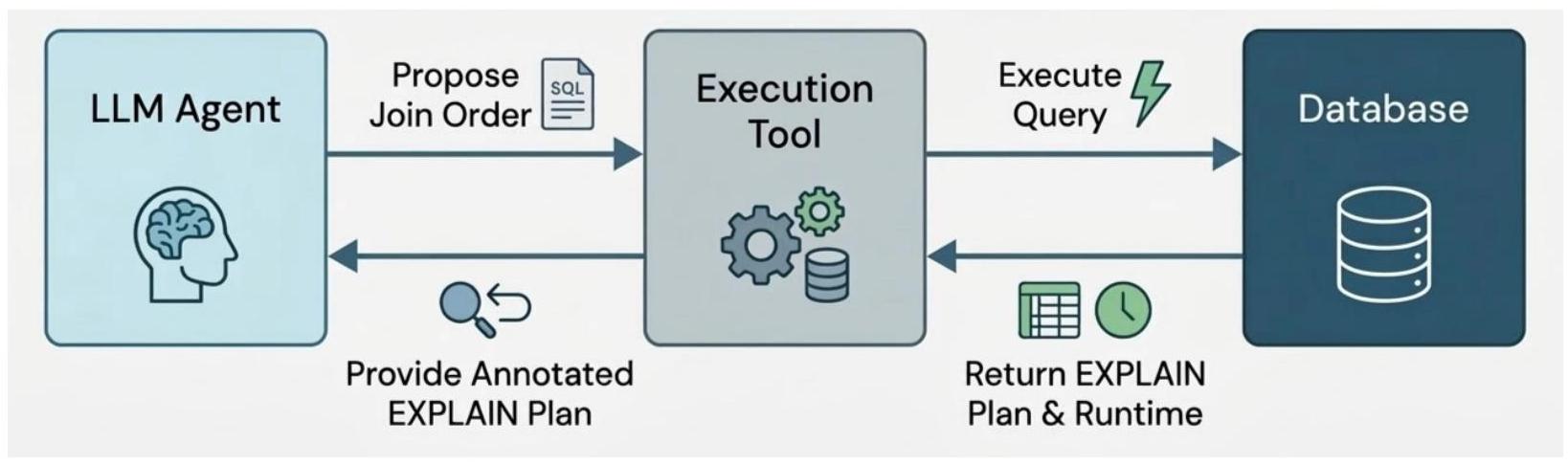
The research outlines a prototype LLM agent that operates through a self-correcting loop: proposing a join order, executing the query, analyzing post-execution statistics, and repeating the process. This iterative feedback mechanism allows the agent to learn and adapt, outperforming conventional optimization methods. On a scaled-up join order benchmark (JOB), the agent achieved significantly better wall-clock results, surpassing default join orders, perfect cardinality estimates, and even state-of-the-art machine learning search techniques. Notably, the agent improved query performance in 80% of cases over 10-20 iterations, with one specific example (Query 5b) demonstrating a remarkable 79% speedup. This empirical evidence validates the practical efficacy of LLMs in a highly technical and performance-critical domain.
Looking forward, the implications of LLM agents mastering such intricate system-level optimizations are far-reaching. This success suggests a future where AI agents could autonomously manage and optimize a broader spectrum of IT operations, from network routing to cloud resource allocation, reducing the need for human intervention and specialized expertise. However, understanding the "thought process" of these LLMs remains a critical area of research; discerning whether they exploit domain knowledge, execute guided search, or overfit training data is crucial for building trust and ensuring reliability in production environments. The challenge lies in developing transparent and explainable AI systems that can justify their optimization decisions, especially as they integrate into mission-critical infrastructure.
Visual Intelligence
flowchart LR
    A["Propose Join Order"] --> B["Execute Query"]
    B --> C["Analyze Statistics"]
    C --> A
Auto-generated diagram · AI-interpreted flow
Impact Assessment
This research highlights a practical application of LLMs beyond natural language, directly impacting database performance and efficiency. It suggests a future where AI agents autonomously optimize complex system operations, reducing manual tuning and improving resource utilization.
Key Details
- ● LLM agents iteratively optimize SQL join orderings.
- ● A prototype agent achieved significantly better wall-clock results on a scaled-up join order benchmark (JOB).
- ● The agent outperformed default plans in 80% of cases over 10-20 iterations.
- ● One case study (Query 5b) showed a 79% speedup in execution time.
- ● The agent's loop involves proposing, executing, and analyzing query plans.
Optimistic Outlook
The ability of LLMs to autonomously optimize SQL queries could lead to substantial performance gains in database systems, reducing operational costs and improving data access speeds. This opens doors for LLM agents to manage and optimize other complex IT infrastructure components, ushering in more self-managing systems.
Pessimistic Outlook
Relying on LLMs for critical database optimization introduces a 'black box' element, making it challenging to debug or understand suboptimal decisions. The iterative execution process could be resource-intensive, and potential for errors in complex, unseen queries might lead to performance degradation or data integrity issues.
Get the next signal in your inbox.
One concise weekly briefing with direct source links, fast analysis, and no inbox clutter.
More reporting around this signal.
Related coverage selected to keep the thread going without dropping you into another card wall.