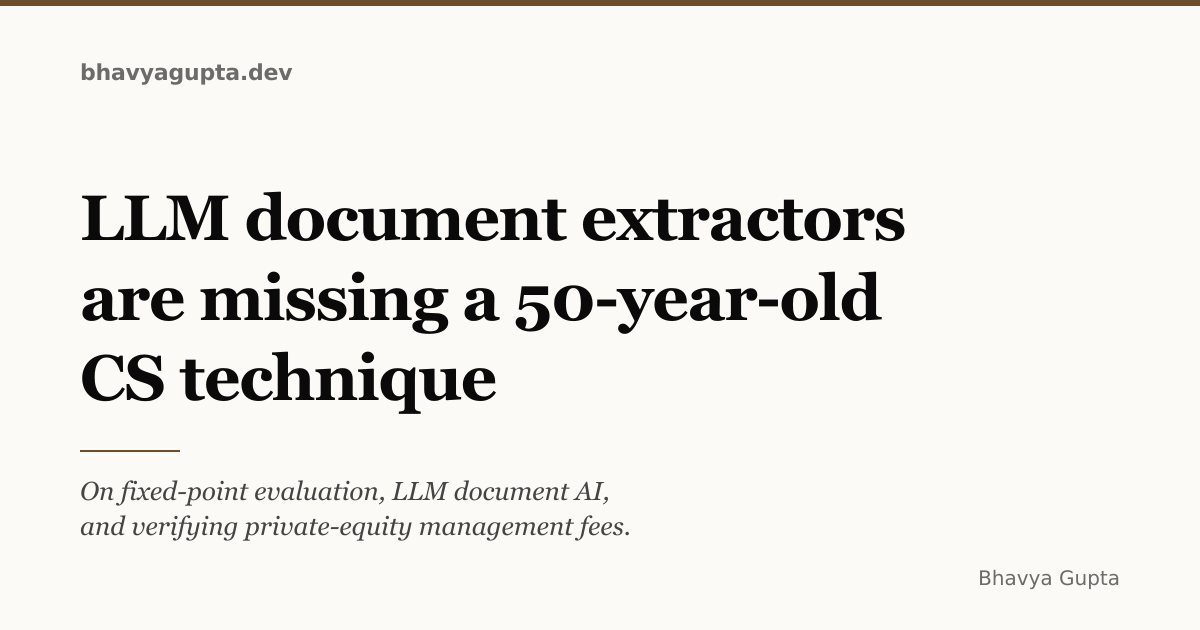
LLM-First Document AI Overlooks 50-Year-Old CS Technique
Sonic Intelligence
LLM-first document AI systems fail on cross-references.
Explain Like I'm Five
"Imagine you have many rule books, and some rules in one book change how rules in another book work. Smart computer programs (LLMs) are good at reading one book at a time, but they get confused when rules jump between books. This means they can make big mistakes when trying to figure out things like how much money someone owes."
Deep Intelligence Analysis
Traditional LLM document systems typically follow an 'extract-then-apply' pattern, where an LLM extracts data points from a single document, which are then validated and stored. Even advanced Retrieval-Augmented Generation (RAG) systems, while improving retrieval, maintain this local perspective, feeding an LLM relevant chunks without providing a mechanism for it to execute clauses against each other in a dependency order. This approach misses the crucial 50-year-old computer science technique of dependency graph analysis or rule-based inference, which is essential for understanding how changes in one document (e.g., an investment period extension) propagate and alter the meaning or application of clauses in others (e.g., fee caps or waivers). The financial implications are substantial, with potential errors ranging from low six figures to seven figures on large commitments.
Moving forward, the industry must pivot towards hybrid architectures that integrate LLMs with robust symbolic AI techniques capable of modeling and executing complex dependencies. This could involve using LLMs for initial extraction and semantic understanding, but then feeding these extracted facts into a knowledge graph or a rule-based inference engine that can track and evaluate inter-document relationships. The challenge is to combine the LLM's natural language understanding prowess with the deterministic, systemic reasoning capabilities of traditional computer science. Without this shift, LLM-first document AI will remain a powerful tool for isolated data extraction but a liability for high-stakes, interconnected analytical tasks.
Visual Intelligence
flowchart LR
  A[Document Corpus] --> B[LLM Extract]
  B --> C[Local Data]
  C --> D{Cross Reference?}
  D -- No --> E[Database Write]
  D -- Yes --> F[Error Potential]
  F --> G[Human Intervention]
Auto-generated diagram · AI-interpreted flow
Impact Assessment
Current LLM-first document processing approaches are fundamentally flawed for complex, interconnected document sets, leading to significant financial errors in critical applications like private equity fee verification. This highlights a gap in AI's ability to handle systemic dependencies.
Key Details
- LLM-first document AI systems often fail to correctly process cross-references and dependencies.
- The issue stems from treating each document as a self-contained unit, ignoring global context.
- A human reading multiple documents can identify clause dependencies, unlike current LLM methods.
- Naive LLM extraction patterns involve `llm.extract(doc, schema)` and `database.write(validated)`.
- RAG systems, while smarter in retrieval, still treat document chunks locally, not globally for clause evaluation.
Optimistic Outlook
Recognizing this limitation can drive innovation towards hybrid AI systems that combine LLM capabilities with traditional computational logic and graph-based representations. This could lead to more robust and reliable document AI solutions for complex legal and financial analysis.
Pessimistic Outlook
The inherent architectural limitations of current LLM-first approaches, which prioritize local context over global systemic understanding, pose a significant barrier. Without a fundamental shift, these systems will continue to produce errors in high-stakes environments, potentially leading to substantial financial losses and eroded trust.
Get the next signal in your inbox.
One concise weekly briefing with direct source links, fast analysis, and no inbox clutter.
More reporting around this signal.
Related coverage selected to keep the thread going without dropping you into another card wall.