MathNet: New 30K Problem Benchmark Challenges AI Mathematical Reasoning
Sonic Intelligence
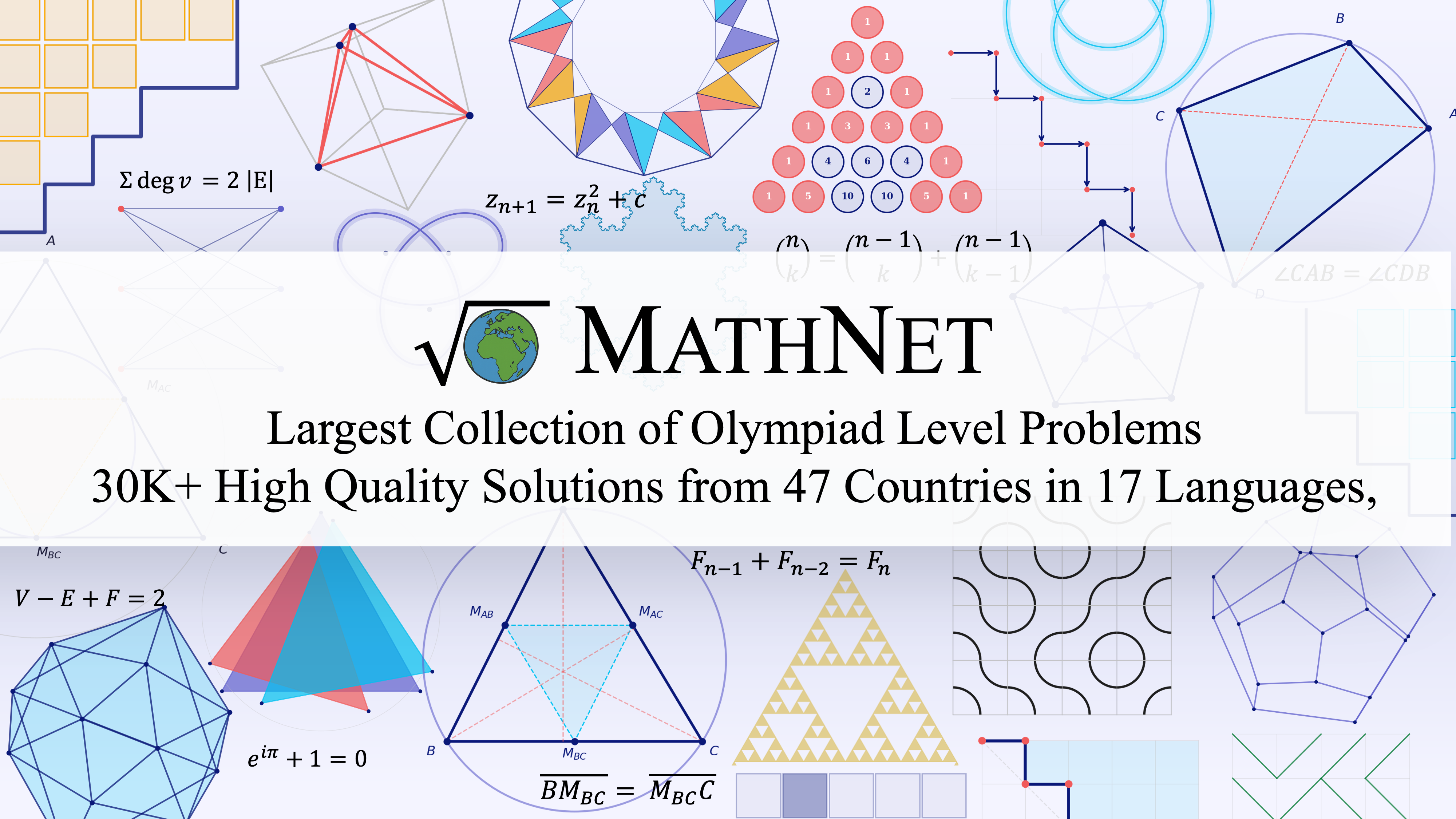
MathNet introduces 30,676 Olympiad-level math problems to benchmark AI reasoning.
Explain Like I'm Five
"Imagine you have super-smart robots that can talk and answer questions. We've given them a giant book of really hard math puzzles, like the ones smart kids solve in competitions. This book, called MathNet, has over 30,000 puzzles from all over the world. Even the smartest robots can only solve about 7 or 8 out of 10 puzzles, and they're really bad at finding similar puzzles. This shows that even though they're smart, they still have a lot to learn about really tricky math."
Deep Intelligence Analysis
MathNet supports three critical tasks: direct problem solving, math-aware retrieval of equivalent problems, and retrieval-augmented problem solving. Experimental results are telling: while leading models like Gemini-3.1-Pro achieve a respectable 78.4% in problem solving, and GPT-5 69.3%, their performance on retrieval tasks is notably poor, with embedding models showing Recall@1 below 5%. This stark contrast highlights a critical deficiency: current AI excels at pattern matching and generating plausible solutions when the problem is directly presented, but struggles profoundly with abstract mathematical equivalence and contextual retrieval. The observation that Retrieval-Augmented Generation (RAG) performance is highly sensitive to retrieval quality, with DeepSeek-V3.2-Speciale gaining up to 12% with good retrieval, underscores the bottleneck.
The implications for AI development are substantial. MathNet provides a clear roadmap for advancing AI beyond superficial understanding to genuine mathematical intelligence. Future research must prioritize improving mathematical retrieval mechanisms and developing models that can deeply comprehend and generalize abstract mathematical concepts, rather than merely processing symbols. The current struggle with Olympiad-level problems suggests that AI is still far from achieving human-level reasoning in complex domains, necessitating a paradigm shift in architectural design and training methodologies to bridge this critical gap. This benchmark will drive innovation towards more robust, context-aware, and truly intelligent mathematical AI systems.
Visual Intelligence
flowchart LR
A["MathNet Dataset (30k Problems)"]
A --> B["Problem Solving Task"]
A --> C["Math-Aware Retrieval Task"]
A --> D["Retrieval-Augmented Solving"]
B --> E["LLM Performance (e.g., Gemini 78.4%)"]
C --> F["Embedding Model Performance (<5% Recall)"]
D --> G["RAG Performance (e.g., DeepSeek +12%)"]
E & F & G --> H["Identifies AI Reasoning Gaps"]
Auto-generated diagram · AI-interpreted flow
Impact Assessment
MathNet provides a critical, large-scale, and multilingual benchmark for evaluating advanced mathematical reasoning in AI, exposing significant limitations in current state-of-the-art models. Its focus on Olympiad-level problems and retrieval tasks pushes the boundaries of AI capabilities beyond simple arithmetic, highlighting the need for more sophisticated reasoning and retrieval mechanisms.
Key Details
- MathNet dataset contains 30,676 expert-authored Olympiad-level math problems with solutions.
- Spans 47 countries, 17 languages, and two decades of competitions.
- Supports three tasks: Problem Solving, Math-Aware Retrieval, and Retrieval-Augmented Problem Solving.
- State-of-the-art models like Gemini-3.1-Pro achieve 78.4% in problem solving, GPT-5 69.3%.
- Embedding models show Recall@1 below 5% for retrieval tasks.
- DeepSeek-V3.2-Speciale achieves up to 12% gains with good RAG quality.
Optimistic Outlook
The release of MathNet will accelerate research into more robust mathematical reasoning and retrieval capabilities for LLMs. By clearly identifying current weaknesses, it provides a roadmap for developing next-generation AI models that can tackle complex, multi-step mathematical problems, potentially unlocking new applications in scientific discovery and engineering.
Pessimistic Outlook
Despite impressive performance on some benchmarks, MathNet reveals that even leading AI models struggle significantly with high-level mathematical reasoning and, critically, with retrieving mathematically equivalent problems. This indicates a fundamental gap in their ability to generalize and understand abstract mathematical concepts, suggesting that true human-level mathematical intelligence remains a distant goal.
Get the next signal in your inbox.
One concise weekly briefing with direct source links, fast analysis, and no inbox clutter.
More reporting around this signal.
Related coverage selected to keep the thread going without dropping you into another card wall.