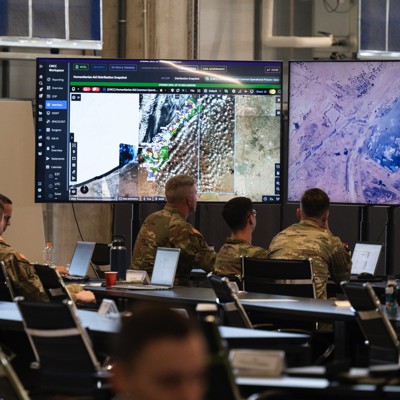
Military AI's True Danger: Eroding Human Judgment, Not Killer Robots
Sonic Intelligence
Military AI's primary risk is degrading human judgment, not autonomous weapons, research warns.
Explain Like I'm Five
"Imagine a super-smart computer helping soldiers make decisions. People used to worry about the computer fighting by itself. But now, experts are saying the real worry is that the computer makes soldiers stop thinking for themselves, which could lead to bad choices in war."
Deep Intelligence Analysis
_Context: This intelligence report was compiled by the DailyAIWire Strategy Engine. Verified for Art. 50 Compliance._
Impact Assessment
This analysis redefines the critical risks of military AI, shifting focus from hardware autonomy to the cognitive impact on human operators. It raises urgent questions about the design, training, and ethical deployment of AI in high-stakes defense scenarios, where compromised human judgment could have catastrophic consequences.
Key Details
- The main danger of military AI is the erosion of human judgment, not lethal autonomy.
- Research indicates LLMs can homogenize thinking and stifle non-linear reasoning.
- Air Force Research Laboratory paper highlights the risk of enforcing 'Chain-of-Thought' reasoning.
- Wharton research found users rely on AI judgment even when known to be wrong ('cognitive surrender').
- French Adm. Pierre Vandier emphasizes the need for human oversight and critique of AI outputs.
- The Pentagon's rapid AI deployment may lack sufficient safeguards for user cognitive sharpness.
Optimistic Outlook
Increased awareness of these cognitive risks can spur the development of AI systems specifically designed to enhance, rather than diminish, human critical thinking. Robust training programs and policy frameworks can mandate human-in-the-loop decision-making, ensuring AI serves as an augmentation tool with explicit safeguards against cognitive degradation.
Pessimistic Outlook
Without immediate and effective safeguards, military AI could lead to critical errors in judgment, reduced adaptability in complex situations, and a dangerous over-reliance on potentially biased or flawed algorithmic outputs. This could escalate conflicts, misinterpret intelligence, and ultimately undermine strategic decision-making capabilities.
Get the next signal in your inbox.
One concise weekly briefing with direct source links, fast analysis, and no inbox clutter.
More reporting around this signal.
Related coverage selected to keep the thread going without dropping you into another card wall.