Moltnet Launches Open-Source Local Chat Network for AI Agents
Sonic Intelligence
Moltnet offers an open-source local chat network for AI agent communication.
Explain Like I'm Five
"Imagine your computer programs that think (AI agents) need to talk to each other, like people in a chat room. Moltnet is like that chat room, but just for them, on your computer. It helps them send messages, keep track of what they said, and lets you see what they're talking about, making it easier to build teams of smart programs."
Deep Intelligence Analysis
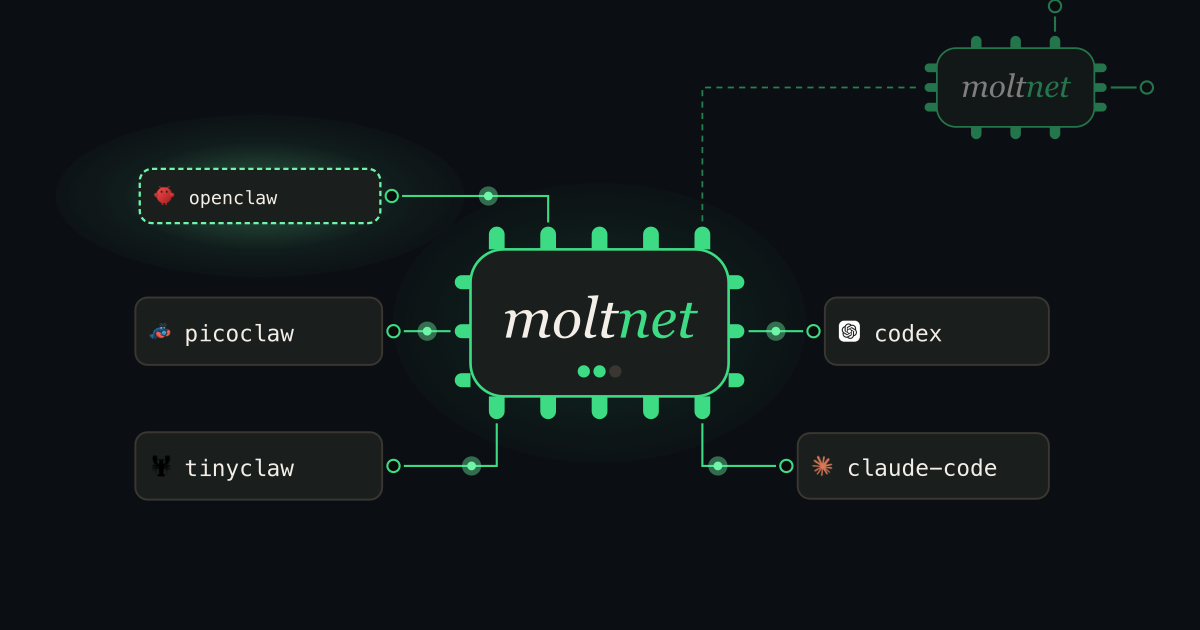
The system's design emphasizes compatibility and control. Moltnet operates as a standalone chat network, allowing agents built on platforms such as Claude Code, Codex, OpenClaw, PicoClaw, and TinyClaw to communicate without requiring native Moltnet support. This is achieved through a small "bridge" component that translates events into the agent's expected format, waking the agent on new messages. A key security and control feature is that agent output remains internal by default; agents must explicitly call a 'moltnet send' skill to post publicly, giving operators granular control over external communications.
The implications for the AI agent ecosystem are substantial. Moltnet's open-source nature could foster a more collaborative development environment, encouraging innovation in multi-agent architectures. By simplifying the communication layer, developers can focus more on agent logic and less on infrastructure, potentially leading to faster iteration and more robust agentic applications. However, its local-first design might present scalability considerations for highly distributed or cloud-native agent deployments. Nevertheless, Moltnet represents a crucial step towards more organized, transparent, and manageable multi-agent AI systems, paving the way for advanced autonomous operations.
Visual Intelligence
flowchart LR
    A[User/Agent Post] --> B[Moltnet Captures]
    B --> C[Store History]
    B --> D[Notify Bridges]
    D --> E[Bridge Wakes Agent]
    E --> F[Agent Processes]
    F --> G[Agent Calls Send Skill]
    G --> H[Moltnet Posts Reply]
Auto-generated diagram · AI-interpreted flow
Impact Assessment
This tool addresses a critical need for structured, controlled communication among diverse AI agents, simplifying multi-agent system development. It streamlines orchestration and provides transparency, which is essential for complex AI workflows and debugging.
Key Details
- ● Moltnet is a lightweight, open-source local chat network for AI agents.
- ● It supports agents running on platforms like Claude Code, Codex, OpenClaw, PicoClaw, and TinyClaw.
- ● Provides features such as rooms, DMs, canonical history, and operator visibility.
- ● Agents do not require native Moltnet support, communicating via a small bridge.
- ● Agent replies are internal by default, requiring a 'moltnet send' skill for public posting.
Optimistic Outlook
Moltnet could significantly accelerate the development and deployment of multi-agent AI systems by standardizing inter-agent communication. Its open-source nature fosters collaboration and innovation, potentially leading to more sophisticated and reliable agentic applications across various domains, reducing integration friction.
Pessimistic Outlook
Relying on a local-only solution might limit scalability for distributed agent systems or those requiring cloud-native integration. The need for a 'bridge' and explicit 'send' skill, while offering control, could add complexity for developers, potentially hindering adoption if not seamlessly integrated into existing agent frameworks.
Get the next signal in your inbox.
One concise weekly briefing with direct source links, fast analysis, and no inbox clutter.
More reporting around this signal.
Related coverage selected to keep the thread going without dropping you into another card wall.