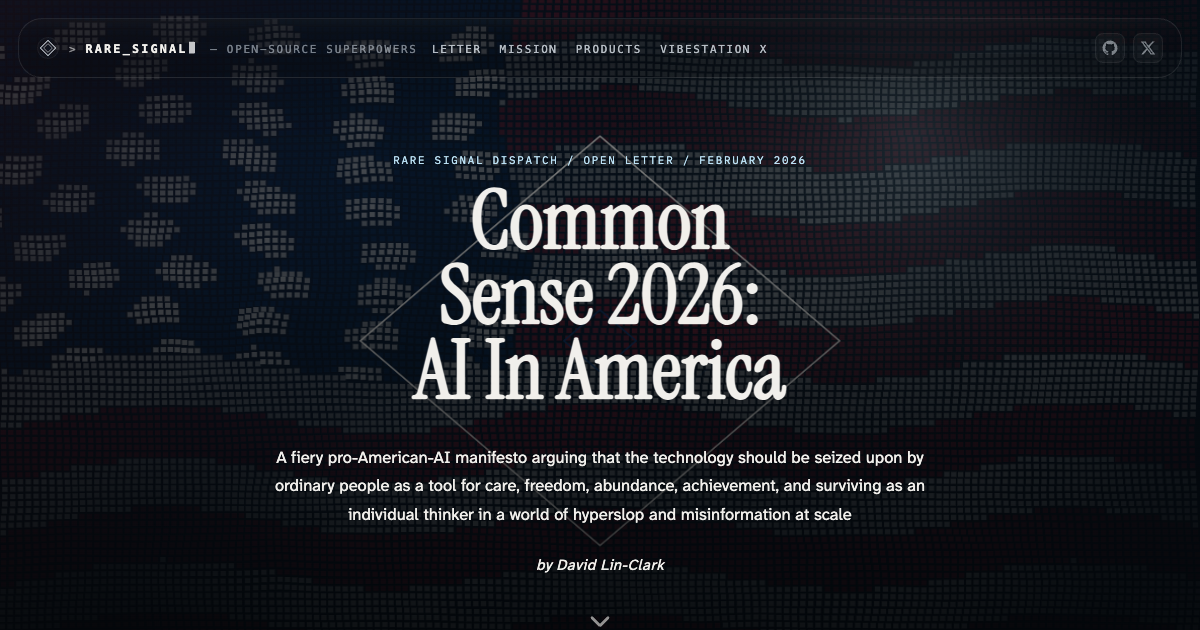
Open Letter Outlines AI's Transformative Role in America by 2026
Sonic Intelligence
The Gist
An open letter frames AI as a civic inheritance for America by 2026.
Explain Like I'm Five
"Imagine a very smart robot that can build other robots. This letter says by 2026, these super-smart robots will be able to do almost anything on a computer, like clicking buttons and fixing problems, making our jobs easier. It's like a big pep talk for America to use these robots to make our country better, healthier, and freer, just like our grandparents built amazing things for us."
Deep Intelligence Analysis
The letter's core premise rests on the prediction that by late 2025, major AI laboratories will have developed systems capable of autonomous computer interaction—specifically, the ability to 'click, build, test, iterate.' This capability is posited as a transformative threshold, shifting AI development from a scientific question mark to an engineering problem on a defined timeline. Consequently, the 'new labor stack' is envisioned where human judgment, imagination, and instruction become the scarce and most valuable resources, directing highly leveraged AI systems. This redefinition of work and value is central to the letter's argument for proactive national engagement.
Forward-looking implications suggest a call to action for America to harness its technological prowess to lead in the AI era, shaping systems around principles of truth, goodness, and freedom. The letter implicitly argues that the nation's historical context and existing technological assets position it uniquely to navigate this transition. However, the broad, aspirational nature of the letter, while inspiring, lacks concrete policy prescriptions or detailed implementation roadmaps. Its impact will likely depend on its ability to catalyze high-level strategic discussions and influence public sentiment, rather than providing immediate, actionable directives for AI governance or development.
_Context: This intelligence report was compiled by the DailyAIWire Strategy Engine. Verified for Art. 50 Compliance._
Impact Assessment
This open letter provides a high-level strategic vision for AI's integration into American society and economy by 2026. It reframes AI from a niche product cycle to a national asset and democratic imperative, aiming to influence policy and public perception regarding its societal and economic impact.
Read Full Story on RaresignalKey Details
- ● The 'Common Sense 2026: AI In America' open letter was dictated over two months.
- ● It predicts that by late 2025, major labs will ship AI capable of using computers to 'click, build, test, iterate'.
- ● The letter posits a 'new labor stack' where human judgment and instruction become primary resources.
- ● It frames AI as a 'civic inheritance' and a 'democratic mission' for America.
Optimistic Outlook
The letter's optimistic framing could galvanize national efforts to harness AI for societal benefit, promoting innovation in health, freedom, and abundance. By positioning AI as a 'civic inheritance,' it encourages a collective, proactive approach to shaping its development and deployment for the public good.
Pessimistic Outlook
The highly aspirational and philosophical nature of the letter, with its broad predictions and lack of concrete policy proposals, risks being dismissed as overly optimistic or lacking actionable guidance. Without specific implementation strategies, its call to action may fail to translate into tangible policy or industry shifts, leaving critical challenges unaddressed.

The Signal, Not
the Noise|
Join AI leaders weekly.
Unsubscribe anytime. No spam, ever.
Generated Related Signals

UK Legislation Quietly Shaped by AI, Raising Sovereignty Concerns
AI-generated text has quietly entered British legislation, sparking concerns over national sovereignty and control.

Digital Provenance: The Fight Against AI-Generated Disinformation
New standards and tools are emerging to verify digital media authenticity.

Pentagon AI Standoff: Conflicting Rulings Trap Anthropic in Supply-Chain Limbo
Conflicting court rulings leave Anthropic designated a Pentagon supply-chain risk.

Deconstructing LLM Agent Competence: Explicit Structure vs. LLM Revision
Research reveals explicit world models and symbolic reflection contribute more to agent competence than LLM revision.
Qualixar OS: The Universal Operating System for AI Agent Orchestration
Qualixar OS is a universal application-layer operating system designed for orchestrating diverse AI agent systems.

Factagora API: Grounding LLMs with Real-time Factual Verification
Factagora launches an API providing real-time factual verification to prevent LLM hallucinations.