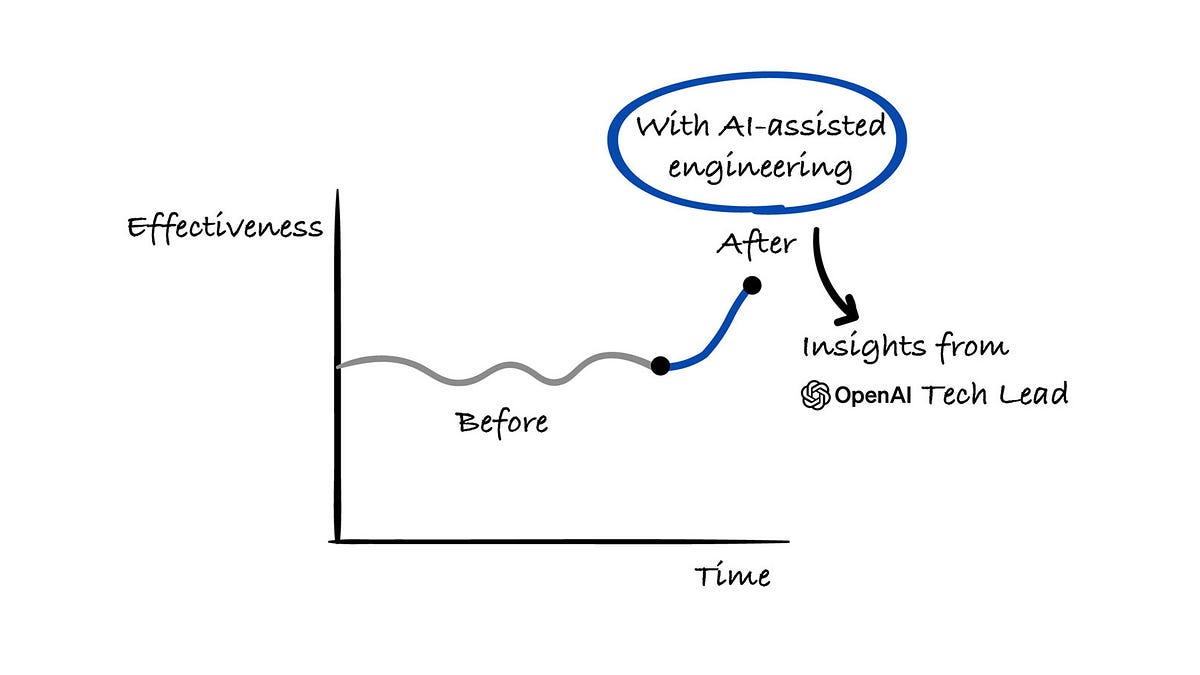
OpenAI Codex Tech Lead Leverages Simple AI-Assisted Engineering Workflow
Sonic Intelligence
OpenAI's Codex Tech Lead uses simple AI for engineering.
Explain Like I'm Five
"A top engineer at OpenAI uses AI to help write computer code, but he doesn't use fancy tricks. He just tells the AI what he wants, it writes some code, and then he checks it. This makes writing programs faster and easier."
Deep Intelligence Analysis
This workflow, championed by an engineer with a distinguished background at Meta and Google, highlights a pragmatic application of AI as a productivity tool rather than a replacement for human intellect. The emphasis on 'clear thinking, good judgment, and fast iteration' suggests that AI serves as an intelligent co-pilot, not an autonomous agent. This context is vital for organizations considering AI adoption; it indicates that successful integration hinges less on mastering intricate AI tools and more on refining the human-AI interaction loop. The ability to quickly generate initial code based on a clear spec allows for rapid prototyping and iteration, which can significantly compress development cycles.
Looking ahead, the simplicity and effectiveness of this model could become a blueprint for broader AI adoption in software development. It implies that the future of engineering will increasingly involve engineers acting as architects and reviewers, leveraging AI for the heavy lifting of code generation. This shift will necessitate a greater emphasis on clear specification writing, robust testing, and critical code review skills, while potentially de-emphasizing rote coding. The challenge will be to scale this efficient human-AI collaboration across larger teams and more complex projects, ensuring that the speed gains do not come at the expense of code quality, security, or maintainability.
Visual Intelligence
flowchart LR
    A[Engineer Writes Spec] --> B[Simple AI Prompt]
    B --> C[AI Generates Code]
    C --> D[Engineer Reviews Code]
    D --> E[Fast Iteration]
Auto-generated diagram · AI-interpreted flow
Impact Assessment
This insight from a leading AI engineer demonstrates that effective AI integration in software development doesn't require overly complex workflows. It highlights the power of AI as a force multiplier for experienced engineers, streamlining mundane tasks and accelerating development cycles through intelligent code generation and review.
Key Details
- Michael Bolin, Tech Lead for OpenAI's Codex open-source repo, employs a straightforward AI-assisted engineering workflow.
- His process involves writing a specification, providing a simple prompt to AI, and then reviewing the generated code.
- Bolin previously worked at Meta and Google, contributing to Buck and Google Calendar.
- The workflow emphasizes clear thinking, good judgment, and fast iteration over complex AI procedures.
- The article details how this approach was used to build a permissions system within Codex CLI.
Optimistic Outlook
The simplicity of this workflow suggests that AI-assisted engineering can be widely adopted without extensive re-training, democratizing advanced development capabilities. It promises significant boosts in developer productivity, allowing engineers to focus on higher-level design and architectural challenges rather than boilerplate code.
Pessimistic Outlook
Over-reliance on simple AI prompts might lead to a decline in fundamental coding skills if engineers become less adept at writing code from scratch. It could also introduce subtle bugs or security vulnerabilities if the review process isn't rigorous enough, potentially leading to a false sense of productivity.
Get the next signal in your inbox.
One concise weekly briefing with direct source links, fast analysis, and no inbox clutter.
More reporting around this signal.
Related coverage selected to keep the thread going without dropping you into another card wall.