Opinion: Embracing AI for Text Composition in Writing, With Disclosure
Sonic Intelligence
An opinion piece argues for accepting AI in text composition, emphasizing the need for disclosure.
Explain Like I'm Five
"Imagine you have homework to write a story. Some people say it's okay to use a computer to check your spelling or find facts. This article says it should also be okay to use the computer to help you write the actual sentences, as long as you tell everyone you used the computer's help. It's like using a fancy tool, but you still need to be honest about it."
Deep Intelligence Analysis
The controversy highlights a fundamental tension between traditional notions of authorship and the capabilities of advanced AI. Critics, including a Rutgers philosophy professor, have reacted strongly to admissions of AI use, suggesting severe professional repercussions. However, the proponent argues that such criticisms often fail to distinguish AI from other widely accepted technological aids, such as word processors or spell checkers. The key verifiable facts include the public criticism faced by Megan McArdle for using AI for tasks like transcription and argument analysis, and the author's assertion that the only ethical breach occurs through non-disclosure. This frames the debate not as a question of whether AI *can* write, but under what conditions its output can be ethically integrated into human-authored work.
The forward-looking implications for publishing, journalism, and creative industries are significant. Should a disclosure-based model become widely accepted, it could lead to a redefinition of authorship, where human-AI collaboration is acknowledged as a valid creative process. This could empower a broader range of voices, reduce production bottlenecks, and potentially foster new genres of content. Conversely, a lack of clear, universally adopted disclosure standards could erode public trust in media and literature, making it increasingly difficult for audiences to discern authentic human expression from machine-generated content. The industry must now grapple with establishing clear guidelines that balance innovation with integrity, ensuring that the benefits of AI are harnessed responsibly without compromising the foundational values of creative and journalistic endeavor.
Impact Assessment
The debate over AI's role in creative and professional writing highlights evolving ethical standards and the definition of authorship. This discussion is crucial for establishing guidelines for transparency and maintaining trust between creators and their audience in an AI-augmented world.
Key Details
- ● The author argues for accepting AI use in writing, including text composition, beyond research and spell-checking.
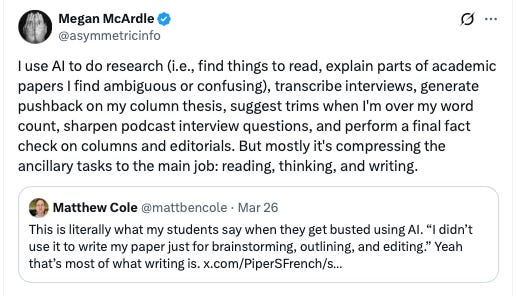
- ● Washington Post columnist Megan McArdle faced criticism for using AI for tasks like transcription, argument analysis, and fact-checking.
- ● Critics suggested McArdle was "outsourcing her thinking."
- ● The author asserts that AI use is unethical only if undisclosed to readers and publishers.
- ● The author encourages publications to avoid blanket bans on AI text composition for writers who need it.
Optimistic Outlook
Embracing AI for text composition, especially with clear disclosure, could democratize writing, empowering individuals with varying skill levels to articulate their ideas more effectively. It could enhance productivity, allow writers to focus on conceptual depth, and potentially lead to new forms of collaborative human-AI creativity, expanding the scope and diversity of published content.
Pessimistic Outlook
Widespread, even disclosed, AI-assisted text composition could devalue human authorship and critical thinking skills, potentially leading to a flood of homogenized content. Readers might lose trust in the authenticity of written works, and the pressure to disclose could create a stigma, hindering adoption even where beneficial, ultimately eroding the perceived value of human intellectual effort.
Get the next signal in your inbox.
One concise weekly briefing with direct source links, fast analysis, and no inbox clutter.
More reporting around this signal.
Related coverage selected to keep the thread going without dropping you into another card wall.