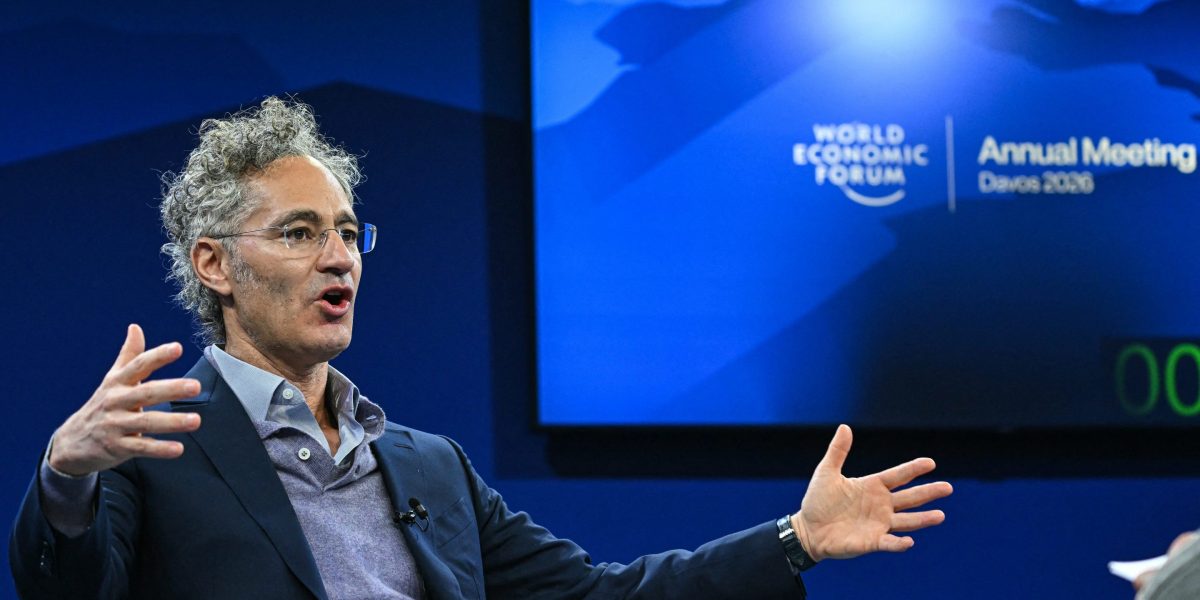
Palantir CEO Predicts AI Will Devastate Humanities Jobs, Advocates Vocational Skills
Sonic Intelligence
Palantir CEO Alex Karp predicts AI will eliminate humanities jobs, favoring vocational skills.
Explain Like I'm Five
"The boss of a big AI company thinks that soon, computers will be so good at thinking and writing that jobs for people who studied things like history or philosophy will disappear. He thinks it will be better to learn a specific trade, like plumbing or coding, or to have a very unique way of thinking, to get a job in the future."
Deep Intelligence Analysis
Karp's argument extends beyond mere job displacement, suggesting a significant societal realignment where the economic power of "humanities trained, largely Democratic voters, and women" diminishes, while that of "vocationally trained, working class, often male voters" increases. This controversial framing highlights the potential for AI to not only reshape labor markets but also to exacerbate existing social and political divides. While other prominent business leaders, such as BlackRock's Robert Goldstein and McKinsey's Bob Sternfels, offer a counter-narrative, emphasizing the enduring value of liberal arts for creativity and non-linear problem-solving, Karp's company, Palantir, has actively championed vocational training through initiatives like its Meritocracy Fellowship, openly criticizing traditional universities.
The forward-looking implications are profound, potentially influencing educational policy, individual career choices, and the broader societal valuation of different skill sets. If Karp's predictions gain traction, there could be a significant shift towards vocational and STEM-focused education, possibly at the expense of the humanities. This raises critical questions about the kind of workforce and society we are building: one that prioritizes efficiency and specialized technical skills, or one that continues to value the critical thinking, ethical reasoning, and creative problem-solving traditionally fostered by a broader education. The ongoing dialogue underscores the urgent need for a nuanced understanding of AI's multifaceted impact on human capital and societal structures.
Impact Assessment
These provocative statements from a prominent AI industry leader highlight a growing, contentious debate about AI's profound impact on the future of work, education, and societal structures. Karp's predictions could significantly influence career choices, educational policy, and public discourse regarding human capital in an AI-driven economy.
Key Details
- Palantir CEO Alex Karp stated at the World Economic Forum that AI 'will destroy humanities jobs'.
- Karp believes individuals with 'generalized knowledge' from elite liberal arts backgrounds will struggle in the future job market.
- He identified vocational training or neurodivergence as the two primary paths to future job security.
- Karp also predicted AI's disruption would disproportionately affect 'humanities trained, largely Democratic voters, and women', while benefiting 'vocationally trained, working class, often male voters'.
- Other prominent CEOs, including BlackRock COO Robert Goldstein and McKinsey global managing partner Bob Sternfels, expressed differing views, still valuing liberal arts majors for creativity.
- Palantir launched a 'Meritocracy Fellowship' for high school students, criticizing traditional universities for 'indoctrinating' students.
Optimistic Outlook
Karp's predictions could spur a necessary re-evaluation of educational priorities, encouraging greater investment in vocational training and specialized skills that are more resilient to AI automation. This shift could ultimately lead to a more adaptable and economically secure workforce, better prepared for the evolving demands of the AI era.
Pessimistic Outlook
Such strong rhetoric risks devaluing critical thinking, creativity, and interdisciplinary skills often fostered by humanities education, potentially leading to a narrower, less innovative workforce. It could also exacerbate societal divisions based on educational background and perceived AI resilience, creating new forms of economic and social inequality.
Get the next signal in your inbox.
One concise weekly briefing with direct source links, fast analysis, and no inbox clutter.
More reporting around this signal.
Related coverage selected to keep the thread going without dropping you into another card wall.