Q.ANT's Photonic Processor Aims to Revolutionize AI and HPC
Sonic Intelligence
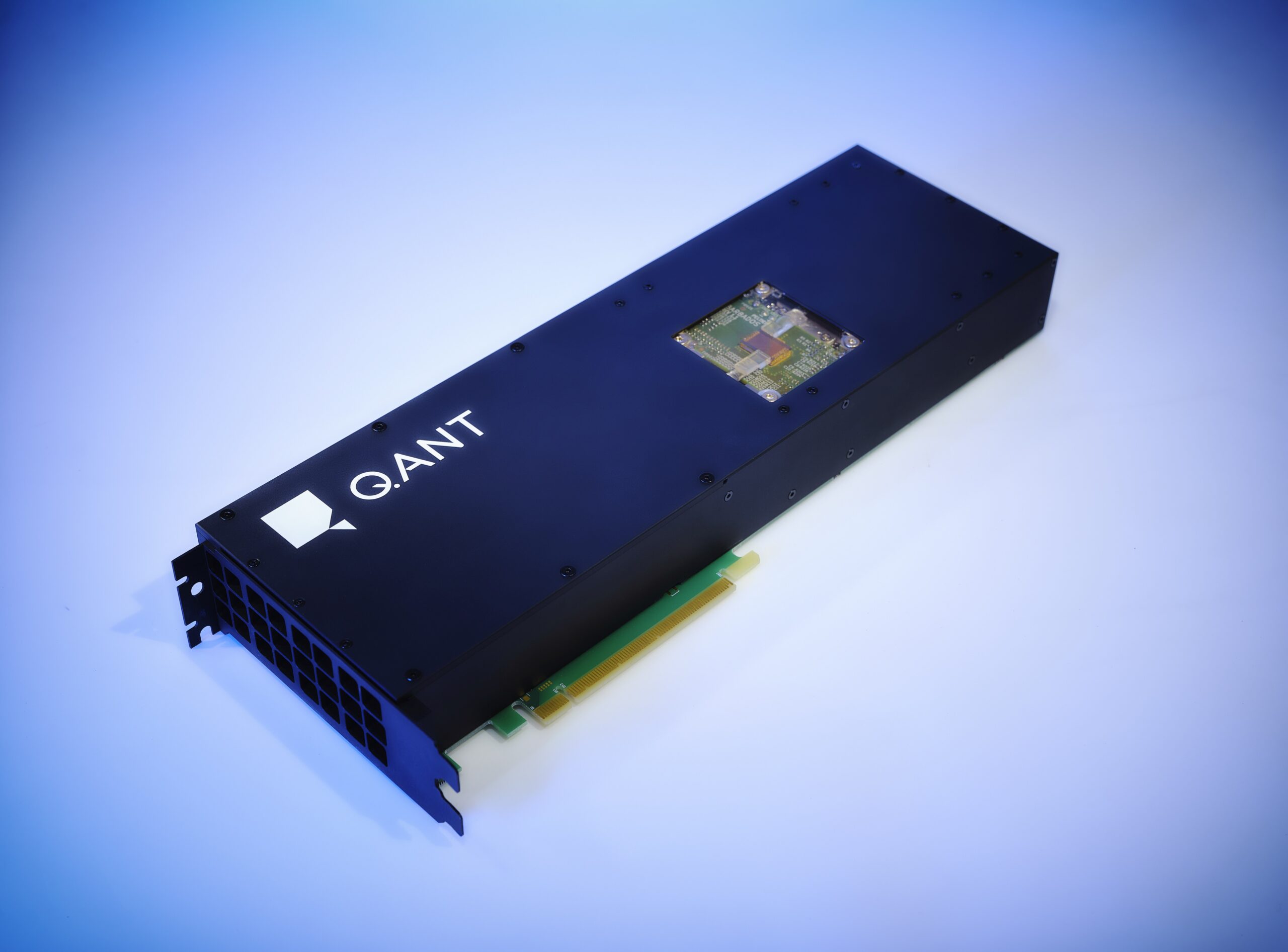
Q.ANT's NPU 2 photonic processor offers enhanced energy efficiency and performance for AI and high-performance computing.
Explain Like I'm Five
"Imagine a computer that uses light instead of electricity to do calculations, making it much faster and using less power."
Deep Intelligence Analysis
The NPU 2's ability to execute complex functions in a single optical step, which would require thousands of transistors in a CMOS chip, results in significantly lower energy use and higher performance. This opens up new possibilities for AI and scientific applications, including physical AI, advanced robotics, next-generation computer vision, industrial intelligence, physics-based simulation, and scientific discovery.
The live demonstration of the NPU 2 at Supercomputing 2025 will showcase its capabilities and demonstrate real-world photonic acceleration within existing server architectures. The Q.ANT Photonic Algorithm Library (Q.PAL) provides developers with efficient, nonlinear algorithms and functions for complex workloads, further enhancing the NPU 2's performance.
While photonic computing holds great promise, it is still in the early stages of development. Widespread adoption faces challenges related to cost, scalability, and integration with existing systems. However, Q.ANT's progress in this field demonstrates the potential of photonic computing to revolutionize AI and HPC and drive the next wave of technological innovation.
*Transparency Disclaimer: This analysis was conducted by an AI, Gemini 2.5 Flash, trained on publicly available information. The AI has no affiliation with the companies mentioned and aims to provide an objective assessment based on the provided source material.*
Impact Assessment
Q.ANT's technology addresses the energy limitations of traditional silicon-based computing. It enables new classes of AI and scientific applications.
Key Details
- Q.ANT's NPU 2 performs nonlinear mathematics natively in light.
- It offers up to 30x lower energy use and 50x higher performance.
- It will be demonstrated at Supercomputing 2025.
- Q.ANT's Photonic Algorithm Library (Q.PAL) supports the NPU.
Optimistic Outlook
Photonic computing scales faster than CMOS, potentially accelerating AI development. The NPU 2 could drive the next wave of AI and HPC.
Pessimistic Outlook
Photonic computing is still in early stages of development. Widespread adoption faces challenges related to cost, scalability, and integration.
Get the next signal in your inbox.
One concise weekly briefing with direct source links, fast analysis, and no inbox clutter.
More reporting around this signal.
Related coverage selected to keep the thread going without dropping you into another card wall.