Quantifying AI Task Completion Time: Insights into Frontier Model Progress
Sonic Intelligence
Research quantifies AI task completion time.
Explain Like I'm Five
"Imagine how long it takes a person to do a small job, like writing a short email. This research tries to figure out how long it takes a super-smart computer program (AI) to do similar small jobs, especially when it's not given extra help or step-by-step instructions. It helps us see how fast these AIs are getting at doing things humans do."
Deep Intelligence Analysis
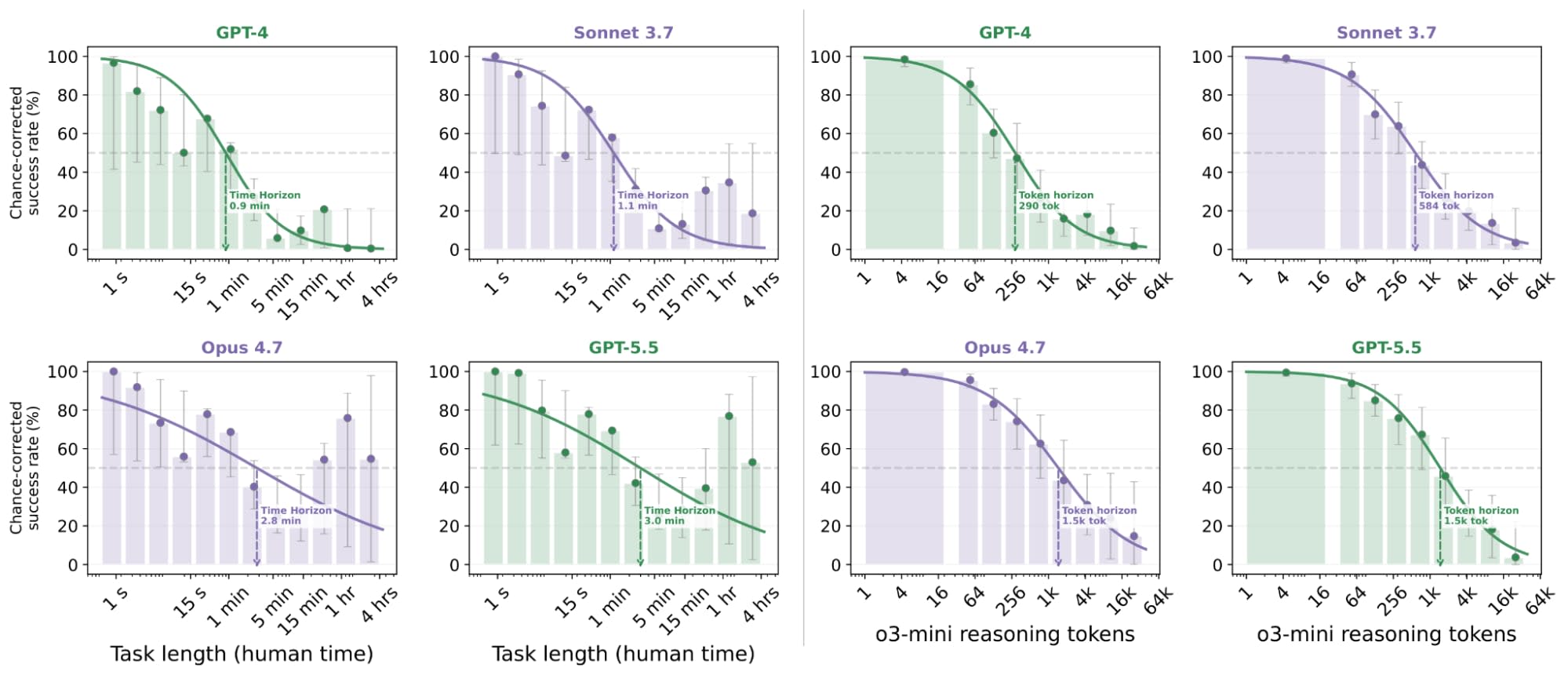
The methodology involves analyzing tasks where AI completion times are comparable to human performance, specifically within the 1-3 minute band, as these are most influential in regression analyses. The study acknowledges the challenge of data access for proprietary models like Claude and highlights the need for careful consideration of task selection, noting that certain outliers, such as 'vibe-coding sabotage' and 'SHADE monitor,' can significantly impact results. This detailed approach to measurement, including extracting accuracy numbers and visually analyzing human-time data, underscores a rigorous attempt to ground AI progress in tangible, time-based metrics.
This quantification of task completion time has significant implications for AI development and deployment. It provides a more practical lens for assessing the real-world utility of frontier models, guiding developers in optimizing for efficiency and identifying specific areas where AI can achieve human-competitive speeds. Furthermore, it offers valuable insights for policymakers and businesses in understanding the economic and societal impact of rapidly advancing AI capabilities, particularly in automating tasks. The focus on 'no-cot' scenarios also pushes the boundary of autonomous AI performance, indicating a trend towards models that can execute complex tasks with minimal human intervention.
Visual Intelligence
flowchart LR
    AI_Model(Frontier AI Model) --> Task_Completion(Task Completion)
    Task_Completion --> Time_Horizon(Time Horizon)
    Time_Horizon --> Inference_Scaling(Inference Scaling)
    Time_Horizon --> Human_Time_Comparison(Human Time Comparison)
    Task_Completion --> Progress_Quantification(Progress Quantification)
Auto-generated diagram · AI-interpreted flow
Impact Assessment
Understanding the time horizons for AI task completion provides a concrete metric for evaluating AI progress beyond traditional accuracy scores. This research helps quantify the practical utility and efficiency gains of frontier models, offering insights into their real-world deployment potential and the rate at which they approach human-level performance on specific tasks.
Key Details
- The paper quantifies the impact of inference scaling on AI progress.
- It estimates 'no-cot' task-completion time horizons for frontier AI models.
- The analysis considers tasks where AI completion time is comparable to human time (1-3 minutes).
- Outliers like 'vibe-coding sabotage' and 'SHADE monitor' are noted for their influence.
- The methodology involves extracting accuracy numbers and pixel-peeping figures for human-time data.
Optimistic Outlook
Quantifying task completion times offers a clear roadmap for AI development, allowing researchers to target specific bottlenecks and accelerate progress towards more efficient and capable models. This precision in measurement can lead to faster integration of AI into complex workflows, boosting productivity across various sectors.
Pessimistic Outlook
The reliance on specific tasks and data points might limit the generalizability of the findings, potentially overstating or understating overall AI progress. Without broader task coverage and transparent data, the insights might not fully capture the diverse capabilities and limitations of frontier models, leading to skewed perceptions of their readiness.
Get the next signal in your inbox.
One concise weekly briefing with direct source links, fast analysis, and no inbox clutter.
More reporting around this signal.
Related coverage selected to keep the thread going without dropping you into another card wall.