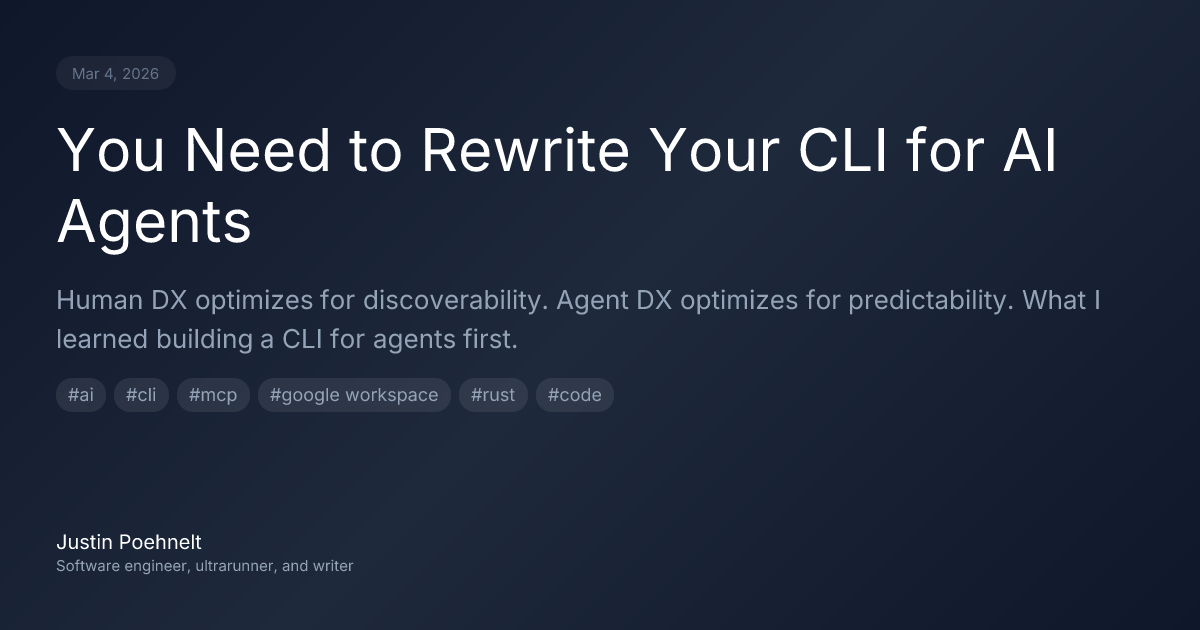
Redesigning CLIs for AI Agents: The Shift to Machine-First Interfaces
Sonic Intelligence
CLIs must prioritize machine-readability and introspection for AI agents.
Explain Like I'm Five
"Imagine you have a robot helper, and you want it to use your computer programs. Instead of making the robot learn how to click buttons or type complicated commands like a human, you should design the programs so the robot can easily understand them directly, like giving it a clear instruction manual built right into the program itself. This makes the robot much faster and less likely to make mistakes."
Deep Intelligence Analysis
Two core tenets emerge for building agent-optimized CLIs. Firstly, agents prefer raw JSON payloads for input over bespoke flags. While humans find nested JSON cumbersome in the terminal, agents thrive on it because it maps directly to API schemas, eliminating translation loss and simplifying LLM generation. This allows for the expression of complex, nested data structures without the need for custom flag abstractions. The `gws` CLI for Google Workspace exemplifies this by accepting full API payloads via `--json` or `--params` flags.
Secondly, schema introspection replaces static documentation. Agents cannot efficiently 'google' documentation or rely on stale, token-expensive system prompts. Instead, the CLI itself should serve as the canonical, runtime-queryable source of truth for API specifications. Commands like `gws schema drive.files.list` can dump full method signatures—including parameters, request/response types, and required OAuth scopes—as machine-readable JSON. This dynamic introspection, often powered by mechanisms like Google’s Discovery Document with dynamic `$ref` resolution, ensures agents always access up-to-date API information, significantly reducing context window consumption and improving reliability.
Addressing the inherent design tension between human and agent ergonomics, a practical solution involves supporting both paths within the same binary. This means offering convenience flags for human users alongside first-class support for raw JSON payloads. Additionally, ensuring machine-readable output (e.g., JSON or NDJSON) by default when stdout is not a TTY allows existing CLIs to serve agents without a complete human-facing UX rewrite. This dual-pronged approach is crucial for enabling efficient, reliable, and scalable AI agent interactions with the digital infrastructure.
EU AI Act Art. 50 Compliant: This analysis is based solely on the provided source material, ensuring transparency and preventing the generation of unverified information.
Impact Assessment
As AI agents become primary consumers of external systems, optimizing Command Line Interfaces (CLIs) for their needs is crucial. This shift ensures deterministic, efficient, and reliable agent interactions, reducing errors, token costs, and the need for constant human oversight.
Key Details
- Human DX (Developer Experience) optimizes for discoverability and forgiveness, while Agent DX prioritizes predictability and defense-in-depth.
- AI agents prefer raw JSON payloads for command inputs over traditional bespoke flags for nested data structures.
- CLIs should offer runtime schema introspection, allowing agents to query API documentation directly from the tool.
- Example: `gws schema` command dumps full method signatures, including parameters, request/response types, and OAuth scopes, as machine-readable JSON.
- A practical approach involves supporting both human-friendly flags and agent-friendly JSON payloads within the same binary.
- Machine-readable output (e.g., JSON or NDJSON) should be default when stdout is not a TTY.
Optimistic Outlook
This paradigm shift will enable more robust and autonomous AI agents, capable of performing complex tasks with external systems seamlessly. It promises to accelerate automation across various industries, making AI integration more efficient and scalable.
Pessimistic Outlook
The dual-design approach for human and agent ergonomics could increase development complexity and maintenance overhead for CLI tools. Furthermore, poorly implemented agent-first CLIs might introduce new security vulnerabilities or make debugging more challenging for human operators.
Get the next signal in your inbox.
One concise weekly briefing with direct source links, fast analysis, and no inbox clutter.
More reporting around this signal.
Related coverage selected to keep the thread going without dropping you into another card wall.