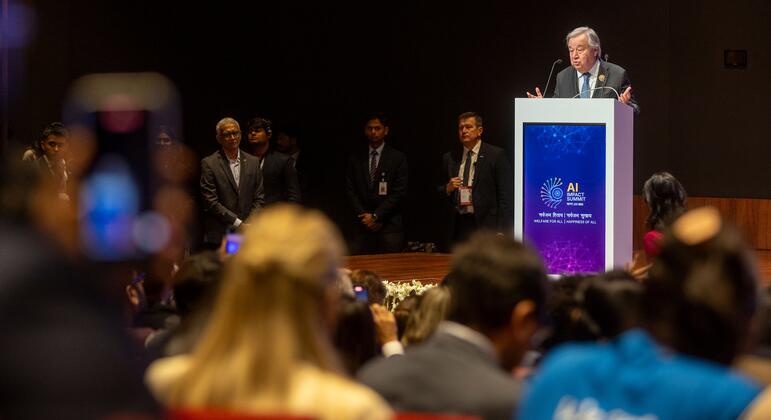
UN Chief Urges AI Experts for Global Clarity Amid Rapid Advancement
Sonic Intelligence
UN Secretary-General calls on 40 experts to provide independent AI assessments.
Explain Like I'm Five
"Imagine the world's boss, the UN chief, gathered 40 super-smart people to help everyone understand new, clever computer brains (AI). Their job is to explain how AI works, what it can do, and how to make sure it helps everyone fairly, so nobody gets scared or confused."
Deep Intelligence Analysis
The panel's primary objective is to bridge the 'AI knowledge gap' and conduct scientific assessments of the technology's real impact across economies and societies. This independent approach is crucial, as the experts are mandated to operate free from the influence of any government, company, or institution, including the United Nations itself. This ensures that their findings are grounded purely in science, not ideology, a point Guterres stressed as vital for fostering trust and preventing division.
Highlighting the rapid pace of AI advancement, Guterres warned that 'never in the future will we move as slow as we are moving now,' underscoring the urgency of the panel's mission. He also cautioned against the potential for misunderstanding and fear when facts are absent or distorted, especially in a time of rising geopolitical tensions. The stakes are incredibly high, as AI is poised to shape peace, security, human rights, and sustainable development for decades to come.
The panel is not starting from scratch, building on the work of another UN initiative, the High-Level Advisory Body on AI, which addresses policy-oriented issues. The inclusion of prominent figures like Nobel Laureate Maria Ressa among the 40 experts further solidifies the panel's credibility and potential impact. This initiative represents a significant global effort to ensure that AI's development is guided by shared understanding and responsible principles, aiming to create a level playing field for all countries.
Impact Assessment
This initiative establishes a crucial independent body to guide global AI understanding and policy, aiming to prevent fear and division by providing science-backed insights. It seeks to ensure AI development benefits humanity and addresses potential risks on a global scale, fostering a shared, scientific understanding.
Key Details
- UN Secretary-General António Guterres addressed the inaugural meeting of a new independent group of experts on Artificial Intelligence.
- The panel comprises 40 experts from diverse regions and disciplines.
- Their mandate is to close the 'AI knowledge gap' and assess the technology's impact across economies and societies.
- Experts will provide scientific assessments independent of any government, company, or institution, including the United Nations.
- Nobel Laureate Maria Ressa is among the 40 experts on the panel.
Optimistic Outlook
The formation of an independent, diverse expert panel offers a structured approach to understanding AI's complex impacts. This initiative could foster global consensus on responsible AI development, mitigating risks and maximizing societal benefits through shared, scientific understanding, thereby shaping peace, security, and sustainable development.
Pessimistic Outlook
Despite the urgency, the 'race against time' suggests that AI's rapid advancement might outpace the panel's ability to provide timely, actionable guidance. Geopolitical tensions could also hinder the adoption of unified recommendations, limiting the panel's ultimate effectiveness in achieving global clarity and preventing misunderstanding.
Get the next signal in your inbox.
One concise weekly briefing with direct source links, fast analysis, and no inbox clutter.
More reporting around this signal.
Related coverage selected to keep the thread going without dropping you into another card wall.



