AI's '3% Problem': Low Paid Adoption Masks Massive Economic & Societal Shifts
Sonic Intelligence
Despite low paid user penetration, AI is already reshaping global economies and labor markets.
Explain Like I'm Five
"Imagine a super-smart robot that can do lots of jobs. Right now, only a few people pay to use the super-robot, but even those few are making big changes in the world, like helping NASA or big banks. Soon, many more people might use these robots, which could make everything cheaper and faster, but also mean some people lose their jobs. It's like making more toys, but fewer people get to play with them."
Deep Intelligence Analysis
However, this limited paid adoption has not hindered AI's profound impact on critical sectors. Examples include NASA leveraging Claude AI to map a path for its Mars rover, the Norwegian sovereign wealth fund utilizing Claude for portfolio screening, and 16 Claude AI agents collaboratively writing a C compiler for a modest $20,000. Furthermore, the launch of agentic AI products like Claude Cowork has already demonstrated significant market disruption, wiping $285 billion from software market capitalization in weeks. These instances highlight that even with minimal deep user engagement, AI is already a powerful transformative force.
The article projects a future where AI penetration significantly increases, leading to a 'Post-AI World' characterized by agentic products such as Claude Cowork, OpenClaw, and OpenAI Frontier. These systems are designed to automate a vast array of daily tasks, from administrative duties to complex contract drafting. The economic implications are dual-edged: a massive uptick in GDP is anticipated due to improved production efficiency and lower input costs. However, a significant second-order effect is widespread job displacement as companies opt for AI subscriptions and APIs over human oversight. The third-order effect, termed 'Ghost GDP' by Citrini Research, posits that increased GDP output will be reinvested into running more AI agents, creating a theoretically higher GDP that does not translate into tangible benefits for humans or flow through the real economy.
The timeline for these shifts remains uncertain, with some experts, like Citadel Securities, predicting an S-curve adoption due to constraints in data center deployment and energy supply. However, the rapid influx of capital into AI and adjacent industries suggests an accelerated adoption curve as scale is achieved. The fundamental tension lies in the disconnect between GDP as a measure of output and its failure to reflect human well-being. As AI agents become more prevalent, societies will face the challenge of ensuring that economic growth translates into broad-based prosperity rather than concentrating benefits within the AI infrastructure itself.
Impact Assessment
The current low paid AI adoption rate belies its profound impact on critical sectors, from finance to space exploration. This early influence suggests an impending, more dramatic transformation of global economies and labor dynamics as adoption scales, potentially leading to unprecedented GDP growth alongside significant job displacement and a 'Ghost GDP' where economic benefits may not flow to human workers.
Key Details
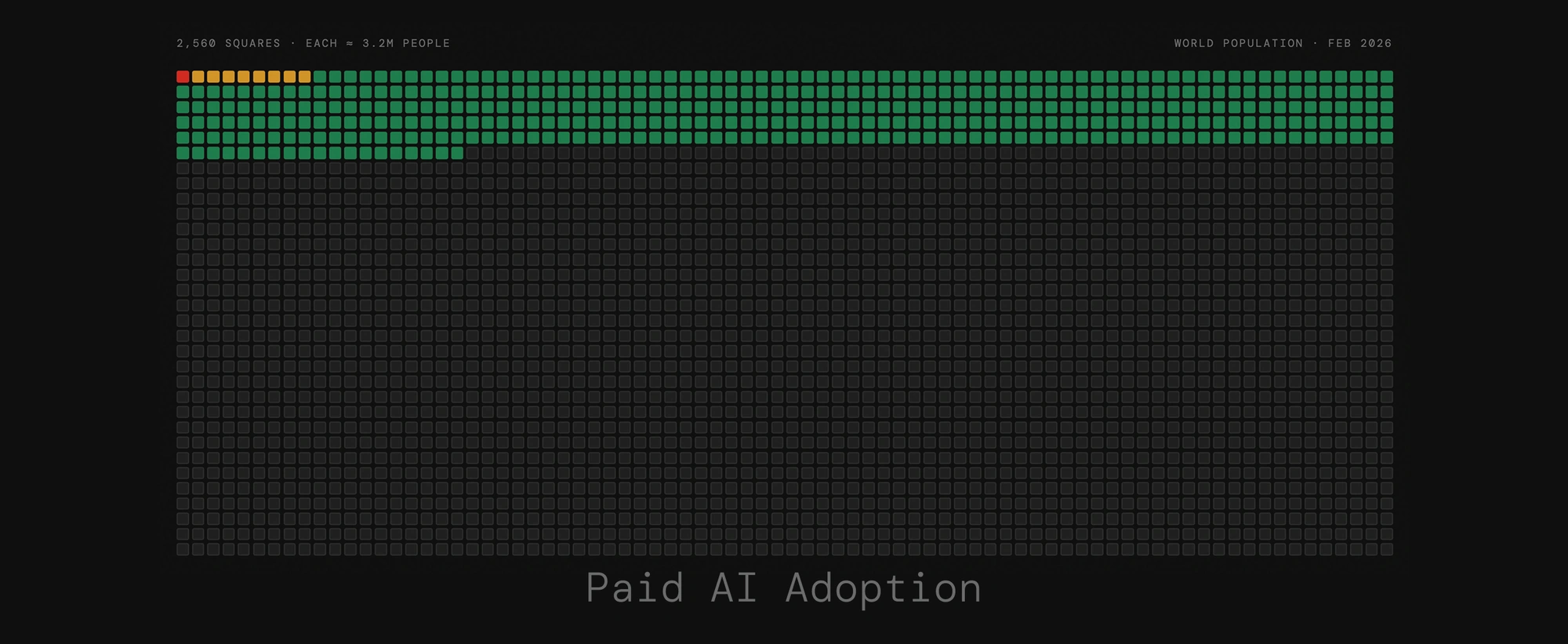
- Only 3% of ChatGPT users (35 million) subscribe to paid tiers, representing 0.4% of the global population.
- Across major AI platforms, just 10% of knowledge workers utilize paid AI services.
- NASA employed Claude AI to map a Mars rover path, marking a significant first for AI in space exploration.
- Claude Cowork's January launch led to a $285 billion market capitalization reduction in software stocks.
- Citrini Research's 'The 2028 Global Intelligence Crisis' memo introduces the concept of 'Ghost GDP'.
Optimistic Outlook
Increased AI penetration promises a massive uptick in global GDP due to enhanced production efficiency and reduced input costs. Agentic AI systems can automate complex tasks, freeing human capital for higher-value work and fostering innovation across industries. This could lead to a new era of productivity and economic expansion, driving advancements previously deemed impossible.
Pessimistic Outlook
The rise of AI agents could lead to widespread job displacement as companies favor subscriptions and APIs over human labor, creating a 'Ghost GDP' where economic growth doesn't translate into human prosperity. Concerns about energy supply, data center constraints, and the uncertain timeline for these shifts highlight potential instability. The benefits of increased output may not flow equitably through the real economy.
Get the next signal in your inbox.
One concise weekly briefing with direct source links, fast analysis, and no inbox clutter.
More reporting around this signal.
Related coverage selected to keep the thread going without dropping you into another card wall.