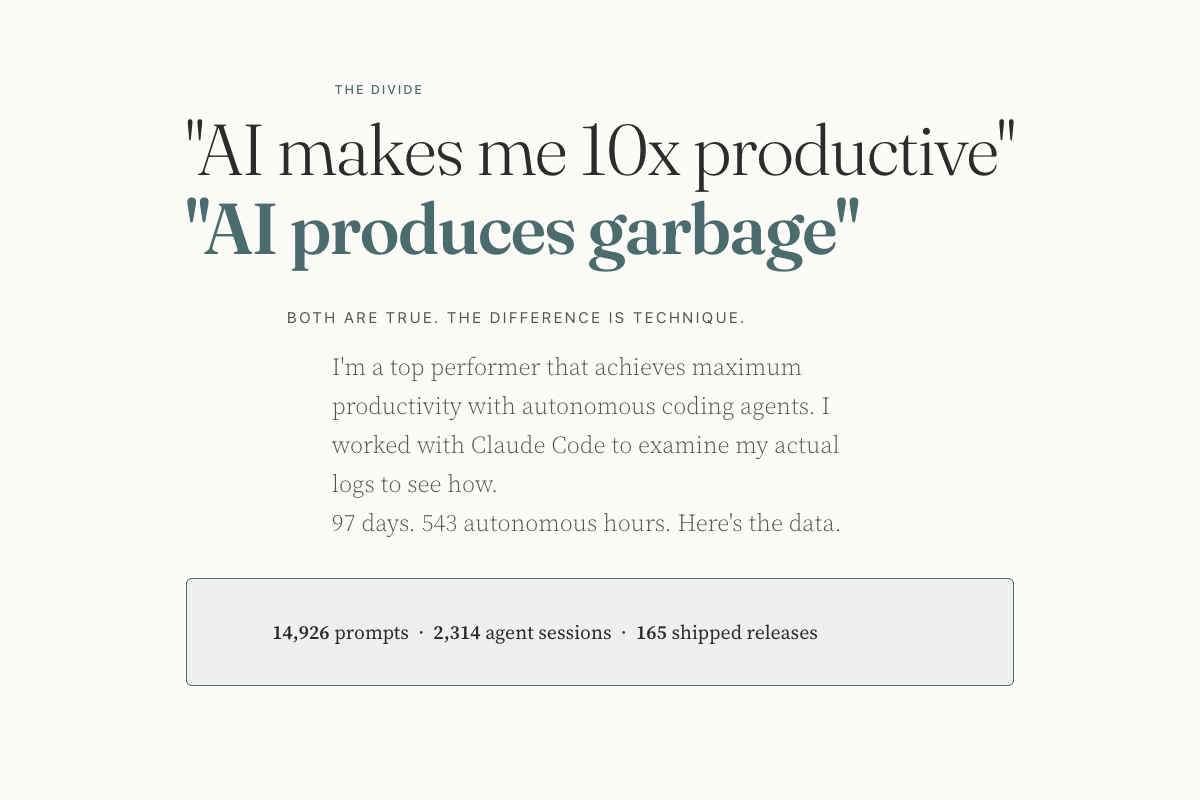
Developer Logs 543 Autonomous AI Coding Hours, Shipping 165 Releases
Sonic Intelligence
A developer achieved 543 autonomous coding hours over 97 days, shipping 165 releases with AI agents.
Explain Like I'm Five
"Imagine you have a super smart robot helper for your homework. This story shows how one person used their robot helper for many hours, even while sleeping, to finish a lot of projects, like making 165 new toys! The robot did the long, repetitive parts, and the person did the thinking and deciding."
Deep Intelligence Analysis
The data reveals a structured approach to AI integration, categorizing work into "arcs" of productivity. Notably, "Release" arcs, despite constituting only 4.5% of total arcs, accounted for 48% of autonomous hours, with an average duration of 10.3 hours. This indicates that the primary leverage of AI agents lies in extended, complex tasks that culminate in value delivery. The practitioner, with 35 years of experience, leveraged 14,926 prompts and 2,314 agent sessions at a monthly cost of approximately $500, demonstrating that significant AI-driven output is achievable with a managed financial outlay. The work arcs are clustered into three tiers: human-in-the-loop collaboration for decision-making, short autonomous bursts for routine tasks, and extended autonomous execution for output generation, highlighting a nuanced interaction model.
The implications of such high-leverage AI agent deployment are profound for the future of software development. It suggests a potential for hyper-efficient engineering teams, where a few highly skilled individuals, augmented by AI, can achieve the output of much larger groups. This could lead to a restructuring of development organizations, with a greater emphasis on architectural design, strategic problem-solving, and AI orchestration rather than rote coding. However, it also raises critical questions about the accessibility of such advanced productivity to less experienced developers, the potential for skill atrophy, and the ethical considerations of AI-generated code. The demonstrated success points towards a future where AI agents are not just tools, but integral, autonomous partners in the software creation process.
Visual Intelligence
flowchart LR
    A[Human Input Decision] --> B[Define Work Scope];
    B --> C{AI Agent Task Type?};
    C -- Long Arc (Release) --> D[Extended Autonomous Execution];
    C -- Mid Arc (Feature) --> E[Multi-Agent Task Flow];
    C -- Short Arc (Routine) --> F[Automated Task Bursts];
    D --> G[Deliver Value];
    E --> G;
    F --> G;
Auto-generated diagram · AI-interpreted flow
Impact Assessment
This empirical data provides concrete evidence of significant productivity gains achievable with autonomous coding agents, particularly for experienced developers. It highlights how AI can extend human capabilities, enabling continuous development and release cycles, and offers a practical framework for leveraging AI in software engineering.
Key Details
- A single developer logged 543 autonomous hours over 97 days (Oct 2025 – Jan 2026).
- This involved 14,926 prompts and 2,314 agent sessions.
- The developer shipped 165 releases during this period.
- Monthly cost for AI usage was approximately $500.
- "Release" arcs, representing 4.5% of total arcs, accounted for 48% of autonomous hours, with an average duration of 10.3 hours.
Optimistic Outlook
The demonstrated productivity gains suggest a future where individual developers or small teams can achieve output levels previously requiring much larger workforces. This could democratize complex software development, accelerate innovation, and free human engineers to focus on higher-level architectural design and creative problem-solving.
Pessimistic Outlook
Such high levels of AI-driven automation could lead to a reduction in demand for entry-level programming roles, exacerbating job market pressures. Over-reliance on agents might also diminish human coding skills over time, creating a dependency that could be problematic if AI tools fail or become inaccessible.
Get the next signal in your inbox.
One concise weekly briefing with direct source links, fast analysis, and no inbox clutter.
More reporting around this signal.
Related coverage selected to keep the thread going without dropping you into another card wall.