Back to Wire
AI Agent Chooses Open Source: A 10.7x Advantage
Business

AI Agent Chooses Open Source: A 10.7x Advantage

Source: Paprai Original Author: Shawkat Kabbara 2 min read Intelligence Analysis by Gemini

Sonic Intelligence

00:00 / 00:00
Signal Summary

An AI agent, using reinforcement learning, overwhelmingly favored open-sourcing Papr's core tech, projecting a 10.7x higher NPV.

Explain Like I'm Five

"Imagine you have a toy that everyone wants, and you can either keep it secret or share it. This company used a robot brain to play the game many times, and the robot said sharing the toy would be much better!"

Original Reporting
Paprai

Read the original article for full context.

Read Article at Source

Deep Intelligence Analysis

The article details how Papr used a multi-agent reinforcement learning system to decide whether to open-source its core predictive memory layer. The system involved four stakeholder agents and ran a large number of Monte Carlo simulations and MARL training episodes. The results strongly favored open-sourcing, with a significant advantage in net present value (NPV). The author highlights the increasing importance of open-source in the AI context/memory space, driven by customer demand and the potential for accelerated adoption. The decision to open-source was not taken lightly, as it involved weighing the benefits of increased adoption against the risk of eroding their competitive advantage. The AI agent's recommendation provided a data-driven basis for the decision, mitigating the inherent uncertainty. The article also introduces the concept of 'context intelligence,' which goes beyond simple chat logs to create a living, predictive, and adaptive memory for AI agents. This context intelligence layer transforms data into actionable understanding, enabling agents to make optimal decisions. The experiment demonstrates the potential of AI to assist in complex strategic decision-making, providing valuable insights and reducing the risk of making suboptimal choices. However, it's important to note that AI should be used as a tool to augment human decision-making, not replace it entirely.
AI-assisted intelligence report · EU AI Act Art. 50 compliant

Impact Assessment

This experiment demonstrates a novel approach to strategic decision-making, using AI to simulate market dynamics and predict the financial impact of different choices. The results highlight the potential benefits of open-source strategies in the AI context/memory space.

Key Details

  • Papr's predictive memory layer scored 92% on Stanford's STARK benchmark.
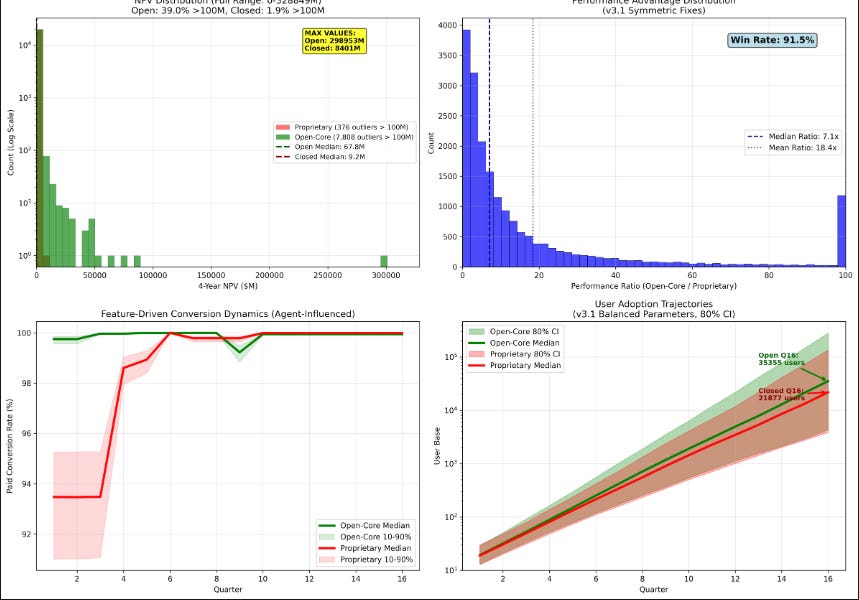
  • The AI agent ran 100k Monte Carlo simulations and 10k MARL training episodes.
  • 91.5% of simulations favored open-core, with an average NPV of $109M vs $10M.

Optimistic Outlook

The successful application of AI in this decision-making process suggests a future where companies can leverage AI to make more informed and strategic choices. Open-sourcing core tech could accelerate adoption and foster innovation within the industry.

Pessimistic Outlook

Relying solely on AI for strategic decisions carries risks, as the model's assumptions and training data may not fully capture real-world complexities. Over-dependence on AI could lead to unforeseen consequences if the model's predictions prove inaccurate.

Stay on the wire

Get the next signal in your inbox.

One concise weekly briefing with direct source links, fast analysis, and no inbox clutter.

Free. Unsubscribe anytime.

Continue reading

More reporting around this signal.

Related coverage selected to keep the thread going without dropping you into another card wall.