AI Agents Collaborate to Build C Compiler
Sonic Intelligence
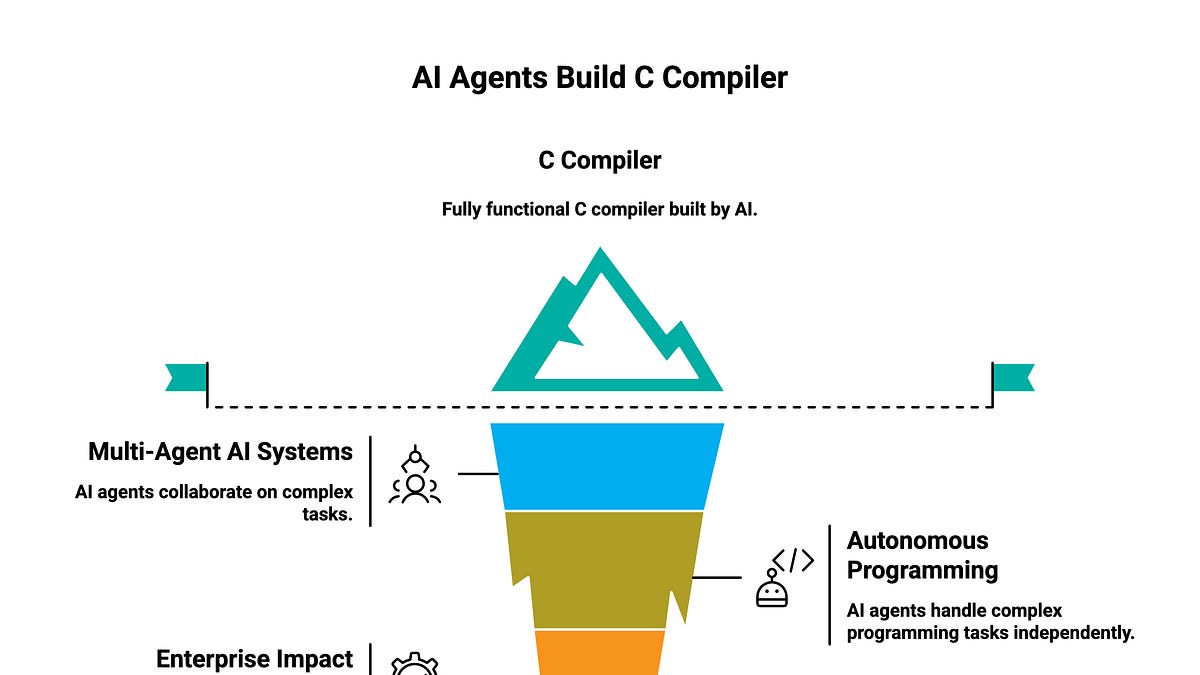
Sixteen AI agents collaboratively built a C compiler, showcasing the potential of autonomous programming.
Explain Like I'm Five
"Imagine a group of robots working together to build the instructions that tell computers what to do, all by themselves!"
Deep Intelligence Analysis
This development signals a shift from AI as a mere assistant to AI as a collaborator, capable of planning, coding, debugging, and testing software independently. Organizations could leverage AI agent teams to build internal tools, maintain legacy codebases, and accelerate product development, potentially leading to significant gains in productivity and efficiency. However, challenges remain. Human oversight is still necessary for coordination and refinement, and the costs associated with large-scale agent workflows can be substantial.
As AI coding agents become more sophisticated, the role of software developers will likely evolve towards supervision, system design, and AI orchestration. This requires developers to acquire new skills in managing and guiding AI agents to achieve desired outcomes. The long-term impact of this technology will depend on its ability to overcome current limitations and demonstrate its reliability and cost-effectiveness in real-world applications.
Transparency is crucial in AI-driven software development. As per EU AI Act Article 50, organizations deploying AI agents for coding must ensure clear documentation of the AI's decision-making processes, provide mechanisms for human oversight, and conduct thorough testing to mitigate potential risks and ensure accountability.
Impact Assessment
This demonstrates a shift towards autonomous programming and agent-driven engineering. It suggests AI can handle complex software engineering tasks with minimal human intervention, potentially redefining productivity in software development.
Key Details
- 16 AI agents based on Anthropic's Claude model built a C compiler.
- The project cost approximately $20,000 in API usage.
- The resulting compiler can build the Linux 6.9 kernel.
- The agents produced roughly 100,000 lines of Rust code.
Optimistic Outlook
AI agent teams could accelerate product development, maintain legacy codebases, and build internal tools more efficiently. This could lead to faster innovation cycles and reduced time to market for businesses.
Pessimistic Outlook
Human oversight is still required for coordination and refinement, and output quality can vary. The costs associated with large-scale agent workflows remain high, limiting immediate widespread adoption.
Get the next signal in your inbox.
One concise weekly briefing with direct source links, fast analysis, and no inbox clutter.
More reporting around this signal.
Related coverage selected to keep the thread going without dropping you into another card wall.