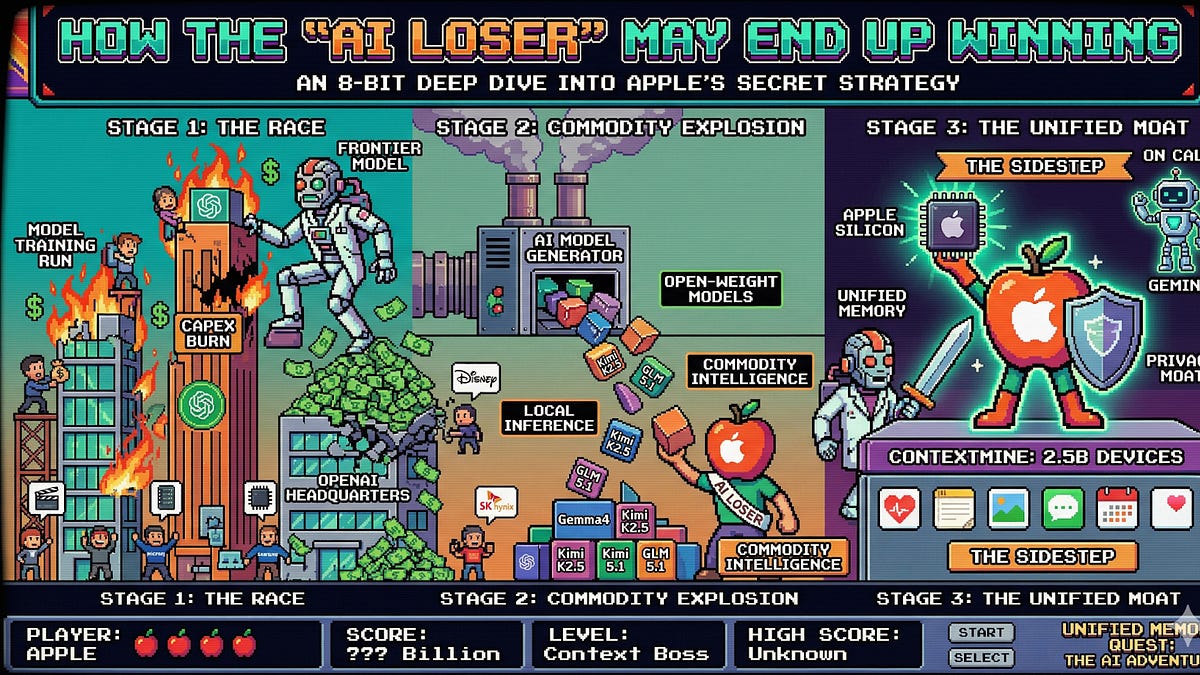
AI Commoditization Shifts Advantage to Apple Amidst Frontier Model Cash Burn
Sonic Intelligence
AI commoditization unexpectedly benefits Apple, while frontier labs face unsustainable cash burn.
Explain Like I'm Five
"Imagine everyone wants the best toy robot. Some companies spend all their money making the smartest robot brain, but these brains are super expensive to run. Meanwhile, a company like Apple, which makes the toy robots themselves, can put these smart brains into their toys cheaper and easier, even if they didn't make the smartest brain first. So, the company that seemed to be 'losing' might actually win because they're better at putting the smart brains into things people already use, while the 'winners' might run out of money trying to make the smartest brain."
Deep Intelligence Analysis
The financial strain on companies pursuing this 'intelligence race' is becoming evident. OpenAI, for instance, despite a $300 billion valuation, faced a stark reality with its Sora video product, which reportedly incurred $15 million in daily costs against only $2.1 million in revenue. This unsustainable burn rate led to the product's shutdown, nullifying significant investments, including a prospective $1 billion equity stake from Disney. On the infrastructure side, OpenAI's non-binding letters of intent for 900,000 DRAM wafers per month—representing 40% of global output—triggered a strategic pivot by Micron, which ceased its consumer memory brand to reallocate capacity. The subsequent cancellation of the 'Stargate Texas' project and failed terms with Oracle caused a demand signal to vanish, leading to a Micron stock crash, underscoring the extreme volatility and risk associated with speculative AI infrastructure investments.
This reorientation suggests that the long-term winners in the AI era may not be the ones burning the most cash on training runs, but rather those capable of integrating increasingly commoditized intelligence into widely adopted platforms and devices. Apple's substantial cash reserves and established hardware base provide a unique optionality, allowing it to leverage improving models without incurring the prohibitive development costs borne by others. The market is transitioning from a focus on 'intelligence' as a standalone product to 'capabilities' delivered through integrated systems. This shift implies a future where hardware-software synergy, cost-efficiency, and user experience will dictate market leadership, potentially leading to a more diversified and sustainable AI industry, but also posing existential threats to companies whose business models rely on perpetual, high-cost frontier innovation.
metadata: {"ai_detected": true, "model": "Gemini 2.5 Flash", "label": "EU AI Act Art. 50 Compliant"}
Impact Assessment
The rapid commoditization of AI intelligence is fundamentally altering competitive landscapes, rewarding companies with strong hardware ecosystems over those solely focused on raw model development. This shift exposes the unsustainable financial models of some frontier AI labs, leading to significant market volatility and strategic re-evaluations for major tech and hardware players.
Key Details
- OpenAI was valued at $300 billion.
- Sora's estimated daily operational cost was $15 million against $2.1 million in daily revenue.
- Disney signed a three-year licensing deal for Sora content generation.
- OpenAI issued non-binding letters of intent for 900,000 DRAM wafers per month, representing 40% of global output.
- Micron redirected its entire consumer memory capacity to AI customers before a major demand signal vanished.
Optimistic Outlook
This market dynamic could foster a more sustainable AI ecosystem, where innovation is driven by efficient deployment and integration rather than just raw compute power. Companies like Apple, with robust hardware platforms, are poised to democratize advanced AI capabilities, making them accessible and affordable for a broader user base, ultimately accelerating AI's practical applications across industries.
Pessimistic Outlook
The intense capital burn by leading AI labs, coupled with volatile demand signals for critical hardware, risks market instability and potential bankruptcies for heavily invested players. This could lead to consolidation, stifling competition and innovation, while also creating significant financial risk for hardware suppliers who pivot too aggressively based on non-binding commitments.
Get the next signal in your inbox.
One concise weekly briefing with direct source links, fast analysis, and no inbox clutter.
More reporting around this signal.
Related coverage selected to keep the thread going without dropping you into another card wall.