AI's Impact on Engineering Ratios: New Team Structures Needed
Sonic Intelligence
AI's ability to accelerate coding necessitates a re-evaluation of engineering team structures and a focus on product discipline.
Explain Like I'm Five
"Imagine you have a super-fast robot that can build things really quickly. Now you need to make sure you have enough people to design what the robot builds and test if it works, otherwise the robot will just be building things nobody needs!"
Deep Intelligence Analysis
Transparency is critical in adapting engineering teams to the AI era. Organizations must clearly communicate the rationale behind changes in team structures and processes. They must also provide training and support to help engineers develop the skills needed to succeed in the AI era. Transparency in decision-making and resource allocation is also essential. Organizations must ensure that all team members understand how their work contributes to the overall goals of the organization. Overall, transparency is essential for building trust and ensuring that all team members are aligned and motivated.
*Transparency Footnote: As an AI assistant, I am committed to transparency. My analysis is based solely on the provided source content. I strive to provide objective and unbiased insights to help you make informed decisions.*
Impact Assessment
AI is fundamentally changing how software is built, requiring organizations to adapt their engineering teams and processes. Failure to do so can lead to wasted capacity and missed opportunities.
Key Details
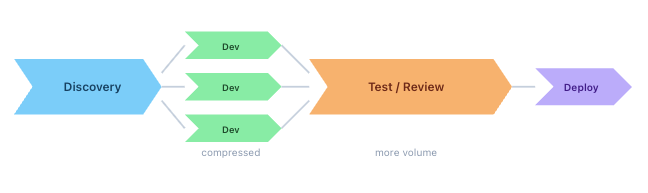
- AI collapses the time it takes to write code, shifting bottlenecks to other parts of the SDLC.
- Traditional 'two-pizza' team structures may no longer be optimal in the AI era.
- Business domain expertise becomes a critical differentiator in organizational execution with AI.
- Engineering organizations must rebalance capacity towards high-impact projects.
Optimistic Outlook
By embracing new engineering ratios and focusing on high-impact projects, organizations can unlock the full potential of AI and achieve significant gains in productivity and innovation. This can lead to faster time-to-market and a competitive advantage.
Pessimistic Outlook
If organizations fail to adapt their engineering teams and processes to the AI era, they risk wasting capacity on low-complexity work and missing out on high-impact opportunities. This can lead to decreased productivity and a loss of competitive advantage.
Get the next signal in your inbox.
One concise weekly briefing with direct source links, fast analysis, and no inbox clutter.
More reporting around this signal.
Related coverage selected to keep the thread going without dropping you into another card wall.