The AI Productivity Myth: Why Most Companies Aren't Seeing the Promised 70% Gains
Sonic Intelligence
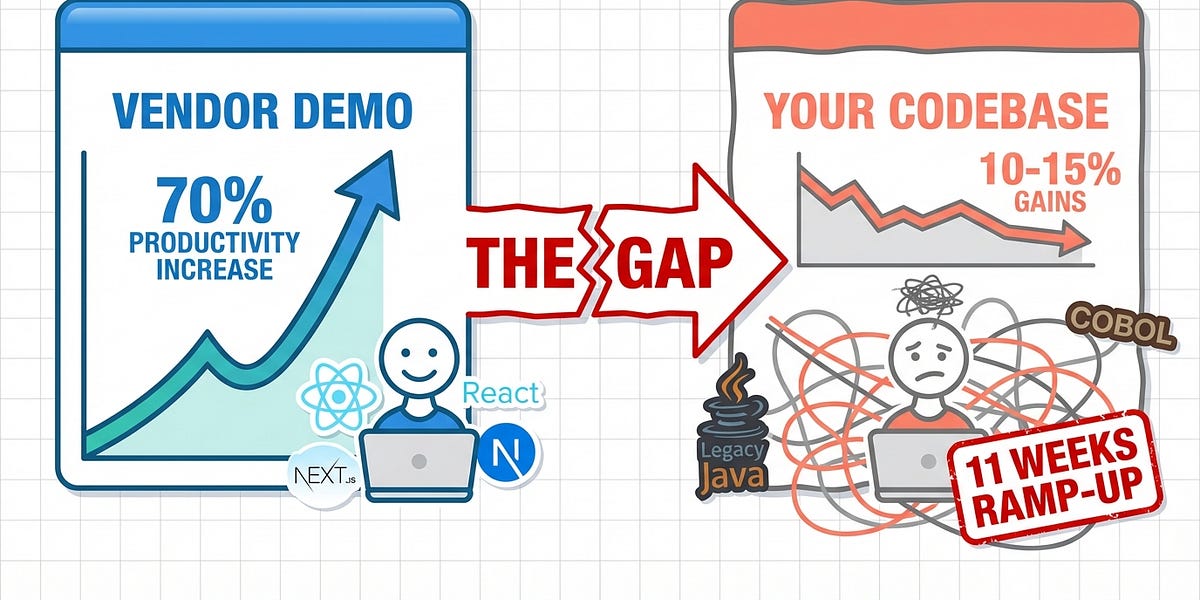
Despite vendor claims of 70-90% AI productivity boosts, a critical analysis reveals these gains are largely a myth for 90% of companies, with some studies even showing AI making experienced developers slower.
Explain Like I'm Five
"Imagine someone tells you a new toy car makes you run 70% faster. But when you try it, you actually run slower, even though you feel faster! Companies are being told AI makes their workers much faster, but for most, it's not true, and sometimes it even slows them down because the AI makes mistakes they have to fix."
Deep Intelligence Analysis
Andrej Karpathy, a co-founder of OpenAI, articulated a profound sense of being 'behind as a programmer' in December 2025, describing AI's impact as a 'magnitude 9 earthquake.' This sentiment starkly contrasts with the prevailing marketing claims. The article posits that the heralded 70-90% productivity gains are true for only about 10% of the industry, primarily AI-native startups unburdened by legacy systems or tech debt. For the remaining 90%, these claims are largely 'marketing hallucination masquerading as data.'
Supporting this uncomfortable truth are various studies. While GitHub claims Copilot makes developers 55% faster, and Microsoft suggests 20-30% improvements, independent research from METR (Model Evaluation & Threat Research) delivered a terrifying finding: experienced developers using AI tools were 19% slower in completing tasks compared to those working without AI. This wasn't beginners, but seasoned engineers familiar with their codebases. Furthermore, the Stack Overflow 2025 Developer Survey revealed that while 52% reported some positive impact, a significant 46% now distrust AI output accuracy, up from 31% the previous year. The primary frustration for 66% of developers was AI solutions being 'almost right, but not quite,' leading to time-consuming debugging.
The most alarming aspect highlighted is the 'productivity illusion' and the inherent measurement problem. The METR study found that developers predicted a 24% speed increase before using AI, and astonishingly, even after being 19% slower, they still believed they had been 20% faster. This cognitive bias means companies might be bleeding productivity while celebrating non-existent AI transformations, making critical headcount and investment decisions based on faulty premises. The disconnect between perception and reality is a powerful driver of the persistent hype, as individual developers feeling faster reinforce the narrative, irrespective of actual performance data.
The article concludes that while the productivity claims aren't outright lies, they are 'true in a lab, false in production.' When a claim works for a small minority but is marketed universally, it constitutes misdirection. The real beneficiaries are primarily AI-native startups, who leverage AI from the ground up without the burdens of existing infrastructure or the need for extensive workforce retraining. This analysis provides a crucial reality check for enterprises, urging a more critical and data-driven approach to AI adoption rather than succumbing to inflated promises.
Impact Assessment
This disconnect between AI hype and reality is costing companies significant resources, misguiding strategic decisions, and potentially leading to a widespread erosion of actual productivity. It highlights a critical measurement problem in AI adoption.
Key Details
- ● Andrej Karpathy's quote from December 2025.
- ● 70-90% AI productivity claim.
- ● 10% of the industry actually sees these gains.
- ● GitHub claims 55% developer speed increase with Copilot.
- ● METR study found experienced developers 19% slower with AI tools.
- ● Stack Overflow 2025 survey: 52% report positive AI impact, 46% distrust AI output, 66% frustrated by 'almost right' AI solutions.
- ● METR study: Developers predicted 24% faster, felt 20% faster, but were 19% slower.
Optimistic Outlook
Identifying this gap allows companies to re-evaluate their AI strategies, focusing on targeted implementations that genuinely deliver value rather than chasing marketing exaggerations. It provides an opportunity to develop better metrics and training, ensuring AI tools are integrated effectively for real, measurable productivity gains in the long term.
Pessimistic Outlook
The widespread belief in inflated AI productivity claims could lead to poor investment decisions, misallocation of engineering resources, and a demoralized workforce grappling with ineffective tools. If left unaddressed, this 'perception gap' could severely hinder genuine AI progress and innovation within many enterprises.
Get the next signal in your inbox.
One concise weekly briefing with direct source links, fast analysis, and no inbox clutter.
More reporting around this signal.
Related coverage selected to keep the thread going without dropping you into another card wall.