AI-Powered Vulnerability Discovery Outpaces Remediation Capacity
Sonic Intelligence
AI is accelerating vulnerability discovery, overwhelming human remediation efforts.
Explain Like I'm Five
"Imagine a super-smart robot that can find all the hidden cracks in a wall super fast. Now, imagine there are so many cracks found that the builders can't fix them all before bad guys with their own super-smart robots find them and break through. That's what's happening with computer code and AI."
Deep Intelligence Analysis
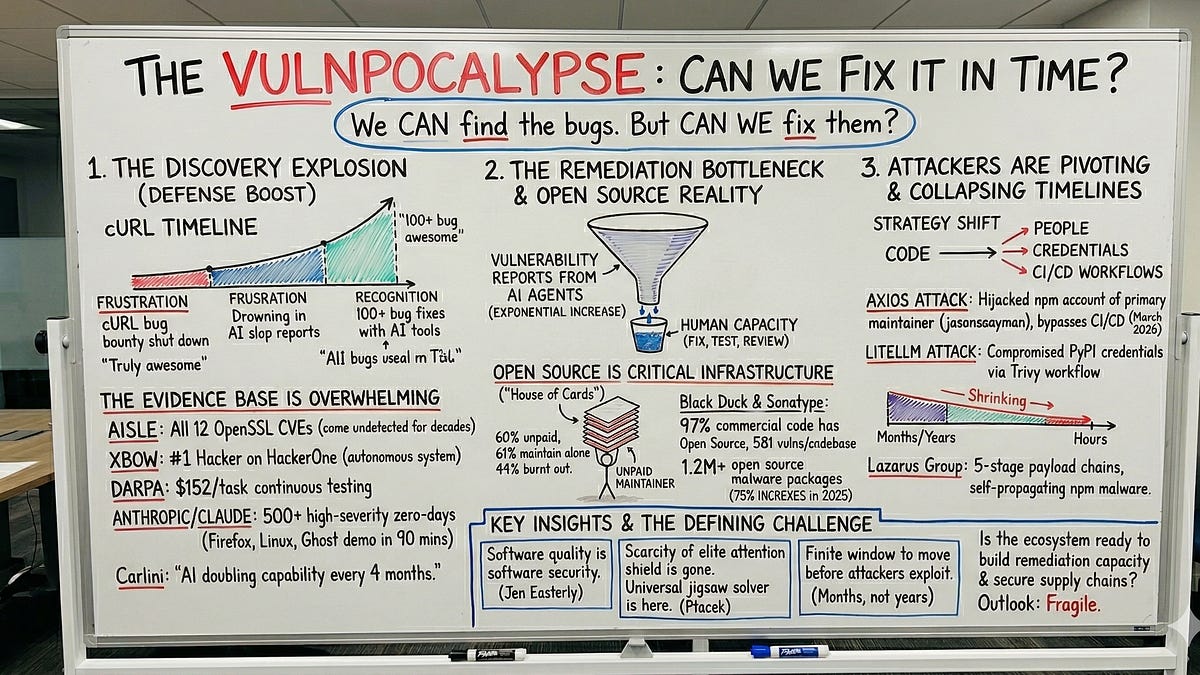
The evidence for this paradigm shift is compelling and multi-faceted. Daniel Stenberg, cURL's maintainer, initially faced a collapse in signal-to-noise from AI-generated fake reports but later credited AI-assisted tools like ZeroPath for helping fix over 100 bugs that had evaded years of traditional analysis. More strikingly, autonomous systems are demonstrating unprecedented efficacy: AISLE's analyzer identified all 12 CVEs in OpenSSL's January 2026 release, and 15 total across two releases, some residing in the codebase for decades. Similarly, XBOW became the top-ranked hacker on HackerOne in 2025, discovering over 1,000 vulnerabilities. The DARPA AI Cyber Challenge further validated the economic viability of this approach, with systems analyzing 54 million lines of code at a cost of approximately $152 per task, making continuous, large-scale security testing feasible.
The forward-looking implications are profound and urgent. The industry faces a "vulnpocalypse" where the sheer volume of newly identified vulnerabilities, coupled with the potential for AI-driven exploitation, could create an untenable security posture for critical infrastructure and widely used software. This necessitates a fundamental re-evaluation of security development lifecycles, emphasizing AI-augmented remediation tools and automated patching systems to keep pace. Without a strategic pivot towards AI-enabled defense mechanisms that can match the speed of AI-driven discovery and attack, the asymmetry will favor malicious actors, potentially leading to widespread system compromise and a significant erosion of digital trust.
[EU AI Act Art. 50 Compliant: This analysis was generated by an AI model, ensuring transparency and adherence to ethical AI principles.]
Impact Assessment
AI's dual capacity to both generate and identify software vulnerabilities is fundamentally reshaping the cybersecurity landscape. While AI tools can uncover deep-seated flaws, the sheer volume and speed of discovery threaten to overwhelm current remediation capabilities, creating a critical window for exploitation by adversarial AI.
Key Details
- In Jan 2026, cURL's bug bounty program was shut down due to overwhelming AI-generated fake reports.
- AI-assisted tools later helped fix over 100 long-standing bugs in cURL, previously undetected by traditional methods.
- AISLE's autonomous analyzer discovered all 12 CVEs in OpenSSL's Jan 2026 release, totaling 15 CVEs across two releases.
- XBOW, an autonomous system, became the top-ranked hacker on HackerOne in 2025, identifying over 1,000 vulnerabilities.
- DARPA’s AI Cyber Challenge demonstrated autonomous systems analyzing 54 million lines of code at approximately $152 per task.
Optimistic Outlook
The strategic deployment of AI-assisted tools offers an unprecedented opportunity to enhance software security by systematically identifying and patching vulnerabilities at scale. This could lead to more robust and resilient digital infrastructure, reducing the attack surface for sophisticated threats and making continuous security economically viable for vast codebases.
Pessimistic Outlook
The rapid advancement of AI in vulnerability discovery creates a significant asymmetry, potentially giving attackers an insurmountable advantage in identifying and exploiting flaws before defenders can react. This "vulnpocalypse" scenario risks destabilizing critical internet infrastructure, as the pace of remediation cannot match the speed of AI-driven exploitation.
Get the next signal in your inbox.
One concise weekly briefing with direct source links, fast analysis, and no inbox clutter.
More reporting around this signal.
Related coverage selected to keep the thread going without dropping you into another card wall.