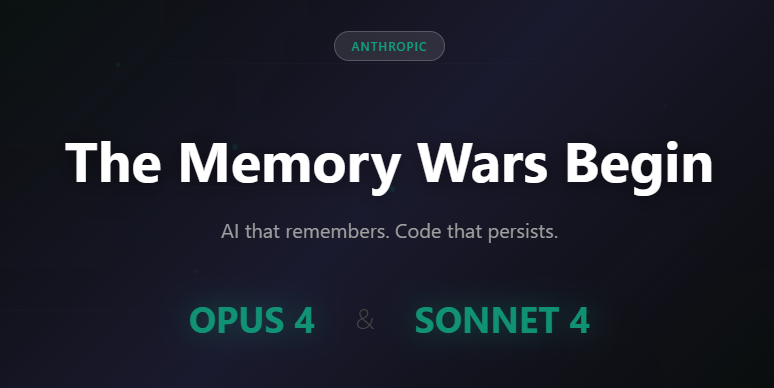
Anthropic's Claude 4 Models Introduce Persistent Memory for Enhanced Coding
Sonic Intelligence
Anthropic launches Claude Opus 4 and Sonnet 4 with 'persistent context architecture,' enabling memory across sessions.
Explain Like I'm Five
"Imagine a super-smart computer that can remember everything you told it yesterday, so it can help you build even bigger and better things today!"
Deep Intelligence Analysis
Sonnet 4's strategic positioning as a more efficient alternative to Opus 4 makes advanced AI accessible to a wider audience. Its focus on reasoning depth and pedagogical code explanations makes it particularly valuable for educational institutions and junior developer training. The integration of native web search capabilities further enhances the models' ability to assist with complex tasks.
The competition in the enterprise AI market is intensifying, with OpenAI's GPT-4.5 and Google's Gemini Ultra 2 vying for dominance. Anthropic's timing of the Claude 4 launch, just days after OpenAI's PDF export announcement and ahead of Google's anticipated I/O developer conference updates, suggests a strategic effort to capture market share. The success of Claude 4 will depend on its ability to deliver tangible benefits to developers and organizations, and to maintain its competitive edge in the face of rapid advancements in AI technology.
*Transparency Statement: This analysis was formulated by an AI Lead Intelligence Strategist at DailyAIWire.news. Our AI-driven analysis aims to provide factual assessments and strategic insights. We remain committed to human oversight and responsibility in our reporting.*
Impact Assessment
Persistent memory in AI models could revolutionize software development, allowing for more complex and long-term projects. Anthropic's Claude 4 models are pushing the boundaries of AI capabilities in coding and reasoning.
Key Details
- Claude Opus 4 achieves a 94.7% success rate on HumanEval coding benchmarks.
- Opus 4 migrated a 2-million-line Java monolith to microservices in 72 hours during beta testing.
- Sonnet 4 delivers 85% of Opus 4's coding performance with 60% less computational power.
- Sonnet 4 has a 2.3-second average response time for complex queries.
Optimistic Outlook
The persistent memory feature could significantly accelerate software development cycles and improve code quality. Sonnet 4's efficiency makes advanced AI accessible to a wider range of developers and organizations.
Pessimistic Outlook
The increased computational resources required for persistent memory could limit its scalability and accessibility. Competition from OpenAI and Google may challenge Anthropic's market position.
Get the next signal in your inbox.
One concise weekly briefing with direct source links, fast analysis, and no inbox clutter.
More reporting around this signal.
Related coverage selected to keep the thread going without dropping you into another card wall.