Arm CEO Teases AI-Driven Products, Aims for $1 Trillion TAM
Sonic Intelligence
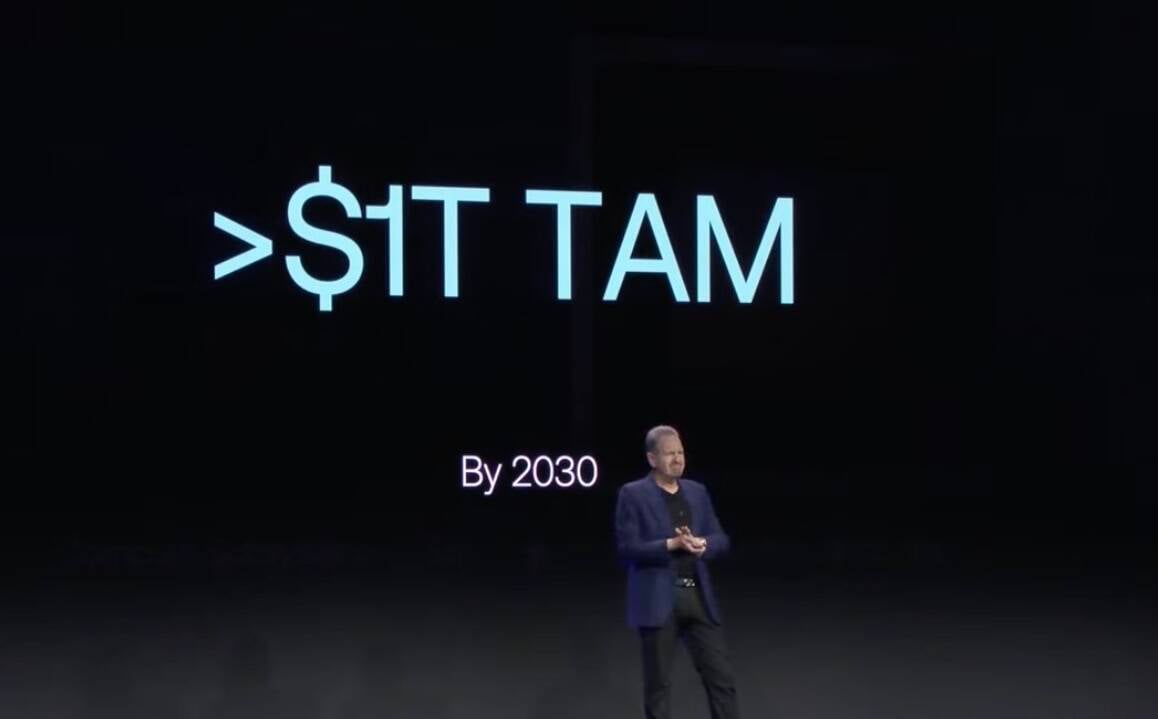
Arm aims for a $1 trillion TAM by 2030 with new AI-focused products.
Explain Like I'm Five
"Imagine Arm usually sells the recipe for computer brains. Now, they're also making some of the brains themselves, especially super smart ones for AI robots. They think this will make them a lot more money, like going from a small shop to a giant supermarket, because everyone will need these new AI brains."
Deep Intelligence Analysis
The company projects its total addressable market to reach $1 trillion by 2030, with datacenter silicon alone contributing over $100 billion, a substantial increase from its current $3 billion annual datacenter royalties. This aggressive forecast is predicated on agentic frameworks, such as OpenClaw, quadrupling demand for CPU cores. The AGI CPU, developed in collaboration with Meta, has already secured commitments from major industry players including OpenAI, SAP, Cloudflare, and SK Telecom, indicating strong initial market validation. This positions Arm to leverage its power-efficient instruction set architecture, already present in chips like Amazon's Graviton, for the demanding and scalable requirements of AI agents.
The implications are multi-faceted. Arm's direct entry into the silicon market could intensify competition with hyperscalers developing their own custom chips and established vendors like Nvidia and Broadcom, who are also supplying agentic systems. While Arm continues to profit from licensed designs, its direct product offering signals a more aggressive stance in controlling the hardware stack for emerging AI paradigms. This strategy could accelerate the adoption of Arm-based solutions in datacenters, potentially leading to a more diverse and competitive landscape for AI infrastructure, but also introduces new operational complexities and potential channel conflicts for Arm.
Visual Intelligence
flowchart LR
    A[IP Licensing Model] --> B{Agentic AI Demand};
    B --> C[New AGI CPU Product];
    C --> D[Direct Silicon Sales];
    D --> E[Increased Datacenter TAM];
    E --> F[Target $1 Trillion TAM];
Auto-generated diagram · AI-interpreted flow
Impact Assessment
Arm is strategically shifting from a pure IP licensing model to direct silicon sales, targeting the rapidly expanding AI agent market. This move positions Arm to capture a larger share of the datacenter compute market, leveraging its power-efficient architecture against established players.
Key Details
- Arm CEO Rene Haas predicts a $1 trillion total addressable market (TAM) by the end of the decade.
- The datacenter silicon TAM is projected to reach over $100 billion by 2030, up from a current $3 billion in royalties.
- Arm unveiled its first datacenter silicon, the 136-core AGI CPU, developed with Meta.
- Key customers for the AGI CPU include Meta, OpenAI, SAP, Cloudflare, and SK Telecom.
- Agentic AI frameworks are expected to quadruple demand for CPU cores.
Optimistic Outlook
Arm's direct entry into datacenter silicon, particularly with a focus on agentic AI, could significantly diversify its revenue streams and expand its market influence beyond traditional licensing. Securing major customers like Meta and OpenAI at launch indicates strong initial adoption and validates its strategic pivot, potentially accelerating its path to a $1 trillion TAM.
Pessimistic Outlook
Despite ambitious TAM projections, Arm faces intense competition from established silicon providers like Nvidia and Broadcom, who also supply agentic systems. Relying heavily on the rapid growth of agentic AI demand carries inherent market risk, and the transition from a licensing model to direct sales presents operational challenges and potential conflicts with existing licensees.
Get the next signal in your inbox.
One concise weekly briefing with direct source links, fast analysis, and no inbox clutter.
More reporting around this signal.
Related coverage selected to keep the thread going without dropping you into another card wall.