Bayer Deploys Agentic AI for Pharmaceutical R&D Data Integration
Sonic Intelligence
Bayer launches agentic AI for drug development.
Explain Like I'm Five
"Imagine a super-smart assistant that can read all the old drug safety reports, understand your questions, and even write parts of new reports for you. That's what Bayer built with PRINCE, using AI to make finding information and writing documents much faster for new medicines."
Deep Intelligence Analysis
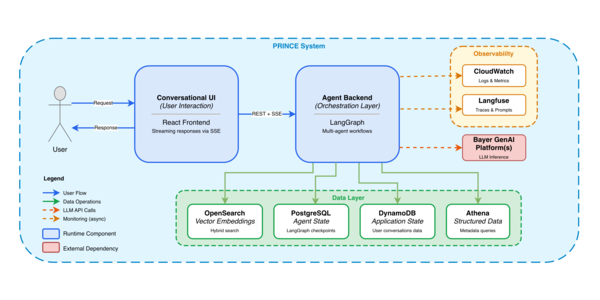
The development of PRINCE is contextualized by the inherent challenges of navigating vast, unstructured preclinical data in the pharmaceutical sector. The platform's architecture emphasizes 'context engineering' to optimize information flow between specialized agents and 'harness engineering' for robust orchestration, recovery, and observability. This dual focus ensures reliability and control, crucial for a production-ready LLM system in a highly regulated environment. Furthermore, the integration of transparency, explainability, and human-in-the-loop mechanisms addresses the paramount need for trust and governance in AI-driven decision-making within drug development.
Looking forward, PRINCE demonstrates the transformative potential of agentic AI in accelerating pharmaceutical innovation. Its ability to streamline data access and automate parts of the regulatory documentation process could substantially reduce the time and cost associated with drug development. The success of such a system will likely spur broader adoption of advanced AI agents across other data-intensive, regulated industries, while simultaneously prompting a re-evaluation of existing compliance protocols and the role of human oversight in AI-augmented workflows.
Visual Intelligence
flowchart LR
    A[Preclinical Data Maze] --> B{PRINCE Platform}
    B --> C[Agentic RAG]
    B --> D[Text-to-SQL]
    C --> E[Complex Queries]
    D --> F[Regulatory Docs]
    E --> G[Human-in-Loop]
    F --> G
    G --> H[Drug Development]
Auto-generated diagram · AI-interpreted flow
Impact Assessment
This deployment signifies a major step in applying advanced AI agents to highly regulated and data-intensive industries like pharmaceuticals. By automating complex data retrieval and document generation, PRINCE could substantially accelerate drug development cycles and improve research efficiency.
Key Details
- Bayer AG, in collaboration with Thoughtworks, developed PRINCE, a cloud-hosted platform.
- PRINCE utilizes Agentic Retrieval-Augmented Generation (RAG) and Text-to-SQL technologies.
- The system integrates decades of preclinical safety study reports, evolving from keyword search.
- It functions as an intelligent research assistant, answering complex queries and drafting regulatory documents.
- Key engineering principles include context engineering, harness engineering, transparency, and human-in-the-loop integration.
Optimistic Outlook
The successful implementation of PRINCE could set a new standard for AI adoption in pharmaceutical R&D, leading to faster drug discovery and development. Enhanced data accessibility and automated compliance document generation promise significant operational efficiencies and reduced time-to-market for critical therapies.
Pessimistic Outlook
Despite its potential, the reliance on AI for regulatory document drafting introduces risks related to accuracy and compliance in a highly scrutinized industry. Potential biases in historical data or errors in agentic reasoning could lead to significant regulatory setbacks or even patient safety concerns if not rigorously managed.
Get the next signal in your inbox.
One concise weekly briefing with direct source links, fast analysis, and no inbox clutter.
More reporting around this signal.
Related coverage selected to keep the thread going without dropping you into another card wall.