Claude Code Signals Neurosymbolic AI as Next Frontier Beyond Pure LLMs
Sonic Intelligence
Claude Code pioneers neurosymbolic AI, integrating classical logic for enhanced performance.
Explain Like I'm Five
"Imagine a super-smart robot that usually guesses things. Claude Code is like that robot, but it also has a special rulebook that helps it be super precise when it needs to be, like when writing computer code. It's like having both a creative brain and a strict rule-follower working together."
Deep Intelligence Analysis
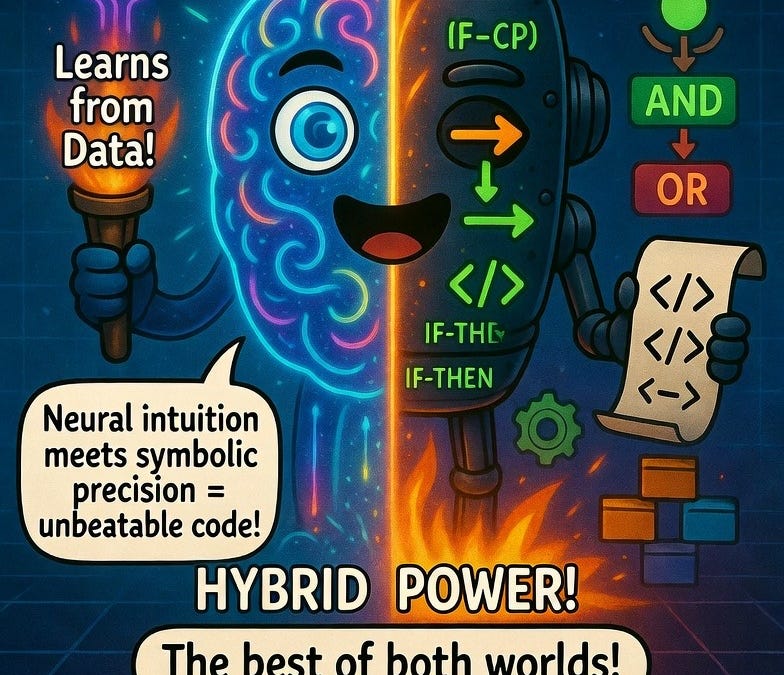
Technical analysis of Claude Code's leaked kernel, `print.ts`, reveals a 3,167-line component featuring a complex IF-THEN conditional structure with 486 branch points and 12 levels of nesting. This design mirrors classical symbolic AI principles, emphasizing pattern matching and logical deduction over purely statistical inference. This architectural choice by Anthropic, a leading AI developer, validates decades of research in neurosymbolic AI, previously overshadowed by the success of deep learning. The success of other neurosymbolic systems like AlphaFold and Code Interpreter further underscores the efficacy of combining neural and symbolic methods for tackling complex, structured problems.
Looking forward, this paradigm shift has profound implications for capital allocation and research direction within the AI industry. If neurosymbolic approaches prove consistently superior for tasks demanding accuracy and explainability, investment may increasingly flow into developing robust symbolic components and their seamless integration with neural networks. This could lead to a new generation of AI agents that are not only more capable but also more trustworthy and less prone to confabulation, ultimately accelerating the deployment of AI in mission-critical applications where current LLM limitations are prohibitive. The challenge now lies in refining these hybrid architectures to achieve both the flexibility of neural networks and the rigor of symbolic reasoning.
Impact Assessment
This development suggests a fundamental shift in AI architecture, moving beyond the limitations of purely probabilistic LLMs. It could lead to more reliable and less erratic AI systems, impacting how capital is allocated in AI research and development.
Key Details
- Claude Code features a 3,167-line kernel, `print.ts`, for pattern matching.
- This kernel includes a large IF-THEN conditional with 486 branch points and 12 levels of nesting.
- The architecture is described as deterministic and symbolic, akin to classical AI.
- Neurosymbolic AI is cited as the reason for Claude Code's superior performance, not just scaling.
- Other neurosymbolic examples include AlphaFold, AlphaEvolve, AlphaProof, AlphaGeometry, and Code Interpreter.
Optimistic Outlook
The integration of symbolic AI could unlock new levels of precision and trustworthiness in AI, particularly for critical applications like coding. This hybrid approach promises more robust and predictable AI, accelerating development in complex problem-solving domains.
Pessimistic Outlook
While promising, the current neurosymbolic implementation in Claude Code is described as imperfect, indicating significant engineering challenges remain. Over-reliance on complex symbolic components could introduce new vulnerabilities or make systems harder to debug and maintain.
Get the next signal in your inbox.
One concise weekly briefing with direct source links, fast analysis, and no inbox clutter.
More reporting around this signal.
Related coverage selected to keep the thread going without dropping you into another card wall.