Compound AI Emerges for Safe, Scalable Autonomous Systems
Sonic Intelligence
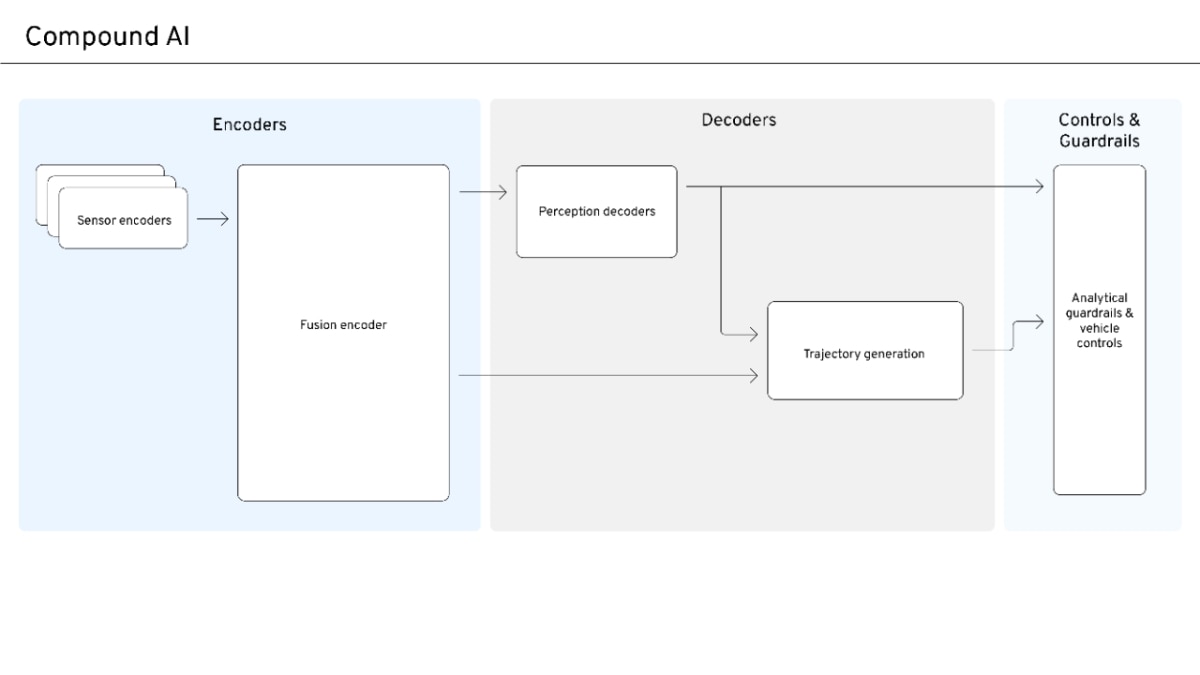
Compound AI balances data-driven scale with safety and interpretability for autonomous systems.
Explain Like I'm Five
"Imagine building a super-smart robot car. You want it to learn fast (data efficiency), but also understand why it does things (interpretability), and be super safe (safety performance). Old ways only did one or two well. 'Compound AI' is a new way that tries to do all three at the same time, making robot cars smarter and safer."
Deep Intelligence Analysis
Historically, autonomous driving stacks have oscillated between purely modular systems and nascent end-to-end learning models. Modular systems, characterized by explicit stages like perception, prediction, and control, offer high interpretability, low data requirements, and straightforward validation of individual components. However, they can struggle with the holistic complexity of real-world driving. While the source doesn't detail pure end-to-end learning, it implies its strength in data-driven scale, often at the expense of interpretability and debuggability. Compound AI seeks to resolve this dilemma by strategically integrating structural elements where they are most critical for safety and understanding, while retaining the efficiency of data-driven learning for everyday scenarios, aiming to solve 99% of common driving situations.
The implications of Compound AI's adoption are far-reaching. A successful implementation could significantly accelerate the development and deployment of autonomous vehicles by providing a more reliable and certifiable foundation. This architectural shift could foster greater regulatory confidence and public acceptance, paving the way for advanced autonomy. However, the "long tail" of rare and complex driving scenarios, which Compound AI acknowledges as requiring further research, remains a formidable hurdle. The industry's ability to effectively manage this balance between scalable everyday performance and robust handling of edge cases will determine the ultimate success and safety of future autonomous systems.
Visual Intelligence
flowchart LR
    A["Modular Systems"] --> B["Low Data Needs"]
    A --> C["Easy Introspection"]
    A --> D["Simple Validation"]
    E["End-to-End Learning"] --> F["Data-Driven Scale"]
    G["Compound AI"] --> B
    G --> C
    G --> D
    G --> F
    G --> H["Safety & Interpretability"]
    A -- "Challenges" --> G
    E -- "Challenges" --> G
Auto-generated diagram · AI-interpreted flow
Impact Assessment
The architectural foundation of autonomous systems directly dictates their safety, scalability, and public acceptance. Compound AI represents a critical evolution, addressing the historical trade-offs between efficiency, interpretability, and safety, which is paramount for widespread AV deployment.
Key Details
- Achieving safe, scalable autonomy is 'existential' for the AV industry.
- Architectural choices impact data efficiency, interpretability, safety validation, and public trust.
- Compound AI is an emerging architecture balancing data-driven scale with safety and interpretability.
- It aims to solve 99% of everyday autonomous driving, with ongoing research for 'long tail' general autonomy.
- Modular systems offer low data requirements, straightforward introspection, and simple validation.
- The industry is converging on Compound AI to combine end-to-end learning benefits with structural integrity.
Optimistic Outlook
Compound AI's hybrid approach could unlock significant progress in autonomous vehicle deployment by providing a robust framework for safety and interpretability. This could accelerate public trust and regulatory approval, leading to safer and more efficient transportation systems globally.
Pessimistic Outlook
The inherent complexity of balancing data efficiency, interpretability, and safety remains a formidable challenge. If Compound AI fails to deliver on its promises for the 'long tail' of general autonomy, the AV industry could face continued delays and public skepticism regarding full self-driving capabilities.
Get the next signal in your inbox.
One concise weekly briefing with direct source links, fast analysis, and no inbox clutter.
More reporting around this signal.
Related coverage selected to keep the thread going without dropping you into another card wall.