
"Frankenstein" Tutorial Demystifies LLM Construction on Kaggle
Sonic Intelligence
The Gist
A tutorial demonstrates building a basic 3.2M parameter LLM from "Frankenstein" on Kaggle.
Explain Like I'm Five
"Imagine you want to teach a computer to talk like a specific book character. This guide shows you how to build a very simple talking computer brain using just one book, 'Frankenstein,' so you can see how it learns words and tries to guess what comes next, without it being super smart like ChatGPT."
Deep Intelligence Analysis
Key technical aspects highlighted include tokenization, the process of converting human text into numerical data that computers can interpret. While modern, high-parameter LLMs utilize word or sub-word level tokenization for efficiency, this tutorial employs character-level tokenization. This simplified approach allows for a clearer understanding of how a model learns language at its most granular level, even if it's less efficient for large-scale applications. The resulting LLM is explicitly defined as a 'raw' model, devoid of the fine-tuning and Reinforcement Learning from Human Feedback (RLHF) stages that characterize commercially available chatbots, emphasizing its role as a predictive engine rather than a conversational agent.
The strategic importance of such educational initiatives lies in fostering greater AI literacy and critical thinking. As LLMs become ubiquitous, a fundamental understanding of their underlying architecture and limitations is essential for responsible development and deployment. While the simplicity of this tutorial is its strength for education, it also implicitly underscores the vast engineering and data challenges involved in creating robust, production-grade LLMs. These projects are vital for grounding public perception in technical reality, moving discussions beyond hype to informed engagement with AI's true capabilities and constraints.
Visual Intelligence
flowchart LR
  A[Text Dataset] --> B[Tokenization]
  B --> C[Numerical Data]
  C --> D[Model Architecture]
  D --> E[Training Process]
  E --> F[Model Parameters]
  F --> G[Raw LLM]
  G --> H[Prompt Prediction]
Auto-generated diagram · AI-interpreted flow
Impact Assessment
This tutorial provides an accessible, hands-on approach to understanding the foundational mechanics of Large Language Models. By building a simple LLM, participants can demystify the technology, grasp concepts like tokenization and parameterization, and gain a clearer perspective on the limitations and capabilities of these models, moving beyond abstract theories.
Read Full Story on OrdinaryintelligenceKey Details
- ● The tutorial guides building an LLM of approximately 3.2 million parameters.
- ● It exclusively uses Mary Shelley's "Frankenstein" as the training dataset.
- ● The process is designed to run on Kaggle Free GPU (T4 x 2) in under 20 minutes.
- ● Employs character-level tokenization, a simplified approach compared to modern LLMs.
- ● The resulting model is a 'raw' LLM, lacking fine-tuning or RLHF stages.
Optimistic Outlook
Such accessible tutorials are crucial for broadening AI literacy, empowering more individuals to understand and potentially contribute to LLM development. It helps demystify complex AI, fostering innovation and critical thinking about the technology's true nature and limitations, particularly regarding theories of consciousness.
Pessimistic Outlook
While educational, a small, raw LLM trained on a single book might inadvertently reinforce misconceptions about commercial LLM capabilities if the distinction between a basic predictive model and a fine-tuned, robust chatbot isn't sufficiently emphasized. The simplicity could also lead to underestimating the engineering challenges of production-grade LLMs.
The Signal, Not
the Noise|
Join AI leaders weekly.
Unsubscribe anytime. No spam, ever.
Generated Related Signals
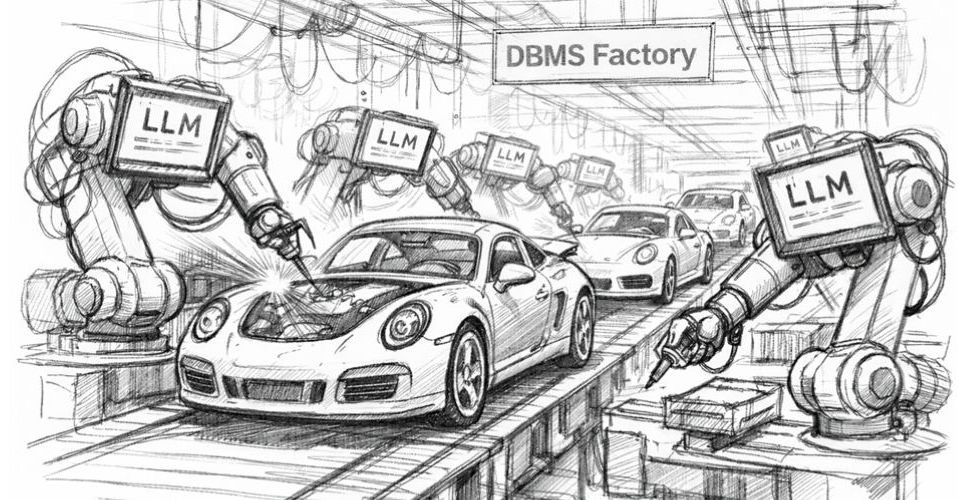
AI Synthesizes Custom Database Engines, Achieving 11x Speedup
AI autonomously generates bespoke database engines for massive speedups.
Researchers Reverse-Engineer Google's SynthID Watermark, Achieve 91% Removal
Researchers reverse-engineered Google's SynthID watermark, achieving 91% phase coherence drop.

Riemann-Bench Exposes AI's Research Math Gap
A new benchmark reveals AI's significant gap in advanced research-level mathematics.
AI Animates SVGs with 98% Token Reduction, Outperforms Competitor
New AI model dramatically reduces tokens for Lottie animation.
Linux 7.0 Integrates New AI-Specific Keyboard Keys for Enhanced Agent Interaction
Linux 7.0 adds support for new AI-specific keyboard keys for enhanced agent interaction.

LLM Pricing Collapses 265x in Three Years, Undermining Vendor Lock-in Fears
LLM pricing plummeted 265x in three years, mitigating vendor lock-in risks.