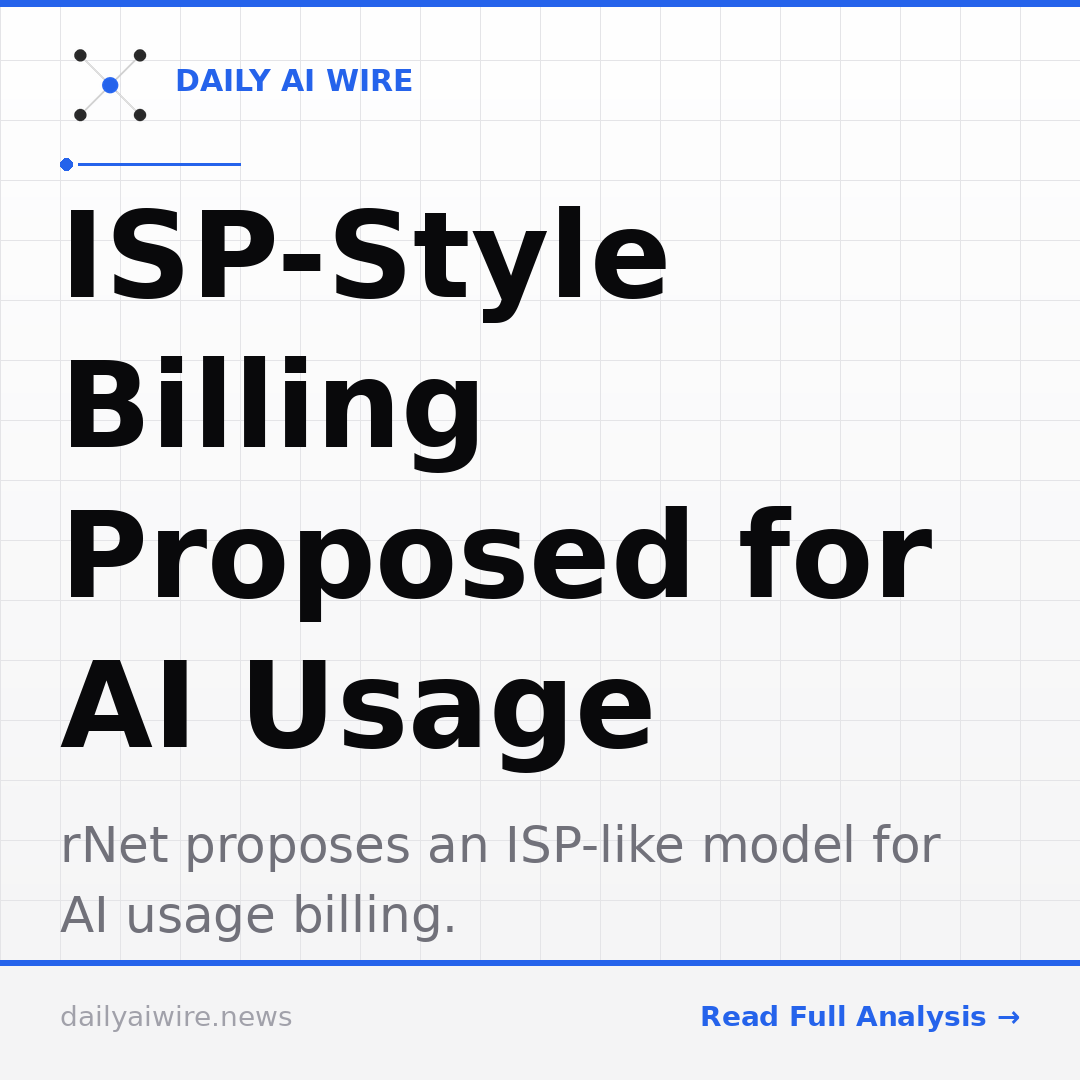
ISP-Style Billing Proposed for AI Usage
Sonic Intelligence
rNet proposes an ISP-like model for AI usage billing.
Explain Like I'm Five
"Imagine you pay for internet once a month, no matter how many websites you visit. This idea wants to do the same for AI: pay once for your AI use, no matter which app uses it, instead of paying each app separately."
Deep Intelligence Analysis
Currently, developers must integrate bespoke pricing systems, manage individual user consumption, and absorb upfront token costs, creating a barrier to entry for smaller projects and increasing operational overhead for larger ones. Users, conversely, experience "double-billing" for underlying AI models used across various applications. rNet, though an early proof-of-concept, has made its protocol live and published libraries on major repositories like npm and Maven Central, indicating a tangible step towards a standardized, user-centric billing infrastructure.
Should this model gain traction, it could profoundly impact the AI ecosystem. It might foster a more equitable and transparent marketplace for AI services, encouraging greater user engagement and developer innovation by reducing financial friction. However, widespread adoption would depend on overcoming significant technical challenges, ensuring interoperability across diverse AI providers, and convincing both developers and end-users of its value proposition over existing, albeit imperfect, models.
Visual Intelligence
flowchart LR
A["Current Dev Burden"] --> B["Track Usage"];
B --> C["Build Pricing"];
C --> D["Handle Token Costs"];
E["Current User Burden"] --> F["Pay Multiple Apps"];
G["rNet Proposal"] --> H["User Funds Usage"];
H --> I["Simplified AI Access"];
Auto-generated diagram · AI-interpreted flow
Impact Assessment
This model could simplify AI cost management for developers and users, potentially reducing friction and encouraging broader AI adoption by standardizing billing. It shifts the financial burden and complexity from developers to users directly funding their own consumption.
Key Details
- Developers currently track individual user usage and manage token costs.
- Users often pay multiple times for the same AI across different applications.
- rNet is an early proof-of-concept protocol.
- Libraries are published on npm and Maven Central.
Optimistic Outlook
An ISP-style model could democratize AI access by making costs transparent and user-controlled, fostering innovation by removing billing complexities for developers. It might lead to more diverse AI applications as cost barriers decrease.
Pessimistic Outlook
Early proof-of-concept status suggests significant technical and adoption hurdles. Users might resist another subscription model, and managing individual AI usage across diverse models could still be complex, leading to fragmentation rather than simplification.
Get the next signal in your inbox.
One concise weekly briefing with direct source links, fast analysis, and no inbox clutter.
More reporting around this signal.
Related coverage selected to keep the thread going without dropping you into another card wall.