Kage Introduces Git-Native Verified Memory for AI Coding Agents
Sonic Intelligence
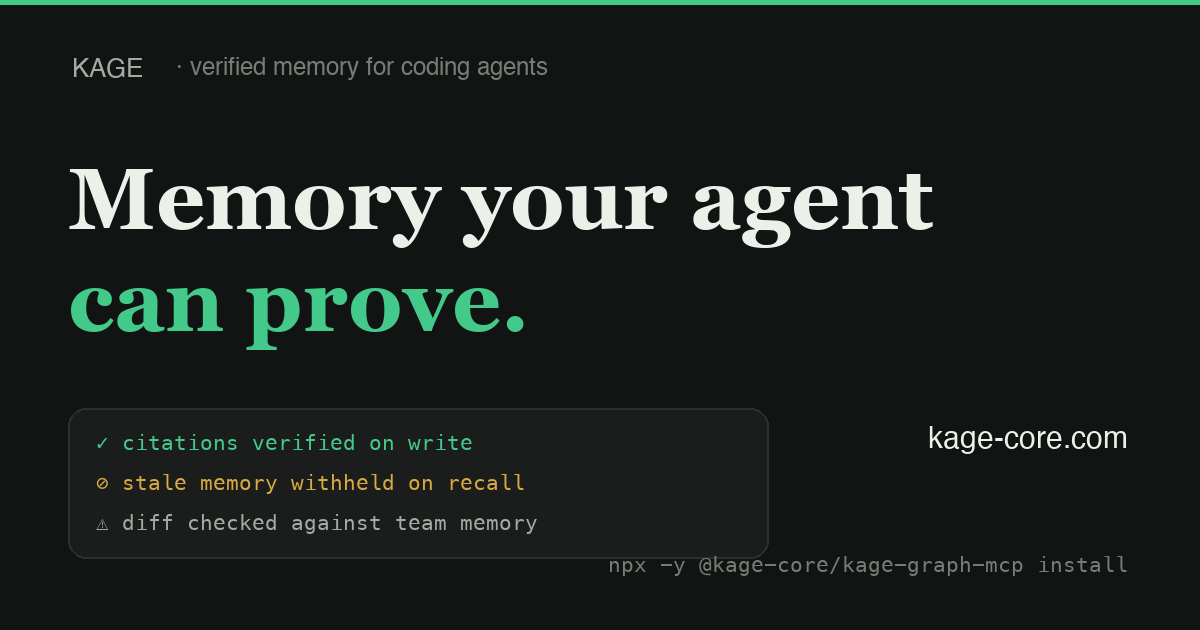
Kage provides shared, verified, git-native memory for AI coding agents.
Explain Like I'm Five
"Imagine your robot helper for coding always forgets what it learned. Kage is like giving it a notebook that everyone on your team can read and write in, and it automatically checks if the notes are still true based on your code. So, the robot remembers important stuff, and everyone learns from each other's robots."
Deep Intelligence Analysis
The core innovation lies in treating agent learnings as first-class artifacts within a standard development workflow. By converting 'lessons' into files, Kage enables teams to review, version, and share agent knowledge, preventing the common issue of agents providing stale or incorrect information. The system's ability to verify citations against the current codebase and warn about invalidations during pull requests is a critical safeguard. Furthermore, its zero-dependency, open-source nature lowers the barrier to adoption, positioning it as a potentially foundational tool for AI-augmented software development.
The implications for software development are substantial. Kage could foster a new paradigm of collaborative intelligence where AI agents contribute to a collective knowledge base, continuously improving their performance and accuracy. This shared memory could lead to more efficient code generation, better refactoring suggestions, and a reduction in repetitive coding tasks. However, the success of such a system will depend on its scalability with large codebases and the quality of its automatic learning distillation, which must be reliable enough to prevent the propagation of erroneous or low-value information across the team's agents.
Visual Intelligence
flowchart LR
    A[AI Agent] --> B{Learn Code}
    B --> C[Create Packet/File]
    C --> D{Verify Against Repo}
    D -- Valid --> E[Store in Git Repo]
    E -- Shared --> F[Team Agents Recall]
    D -- Invalid --> G[Warn/Reject]
Auto-generated diagram · AI-interpreted flow
Impact Assessment
This innovation addresses a critical limitation of current AI coding agents: their lack of persistent, verifiable memory. By integrating memory directly into a Git workflow, Kage enables collaborative learning and ensures the accuracy of agent-generated code, significantly enhancing developer productivity and code quality.
Key Details
- Kage offers a shared memory solution for AI coding agents, integrating with Git repositories.
- Learnings are stored as versioned files in the repository, enabling team-wide sharing and pull request reviews.
- The system verifies citations against the codebase to prevent stale or deleted references from misleading agents.
- It operates with zero dependencies, no account/API key requirements, and is free and open source.
- Kage includes features for automatic learning distillation, session warm-up with digests, and pull request checks for memory invalidation.
Optimistic Outlook
Kage could accelerate the adoption of AI coding agents in professional development environments by providing a robust, auditable memory system. This shared knowledge base will allow agents to learn continuously and collectively, leading to more sophisticated and reliable AI-assisted code generation and refactoring.
Pessimistic Outlook
While promising, the effectiveness of Kage relies heavily on developer adoption and consistent integration into existing Git workflows. Potential challenges include managing the volume of memory files in large repositories and ensuring the quality of auto-distilled learnings, which could still introduce inaccuracies if not properly curated.
Get the next signal in your inbox.
One concise weekly briefing with direct source links, fast analysis, and no inbox clutter.
More reporting around this signal.
Related coverage selected to keep the thread going without dropping you into another card wall.