Andreessen: AI's Current Boom is an 80-Year Culmination, Not Hype
Sonic Intelligence
Marc Andreessen asserts AI's current phase is a platform shift, not mere hype.
Explain Like I'm Five
"Imagine computers getting smarter for a very, very long time. A very smart investor named Marc says that now, they're finally smart enough to do truly amazing things, not just simple tricks. He thinks it's like a big puzzle that's finally coming together, and it's going to change everything, even how we make computer programs and what they can do on their own."
Deep Intelligence Analysis
Contextually, Andreessen's firm recently raised $15 billion, underscoring the significant capital flowing into the sector. He draws a nuanced comparison between today's AI capital expenditure boom and the fiber/data-center overbuild of the 2000 dot-com crash, yet distinguishes the current cycle by noting the presence of cash-rich incumbent buyers and established demand. Key technical drivers include the expected continuation of AI scaling laws, the increasing value of older NVIDIA chips due to software progress and supply constraints, and the rising importance of edge inference facilitated by local models and specialized hardware like Apple Silicon. The emergence of open-source models, such as DeepSeek, is highlighted not just for cost but for their role in disseminating knowledge and shifting market dynamics.
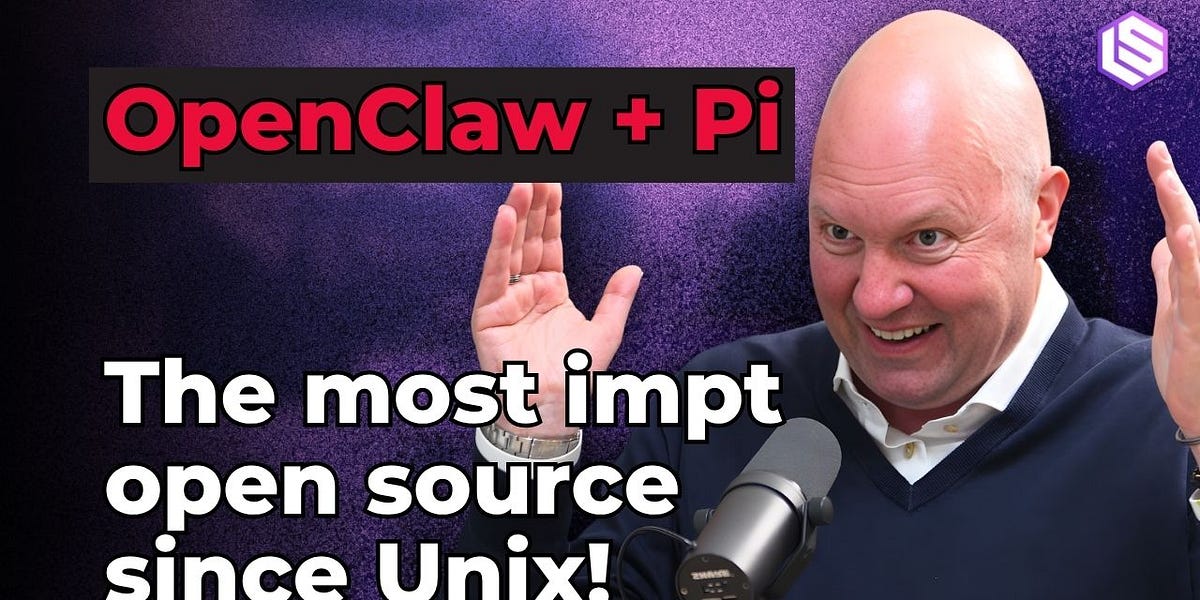
Looking forward, the integration of large language models with system shells, file systems, and cron loops, as seen in agents like Pi and OpenClaw, is identified as a major architectural breakthrough. This development suggests a redefinition of software itself, where self-modifying agents with portable state could fundamentally alter programming paradigms and language relevance. The implications extend to abundant software, cross-language bot translation, and a future where the concept of a 'programming language' becomes less salient, echoing lessons from the early web's open protocols and human readability.
_Context: This intelligence report was compiled by the DailyAIWire Strategy Engine. Verified for Art. 50 Compliance._
Impact Assessment
A leading venture capitalist's analysis of AI as a fundamental platform shift, rather than a cyclical boom, provides critical strategic guidance for investors, developers, and enterprises. His emphasis on autonomous agents and infrastructure bottlenecks highlights key areas for future innovation and market disruption, shaping investment flows and technological trajectories.
Key Details
- Andreessen's firm recently secured $15 billion in funding.
- He characterizes AI's evolution as an '80-year overnight success' from early neural nets to modern agents.
- Andreessen draws parallels between the current AI capital expenditure boom and the 2000 dot-com fiber/data-center overbuild.
- He predicts the continuation of AI scaling laws.
- He identifies AI agents, exemplified by Pi and OpenClaw, as a significant architectural breakthrough in software.
Optimistic Outlook
Andreessen's perspective suggests a sustained period of AI-driven innovation, creating substantial opportunities for startups to build durable value atop rapidly advancing models. The focus on edge AI, open-source contributions, and the redefinition of software itself points towards a future of democratized and pervasive AI applications, fostering widespread adoption and novel solutions.
Pessimistic Outlook
The comparison to the dot-com era's infrastructure overbuild raises concerns about potential capital misallocation and market corrections, despite current demand. Persistent chip supply shortages and the inherent friction from 'messy institutions' struggling to adapt could impede AI's full potential, leading to slower adoption rates and increased market consolidation favoring well-capitalized incumbents.
Get the next signal in your inbox.
One concise weekly briefing with direct source links, fast analysis, and no inbox clutter.
More reporting around this signal.
Related coverage selected to keep the thread going without dropping you into another card wall.