Market Pricing Signals Rapid AI Adoption, Diverging from Fed's Muted Outlook
Sonic Intelligence
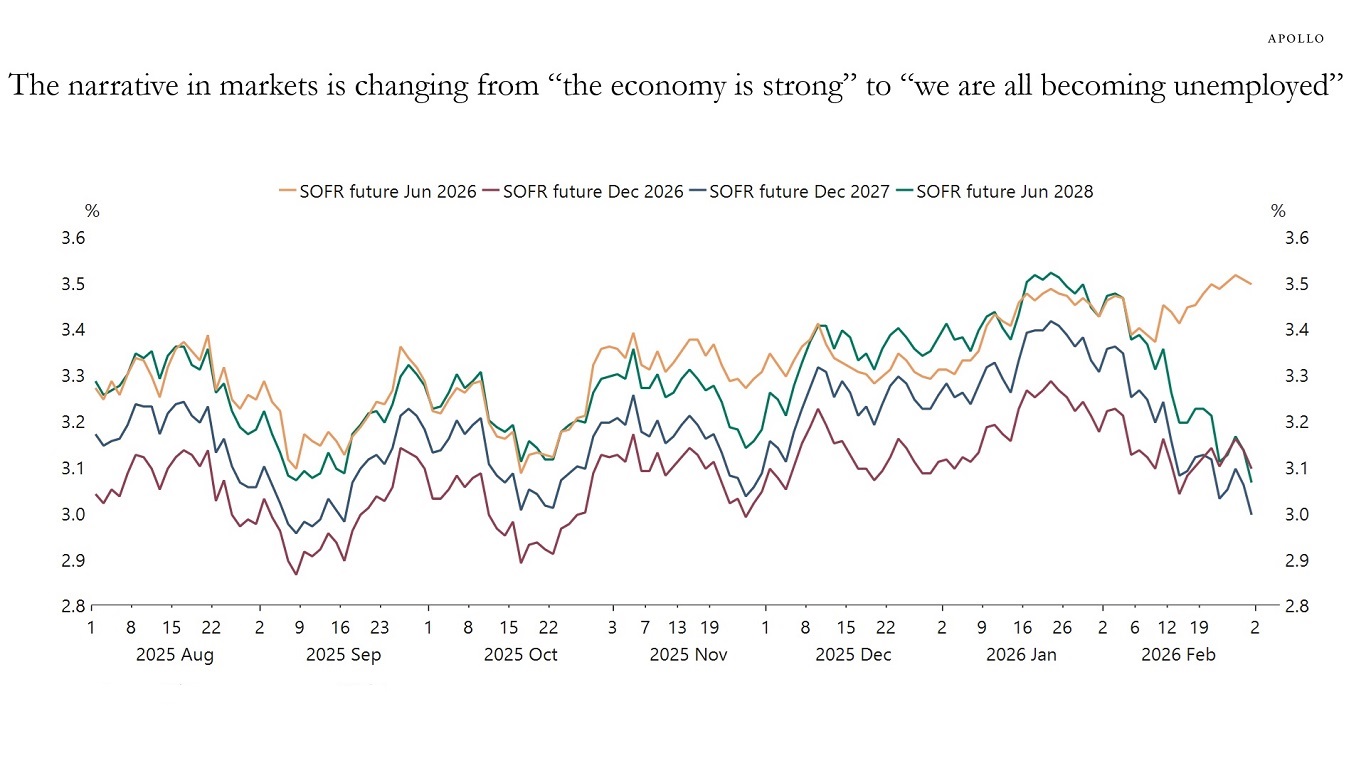
Markets are pricing in rapid AI adoption, anticipating higher unemployment and Fed rate cuts by December 2026.
Explain Like I'm Five
"Imagine everyone in the playground thinks a new super-fast robot is coming that will do everyone's chores, so some kids worry they won't have jobs. The grown-ups who manage the money (the Fed) think it will take longer, but the kids who bet on things (the market) are already acting like it's happening very soon, expecting big changes by 2026."
Deep Intelligence Analysis
This market-driven outlook anticipates that the swift integration of AI technologies will lead to a notable increase in the unemployment rate. Consequently, these investors are projecting that the Federal Reserve will be compelled to implement "many more Fed cuts" by December 2026 to counteract the economic slowdown induced by AI-driven job displacement. This perspective aligns with the views of "techno-optimists," who foresee a rapid and transformative impact of AI on the labor market and broader economy within a relatively short timeframe, often cited as 12-18 months.
However, the author of the analysis, Torsten Slok, presents a contrasting viewpoint, challenging the techno-optimists' macro impact assessment. Slok argues that the pace of AI adoption is likely to be considerably slower than market expectations, suggesting it will take "much longer" than the 12-18 months frequently discussed. Furthermore, he posits that the overall impact on productivity will be "much more muted" than anticipated by the more bullish market participants. From this perspective, the risk of an overheating economy, driven by factors like AI spending, an industrial renaissance, and significant legislative spending (the "One Big Beautiful Bill"), remains a more substantial concern looking ahead to December 2026 than the prospect of the unemployment rate soaring to 10%.
This fundamental disagreement between market pricing and more measured economic forecasts underscores the uncertainty surrounding AI's immediate economic consequences. If the markets are correct, policymakers will need to prepare for significant labor market adjustments and potentially aggressive monetary policy responses. Conversely, if the more cautious view prevails, the current market pricing could represent an overreaction, potentially leading to misallocated capital and policy errors. The ongoing debate highlights the necessity for robust economic modeling and careful monitoring of AI's real-world integration to inform both investment strategies and governmental policy decisions.
EU AI Act Art. 50 Compliant: This analysis is based solely on the provided source material, without external data or speculative embellishment.
Impact Assessment
Market pricing reflects a significant belief in AI's disruptive economic potential, specifically its impact on employment and monetary policy. This divergence from more conservative economic forecasts highlights a critical debate about AI's short-term societal and financial implications.
Key Details
- ● Market narrative shifted from 'strong economy' to 'unemployment' due to AI expectations.
- ● Rates investors are pricing in rapid AI adoption.
- ● Rapid AI adoption is expected to push the unemployment rate higher.
- ● Markets anticipate 'many more Fed cuts by December 2026'.
- ● The author believes techno-optimists are wrong about the macro impact and adoption pace.
Optimistic Outlook
If market expectations of rapid AI adoption prove accurate, it could signal a period of significant productivity growth and technological advancement, potentially leading to new industries and economic efficiencies. While initial job displacement might occur, the long-term benefits could include a more innovative and prosperous economy, driven by AI's transformative capabilities.
Pessimistic Outlook
The market's anticipation of rapid AI adoption leading to higher unemployment and necessitating Fed rate cuts by December 2026 suggests a potentially disruptive economic transition. If this scenario unfolds, it could lead to significant social challenges, including widespread job displacement and increased economic inequality, requiring substantial policy interventions to mitigate adverse effects.
Get the next signal in your inbox.
One concise weekly briefing with direct source links, fast analysis, and no inbox clutter.
More reporting around this signal.
Related coverage selected to keep the thread going without dropping you into another card wall.